By Ho Truong
Evidence: Independent analysis — no products have been received or tested
Last checked: September 7, 2026
Short answer
Clip-ons usually add less bulk, but their attachment and lens clearance must match the prescription frame. Fit-overs accept a wider range of frame shapes, but add width, weight, and another set of bridge and temple contact points. Neither format is automatically better for progressive wearers: start with a stable carrier frame, measure it, then compare coverage, contact, documentation, handling, and activity limits.
This is an unranked buying framework, not a hands-on review. The four Amazon candidates are examples to investigate; their fit, performance, warranty, and return terms remain unverified.
Clip-on or fit-over: which should you investigate first?
Investigate a clip-on first when the carrier frame is stable, its front dimensions can be measured, and there appears to be enough room for an attachment without pressing on the prescription lenses. The likely tradeoff is a smaller package versus more dependence on attachment geometry.
Investigate a fit-over first when a clip mechanism appears incompatible, or when a shell with front and side coverage better matches the intended use. The tradeoff is broader accommodation versus more bulk and possible interaction with the bridge, temples, cheeks, hat, or helmet.
Choose neither on the basis of a listing photo alone. A loose, damaged, or already unstable prescription frame is a poor baseline for either overlay. Readers who need certified protective eyewear, reliable retention for high-speed activity, or night-driving eyewear need exact evidence for that purpose rather than an ordinary sun-overlay listing.
| Start by investigating | Carrier-frame conditions to check | Main uncertainty to resolve |
|---|---|---|
| Clip-on | Measurable lens envelope; accessible attachment area; acceptable contact points | Whether the mechanism clears lenses, bridge, and frame finish while remaining stable |
| Fit-over | Enough outer width, height, bridge space, and temple clearance | Whether the shell causes pressure, movement, side obstruction, or interference |
| Another solution | Loose/damaged frame; protective standard required; overlay contact is unacceptable | Whether a separate prescription sun pair or purpose-specific certified eyewear is more appropriate |
How we compared the two formats
We used the same desk-analysis matrix for both formats: dimensions, attachment or contact points, added layers, coverage, carrier-frame interaction, handling, storage, documentation, warranty/return information, and missing data. We did not use Amazon ratings, review counts, price, badges, popularity, or listing superlatives as evidence.
A future hands-on comparison needs four current products from at least three manufacturers, with both formats represented. Each sample would be checked on at least three carrier-frame sizes under the same controlled static-movement protocol. This would not imply road, cycling, impact, or long-term durability testing.
Measure the carrier frame before considering a product
Record the carrier frame's total front width, one-lens width and height, bridge width, front thickness, and temple clearance. Also note where a clip could touch and how much space a shell would need around the frame. Product diagrams may measure different reference points, so a pair of numbers is useful only when both measurement conventions are understood.
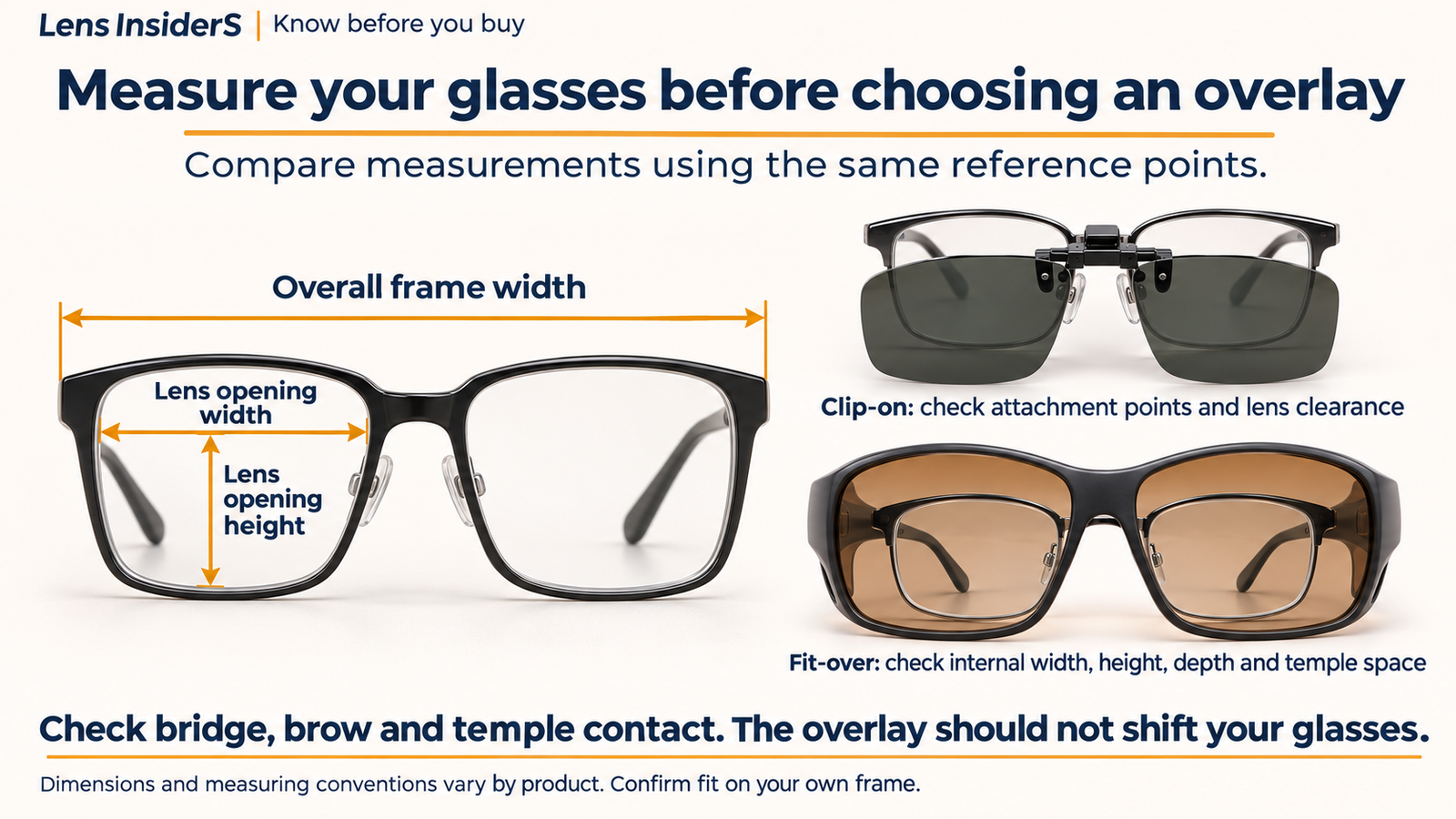
The original measurement article planned for /measure-glasses-clip-on-fit-over-sunglasses/ should be linked here only after it is live, indexable, and canonical. Until then, the checklist above must stand on its own.
Clip-on strengths, drawbacks, and fit gates
A clip-on can sit close to the existing frame without a second full chassis. That does not establish light weight, comfort, stability, or safe clearance. A small mechanism can still touch a lens, bridge, rim, coating, or frame finish.
Magnetic and mechanical attachments
Magnetic systems require mating geometry designed for the carrier frame; a generic mechanical clip uses arms, hooks, springs, or pads to grip an existing frame. For either type, document how it opens, where it contacts the carrier, whether any part approaches the prescription lenses, and whether removal can be performed without twisting the base frame.
Lens clearance and contact risk
Check clearance at the center bridge, upper and lower rims, and rear-facing hardware. Check whether the sun lens can touch the prescription lens when handled. A listing image cannot establish clearance under head movement, repeated removal, or flexing.
Clip-on fit gate: do not proceed when the attachment must be forced, hardware touches a prescription lens, coverage leaves a distracting gap, or the carrier frame shifts from its normal position. For progressive lenses, movement matters because the wearer relies on the frame remaining in its fitted position; this article does not quantify an acceptable amount of movement.
Fit-over strengths, drawbacks, and fit gates
A fit-over creates a shell around the prescription frame. This can avoid a center clip and may add side panels, but it adds its own bridge, temples, and inner surfaces. Listed outer dimensions are less useful than verified internal usable width, height, depth, and clearance.
Front coverage and side panels
Front and side coverage should be observed rather than inferred from a wraparound appearance. A side panel may change peripheral visibility or reflections; it is not proof of complete coverage, glare elimination, UV performance, or protective-eyewear certification.
Bridge, temple, and helmet interaction
Check whether the fit-over rests on the prescription frame, the wearer's nose, or both. Inspect temple pressure, cheek contact, brow clearance, and interference with a hat or helmet. Static desk fit cannot establish retention or safety during driving, cycling, running, or impact.
Fit-over gate: do not proceed when the shell pushes the carrier frame out of its normal position, presses uncomfortably at contact points, obstructs needed side vision, or requires the temples to flex beyond their normal path.
What polarization and UV labels do—and do not—prove
Polarization and UV protection are different questions. Exact-model manufacturer documentation is needed for substantive claims. An LCD rotation check on a received sample may support polarizing behavior, but would not measure optical quality or UV transmission. Displays vary, so no universal visibility promise is appropriate.
Impact or sport suitability requires the applicable standard and exact-model certification; lens shape or material alone is insufficient. “Shatterproof” and “unbreakable” should not appear in the publishable article without properly scoped evidence. Polarization does not establish UV performance, impact protection, display compatibility, or safe use at night.
Progressive-specific stability checklist
Before comparing purchase candidates, confirm that the prescription frame:
- Sits level in its normal fitted position.
- Does not slide noticeably during ordinary static head movement.
- Has no loose, damaged, or distorted attachment area.
- Keeps its normal bridge and temple contact after the overlay is added.
- Does not shift when the overlay is attached, removed, or handled.
- Preserves the wearer's usable view through the progressive zones for the intended ordinary task.
These are screening checks, not a prescription assessment or safety certification. Persistent blur, double vision, pain, headaches, sudden visual changes, flashes, or new floaters warrant appropriate eye-care assessment rather than repeated overlay adjustment.

Start with the carrier frame and contact tolerance, then choose the overlay type to verify. Original Lens InsiderS decision framework; it identifies a candidate only and does not declare a universal winner.
Four unranked Amazon candidates to investigate
Commercial-link draft note: The four links below are direct Amazon product URLs copied from the September 7, 2026 internal sample shortlist. They contain no Associate tag and are not production affiliate links. Before publication, verify the exact destination, ASIN, title, selected variant, seller, availability, current documentation, and transaction-route policies. If links are converted to commission-generating Amazon Special Links, place the currently required Amazon and Lens InsiderS disclosures before the first paid recommendation and use
rel="sponsored nofollow external". Prices and ratings are intentionally omitted.
Clip-on candidates
SUN-01 — CAXMAN compact non-flip-up clip-on candidate. The shortlist assigns this model to the compact attachment, coverage, and frame-contact test role. Its current selected-variant dimensions and attachment details still require live confirmation. Check Amazon ASIN B0919HM3H1.
SUN-02 — Eyekepper metal-rim clip-on candidate, gray lens, listed as 54 × 34 mm in the shortlist. Those dimensions and the exact variant must be reconfirmed; they do not establish fit on a carrier frame. Check Amazon ASIN B015MHXH5U.
Fit-over candidates
SUN-03 — yodo black/gray fit-over candidate. The shortlist gives this shell-style product a clearance, contact, and coverage test role, but flags the destination as conditional because the exact Amazon US listing may change. Skip it rather than accept an automatic substitute if the page no longer matches. Check Amazon ASIN B0C1GDJFNL.
SUN-04 — DUCO DC8968 black/gray fit-over candidate, if that exact variant remains available. The shortlist flags advertised polarized/UV400 language for documentation, not acceptance. No such performance claim is made here. Check Amazon ASIN B0DG1YQGZC.
Best for / Not ideal for
A clip-on may be worth investigating for: a wearer with a stable, measurable carrier frame; acceptable attachment points; sufficient lens clearance; and a preference for a smaller removable overlay.
A fit-over may be worth investigating for: a wearer whose frame fits inside documented internal dimensions without pressure or movement, and who accepts the extra shell, bridge, and temple interaction.
Neither is ideal for: an unstable or damaged carrier frame; uncertain clearance; users expecting one size number or “universal fit” copy to guarantee compatibility; night use; certified protective-eyewear needs; or high-speed activity without exact product evidence for that purpose.
Meaningful unknowns across all four candidates include exact fit, added weight, reflections between lens layers, contact under movement, display interaction, retention, storage quality, current manufacturer support, warranty, and the remedy available through the actual transaction route.
Check current size and attachment details
Use the links only after measuring the carrier frame and choosing a form factor to investigate. At the destination, confirm the exact ASIN, brand, model, selected size/color, seller, dimension reference points, attachment or internal clearance, package contents, manufacturer documentation, warnings, warranty, and return path. Do not follow an automatic substitute when any of those details differ.
Lens InsiderS is not naming a winner. The strongest next step is to reject candidates whose geometry or documentation cannot be matched to the intended carrier frame and use. Equivalent samples and controlled testing are required before any relative performance conclusion.
Sources and further reading

About Ho Truong
Ho Truong is a trained optician at a family optical practice established in 1991. Lens InsiderS explains lens design and fitting choices for buyers. It does not diagnose eye conditions or replace an eye examination.