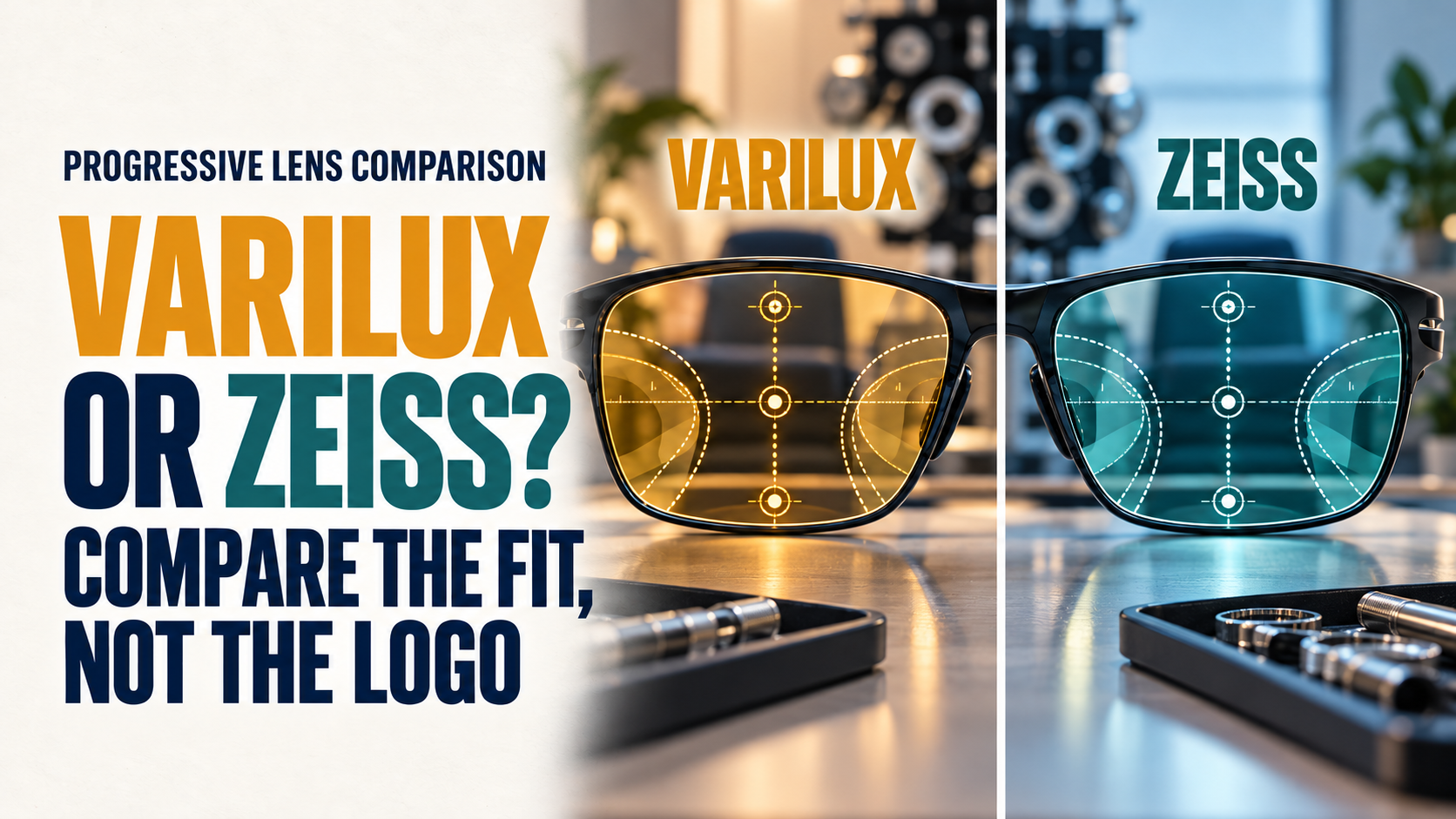
A model-level comparison of Varilux XR Series and ZEISS SmartLife Individual 3. The useful question is not which logo wins, but whether the exact design, measurements, frame, visual tasks, and remake terms match your order.
Quick answer
Varilux XR Series and ZEISS SmartLife Individual 3 should be compared as exact products, not as two universal brand labels. Both manufacturers describe highly personalized progressive designs, but a wearer’s result still depends on prescription, ADD, frame, fitting height, position-of-wear measurements, visual tasks, and the practice’s remake support. Ask for the exact model and the fitting data entered before comparing price.
What this comparison is—and is not
This article is a buying and fitting guide based on current manufacturer information, not a lab test. It does not claim that one brand gives every wearer a wider field, faster adaptation, or better value. “Best” is not portable from one prescription and frame to another. The practical comparison is the complete order: design, material, coating, measurements, frame geometry, dispensing quality, and what happens if the first pair does not work.
That distinction matters because both names can cover multiple designs, materials, markets, and generations. A quote that says only “Varilux” or “ZEISS progressive” is not specific enough to compare.
Varilux XR vs ZEISS SmartLife Individual 3: the short comparison
| Comparison point | Varilux XR Series | ZEISS SmartLife Individual 3 |
|---|---|---|
| Manufacturer positioning | Essilor presents XR as a progressive design using AI-informed modeling of eye movement and pupil dynamics, with claims about sharpness in motion and transitions. | ZEISS presents SmartLife Individual 3 as an individualized progressive solution using personal, anatomical, frame, and viewing information. |
| What the claim means | It describes Essilor’s design approach and intended benefits, not a guarantee for every prescription or wearer. | It describes ZEISS’s personalization and portfolio positioning, not a guarantee that every wearer will see the same result. |
| Most important verification | Exact XR model/generation, included personalization, material, coating, fitting inputs, and local remake policy. | Exact SmartLife Individual 3 configuration, included personalization, material, coating, fitting inputs, and local remake policy. |
| Useful decision question | Can the practice show which measurements and visual priorities will be used for this frame and prescription? | Can the practice show which measurements and visual priorities will be used for this frame and prescription? |
Essilor’s official Varilux XR Series page describes the product using eye-movement and pupil-dynamics language. ZEISS’s professional progressive portfolio page describes SmartLife Individual 3 as adapted to frame choice, facial anatomy, and dynamic viewing needs. Those are useful descriptions of design intent; they are not independent head-to-head evidence.
Compare the fitting inputs before the marketing claims
A premium design cannot correct a poor order. Before choosing between the two, confirm the following:
- Current prescription: record sphere, cylinder, axis, prism if prescribed, and the ADD exactly as written. If you are unsure what ADD means, see our guide to ADD on an eyeglass prescription.
- Frame first, measurements second: select and adjust the frame before the final fitting. A frame that slips, sits too low, or has a different wrap can change the usable zones.
- Monocular measurements: request monocular PD and fitting height for each eye, rather than assuming one binocular number is sufficient.
- Position of wear: ask whether vertex distance, pantoscopic tilt, wrap, frame shape, and other position-of-wear inputs are collected and entered.
- Real tasks: explain whether your priority is driving, dashboard work, monitor distance, phone use, reading, walking, cooking, or frequent switching between tasks.
- Written model name: get the exact product, generation, material, coating, and any personalization package in writing.
Our corridor and fitting-height guide explains why a small measurement change can affect where the intermediate and near zones land. It is also why comparing two brand names without the measurement sheet is incomplete.
Which one should you investigate?
| Your situation | What to prioritize | What not to assume |
|---|---|---|
| You want a highly personalized premium quote | Full measurement set, exact model, frame fit, and service/remake terms. | That the most expensive quote is automatically the best fit. |
| You spend long hours on screens | How intermediate and near priorities are balanced; whether a separate office pair makes more sense. | That a progressive advertised for digital life is automatically ideal for every desk distance. |
| You are wearing progressives for the first time | Stable frame position, accurate fitting, realistic adaptation guidance, and a clear remedy path. | That a premium brand eliminates the adaptation period. |
| You previously failed with progressives | Review prescription, frame, measurements, visual tasks, and adaptation history before switching brands. | That changing the logo alone identifies the cause. |
| You alternate between driving and desk work | Whether one pair can meet both priorities or whether a dedicated office/driving solution is more sensible. | That one pair must be forced to do every task equally well. |
Screen work: progressive or office lens?
Many complaints blamed on a brand are actually task mismatch. A general-purpose progressive has to balance distance, intermediate, and near vision. A dedicated office design can give more room to the distances used at a desk, but it is not a substitute for driving or all-day outdoor use.
Before ordering either premium progressive, measure your real working distance from eyes to monitor, keyboard, phone, and documents. Then ask the practice to explain where those distances sit in the chosen design. Compare this with our office lenses vs progressive lenses guide.
Price: normalize the quote before you compare it
Request both quotes in the same format:
- same prescription and ADD;
- same or clearly identified lens material and index;
- same coating, photochromic option, tint, and warranty;
- same frame or a frame with comparable fit and geometry;
- same measurement package and personalization inputs;
- same adjustment, remake, adaptation, and return terms.
A lower quote may omit a coating, use a different material, or include less follow-up. A higher quote is not automatically better if the practice does not collect or use the fitting data that the design expects. For a deeper explanation of material trade-offs, see progressive lens index and weight.
What to ask the optician before paying
- What is the exact product name and generation?
- Which fitting measurements will be entered for each eye?
- Which visual task is the design being optimized for?
- What frame restrictions apply to this prescription and lens design?
- What is included in the price: material, coating, personalization, fitting, adjustment, and follow-up?
- What happens if I cannot adapt: remake window, exclusions, fees, and who evaluates the problem?
- Can I receive the final order details in writing?
Should you compare a third portfolio?
Yes, if the first two quotes are not clearly normalized or if your prescription and tasks are unusual. Hoya’s official Hoyalux iD portfolio page is a useful starting point for a third comparison, but availability and exact naming vary by market. Do not add a third brand simply to create a longer scorecard; add it when the practice can explain what design or fitting choice changes for your use case.
Common failure modes after ordering
Blur at one distance, head-turning, eye strain, or difficulty with stairs can have several causes: an incorrect prescription, inaccurate measurements, frame movement, an unsuitable corridor or task balance, unrealistic expectations, or a genuine manufacturing/remake issue. Document when the problem happens and at what distance. Then return to the dispensing practice for a structured check instead of immediately buying another brand. See progressive lens adaptation problems for a troubleshooting sequence.
Bottom line
Varilux XR and ZEISS SmartLife Individual 3 are credible premium designs to investigate, but the winner cannot be selected from the logos alone. Choose the quote that is clearest about the exact model, fitting inputs, visual priorities, price inclusions, and remake support. If a seller cannot explain those details, the unresolved fitting risk matters more than the brand name.
Practical next step: ask for both brands to be quoted against the same frame, prescription, measurements, coatings, and written remake terms. Keep the quote and measurement sheet so you can compare the order after dispensing.
Sources and further reading
- Essilor: Varilux XR Series
- ZEISS: professional progressive lens portfolio
- ZEISS: SmartLife progressive lenses for consumers
- HOYA: Hoyalux iD progressive lens portfolio
- Lens InsiderS: Varilux vs ZEISS progressive lenses
- Lens InsiderS: corridor and fitting height
- Lens InsiderS: office lenses vs progressive lenses
Editorial note: This staging draft contains no commercial links. Confirm Lens InsiderS’s relationship status before adding any retailer or referral links. If a link may generate commission, add the active disclosure near the first commercial recommendation and use the correct sponsored-link treatment.

About Ho Truong
Ho Truong is a trained optician at a family optical practice established in 1991. Lens InsiderS explains lens design and fitting choices for buyers. It does not diagnose eye conditions or replace an eye examination.