By Ho Truong
Evidence: Independent analysis — no products have been received or tested
Last checked: September 7, 2026
Short answer
A useful eyeglass-cleaning kit is a three-part system: a cleaner with instructions that address your lens or coating, a clean and maintainable microfiber cloth, and storage that keeps both away from grit. Compare documented compatibility, included items, application control, portability, replacement cloths, and missing information. Do not let a large pack, promotional image, rating, or seller claim substitute for the lens maker’s care instructions.
This draft examines four Amazon candidates without ranking them. Listing details and policies can change; compatibility remains unverified unless current manufacturer instructions explicitly support it.
What belongs in a coating-safe lens-care system?
The “kit” is not just the bottle or wipe. Every part affects the routine, and the weakest part can undermine the rest. Clear instructions are more useful than a broad marketing promise because they tell you what surfaces are covered, how the product should be applied, and when not to use it.
Cleaner with documented compatibility
Start with the instructions for the exact lenses or coating, then check the cleaner’s current label or instructions for use. “Lens cleaner” in a listing title does not establish suitability for every anti-reflective, mirror, photochromic, polarized, older, or already damaged surface. If the guidance is vague or conflicts with the lens maker’s instructions, stop and ask the lens provider or manufacturer.
Format changes the questions: sprays require bottle and cloth checks; wrapped wipes require moisture, lint, and disposal checks. Neither is automatically better.
Washable microfiber cloth
A reusable cloth is valuable only while it is clean and maintained according to its maker’s care instructions. Its appearance does not prove fiber quality or cleanliness. Record the cloth type, washing directions, drying directions, replacement availability, and any warnings before treating it as a dependable part of the system.
Protected storage for cleaner and cloth
Storage is the overlooked third part. The future hands-on protocol should document cloth storage, cap or nozzle protection, packed orientation, and observed leakage. Until then, this article makes no leakage or durability verdict.
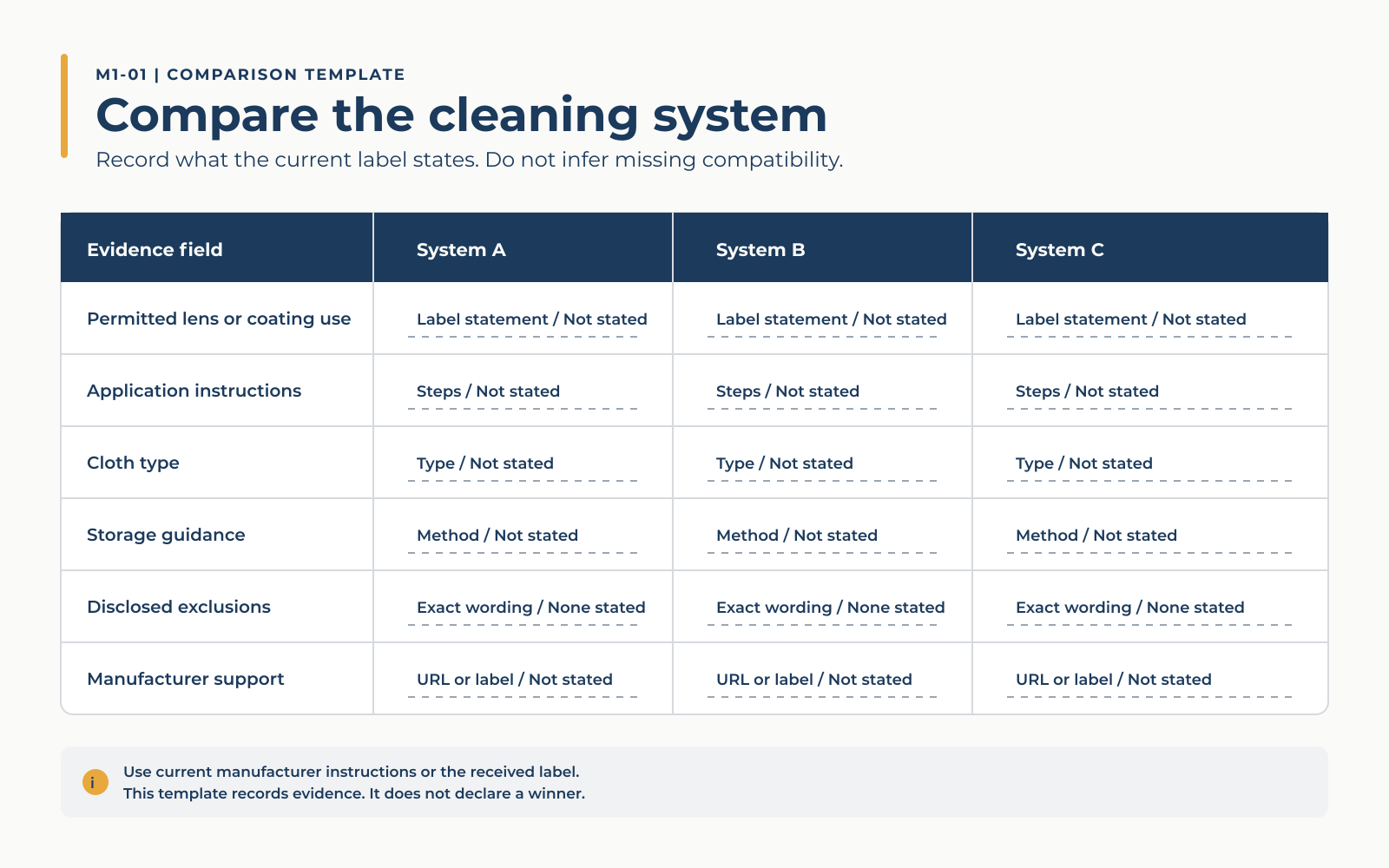
The useful comparison starts with instructions and compatibility, not pack size. Original Lens InsiderS framework; populate it only from current labels or manufacturer instructions. It is not a test result or product verdict.
How we evaluated current cleaning kits
This is an independent desk analysis of four purchase candidates from three manufacturers. We assigned no scores, inferred no compatibility from product names, and treated no Amazon popularity signal as evidence.
Before any comparison verdict, the same locked matrix should be completed for every candidate:
| Decision factor | What must be verified | Why it matters |
|---|---|---|
| Permitted use | Current label, manufacturer instructions, and named exclusions | Broad category language may omit a specific coating or surface. |
| Application | Spray/wipe directions and warnings | Format affects liquid control and handling. |
| Cloth | Material specification, care, storage, and replacement | A reusable cloth becomes a separate maintenance item. |
| Kit contents | Exact ASIN, variant, packaging, and seller at checkout | Contents can change by pack or listing selection. |
| Portability | Individual wrapping or bottle closure, verified in hand | Listing photos cannot prove leak resistance or day-to-day convenience. |
| Support | Manufacturer contact, warranty, and remedy terms | Missing support information shifts more risk to the buyer. |
If samples are approved, performance observations require equivalent expendable coated samples, fixed inputs and wiping passes, separate cloths, locked imaging, blind checks, and retained notes. A short test would not establish years of coating safety.
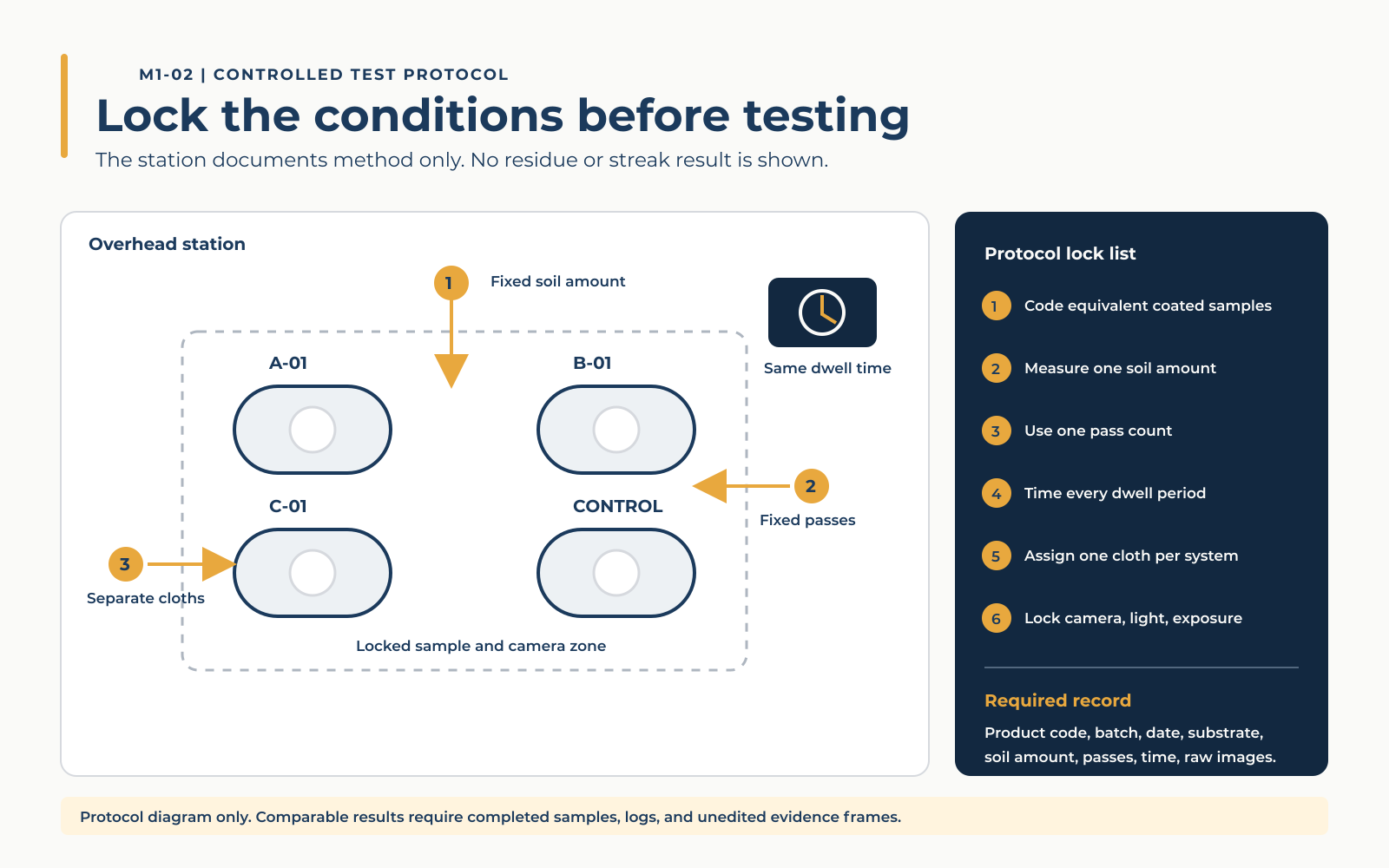
Equivalent samples and a fixed protocol are required before comparing residue or streaking. Original Lens InsiderS test framework; it describes a proposed method, not completed testing or results.
Compare kits by use case, not popularity
The candidates below are unranked. Each fills a different role in a future system comparison, and each still has evidence gaps.
Commercial-link note: These are direct Amazon product links in this draft and are not active affiliate Special Links. Affiliate disclosure and compliant tagging are required if and when the Amazon Associates program is approved. Prices and ratings are intentionally omitted.
Home cleaning setup: Koala spray-plus-cloth candidate
The shortlisted Koala Eyeglass Lens Cleaner Spray Kit is a four-piece candidate described as two spray bottles plus two microfiber cloths. It permits future checks of nozzle handling, cloth care, and storage.
Check the current Koala kit, ASIN B07K4R213M, on Amazon.
Meaningful drawback or unknown: the draft evidence set does not yet include the current manufacturer instructions, coating-use wording, cloth-washing directions, exclusions, or leakage results. The Amazon ASIN and exact four-piece variant must also be reconfirmed before purchase or publication.
Travel-size setup: ZEISS individually wrapped wipe candidate
The shortlisted ZEISS Pre-Moistened Lens Cleaning Wipes candidate is the 200-count variant. Individual wrapping may help containment but creates recurring packaging waste. Moisture consistency, residue, and lint require testing.
Check the current ZEISS 200-count candidate, ASIN B0030E4UIQ, on Amazon.
Meaningful drawback or unknown: this is a consumable wipe system rather than a reusable-cloth system, so waste and replenishment differ from a spray kit. The exact variant, current instructions, permitted surfaces, exclusions, and pack condition still need verification.
Second wipe candidate: Care Touch
The shortlisted Care Touch Lens Wipes for Eyeglasses candidate is the 210-count variant. A second wipe manufacturer would make future checks of moisture and packaging consistency more informative; no relative performance is established.
Check the current Care Touch 210-count candidate, ASIN B01NCOUY05, on Amazon.
The five images below are manufacturer promotional/listing graphics, not Lens InsiderS product photography or hands-on evidence. They are included for editorial review while rights and exact-variant relevance remain unresolved.
What these listing graphics do not prove
Together, the graphics show how the wipes are marketed: count, format, size, suggested surfaces, directions, and claimed benefits. They do not prove the current contents of ASIN B01NCOUY05, compatibility with a specific coating, moisture consistency, residue or lint, surface safety, packaging integrity, or relative performance. The conflicting count and size shown across the supplied graphics make current package instructions and in-hand verification especially important.
Meaningful drawback or unknown: the seller and 210-count title were observed during shortlist preparation, but they must be reconfirmed. Current manufacturer instructions, coating compatibility, exclusions, moisture consistency, lint, and packaging integrity have not been independently documented for this article.
Refill and reusable-cloth setup: MagicFiber dry-cloth candidate
The shortlisted MagicFiber Microfiber Cleaning Cloth is a six-pack candidate. It contains no solution, so it is not a complete kit. It could serve as a reusable-cloth option or future dry-cloth control when paired with an approved method.
Check the current MagicFiber six-pack candidate, ASIN B0050R67U0, on Amazon.
Meaningful drawback or unknown: buyers still need compatible cleaner guidance and protected storage. The exact six-pack variant, cloth specifications, washing instructions, replacement schedule, and performance after repeated washing remain unverified. The shortlist also flags this candidate for live-page confirmation before ordering.
What brand marketing does not prove
A polished image can show intended positioning or a suggested use, but it cannot establish compatibility with your coating, cleanliness of a cloth, absence of residue, leak resistance, long-term durability, or test equivalence. Those conclusions require current instructions or controlled evidence.
Meaningful drawbacks across the candidates
Spray kits require cloth care and bottle control. Wrapped wipes trade reusability for single-use containment and more packaging. A cloth-only pack still needs a compatible method and protected storage. Seller and variant changes also mean a listing is not a permanent specification.
A compatibility statement still would not prove safety for every older, damaged, or unidentified coating. Short tests can document defined observations; they cannot simulate years of wear.
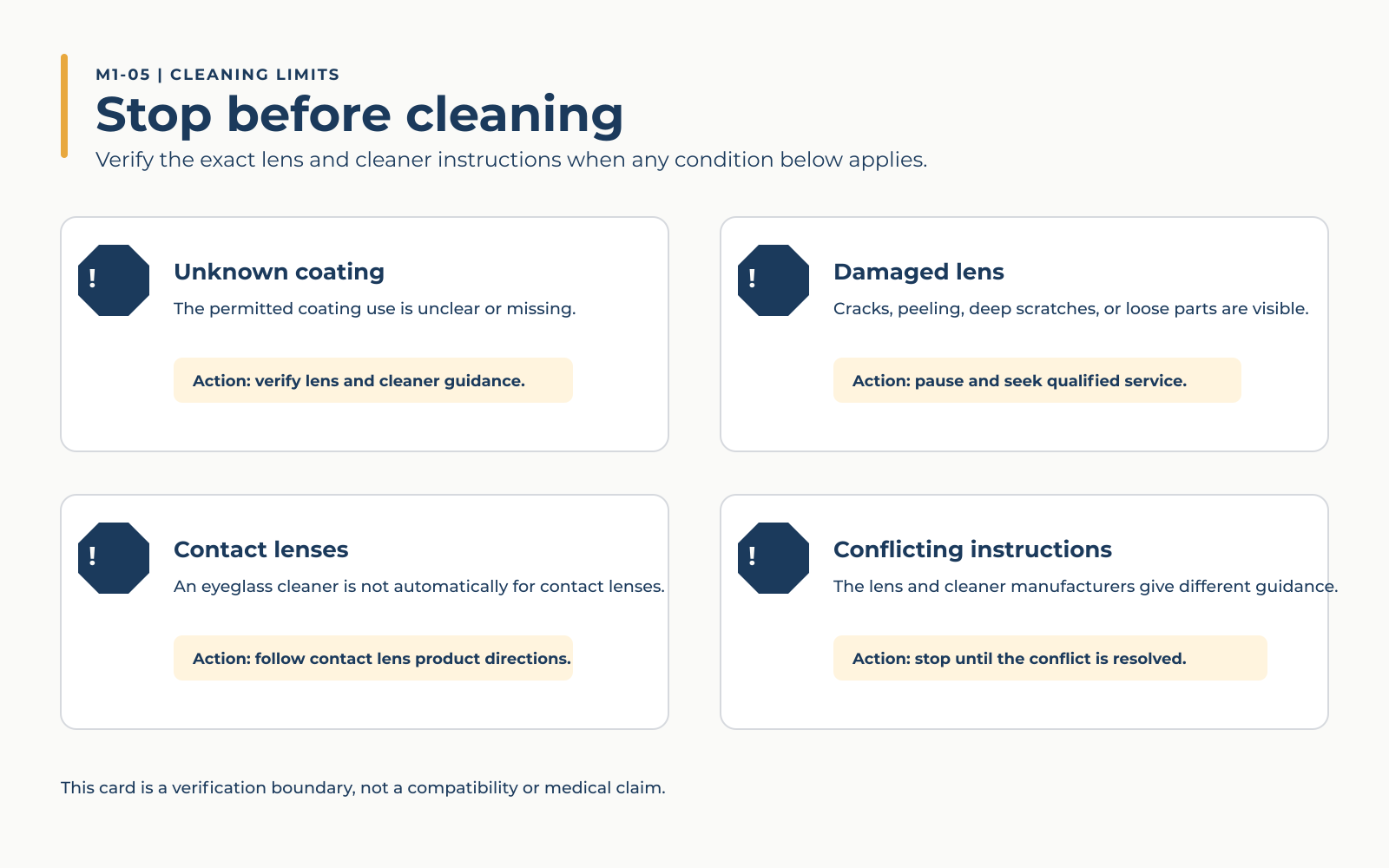
If the exact coating or cleaner instructions are unclear, verify them before use. Original Lens InsiderS framework; it is a decision boundary, not a diagnosis, universal safety statement, or test result.
Best for / Not ideal for
Best for: a buyer who wants a documented routine, is willing to verify the exact label against the lens maker’s instructions, will maintain or replace the cloth as directed, and will store cleaning items away from grit.
Not ideal for: someone trying to repair scratches, peeling, crazing, or other surface damage; anyone with unknown lens materials or coating instructions; a user who plans to reuse a visibly dirty cloth; or a buyer who wants a ranked performance winner before equivalent samples are tested.
If blur or visual discomfort remains after the lenses are clean, do not assume another cleaner is the answer. Separate residue from an optical problem and seek appropriate eye-care support for persistent or concerning symptoms. Cleaning does not correct a prescription, fitting height, lens design, frame position, or damaged coating.
Use the safe cleaning sequence
First, inspect the lenses and stop if the surface appears damaged or the instructions are unclear. Remove loose grit using the lens maker’s approved method. Apply only a cleaner permitted by the relevant instructions, then use a clean microfiber cloth as directed. Finally, let the items dry as instructed and store the cloth where it will not collect debris.
This is a summary, not a substitute for product-specific directions. Follow the safe cleaning method for anti-reflective coated glasses before choosing a kit. Never treat more pressure or repeated rubbing as a repair technique. Cleaning may remove dirt or residue; it does not restore scratched or failing coatings.
Check current kit contents and instructions
Use the four links above to confirm the exact ASIN, variant, seller, pack contents, and current manufacturer directions. Do not substitute a recommended alternative automatically if the product title or variant changes. For each candidate, look for explicit permitted uses, exclusions, cloth-care instructions, storage guidance, and a support or remedy path before checkout.
At this stage, Lens InsiderS is not naming a winner. A defensible comparison needs complete manufacturer documentation and equivalent hands-on testing of eligible samples. Until then, the safest decision is the product whose current instructions clearly match your lenses and whose entire cleaner–cloth–storage routine you can maintain.
Sources and further reading

About Ho Truong
Ho Truong is a trained optician at a family optical practice established in 1991. Lens InsiderS explains lens design and fitting choices for buyers. It does not diagnose eye conditions or replace an eye examination.