By Ho Truong
Evidence: Independent analysis; no cases have been received or tested
Last checked: September 7, 2026
Short answer
Choose a multi-pair glasses case by your largest frame, usable compartment dimensions, divider integrity, lens-to-hardware clearance, closure, and how quickly you can identify each pair. A soft pouch or roll may pack compactly, while a hard-shell organizer may provide more structure. Neither format is automatically better. Measure real frames and inspect contact points before relying on an advertised pair count or checking Amazon.
This draft considers four unranked purchase candidates. Listing copy and promotional images help identify questions to verify, but they do not establish fit, protection, convenience, durability, or a product winner.
Which organizer format fits your travel pattern?
Start with the jobs your glasses perform. Everyday progressives, office pairs, readers, and prescription sunglasses may look similar but are not interchangeable. Record which pair must stay accessible, then measure the largest frame. It, not the advertised slot count, sets the minimum usable space.
Rigid multi-compartment cases
A rigid or structured shell may help compartments keep their shape, but it can occupy more luggage space. Check internal dimensions, dividers, closure clearance, and frame-to-hardware contact. A hard exterior alone does not establish crush, impact, scratch, or water protection.
Folding, roll, and soft organizers
Soft pouches and folding organizers may pack smaller, but lens separation and hardware clearance can depend more on surrounding contents. Check each opening, divider, fastener, and folded position with real frames. "Compact" and "convenient" remain unverified judgments.
How we evaluated current organizers
This desk analysis covers four formats from four manufacturers. Candidate identities and test roles come from the internal shortlist. The evidence is not complete enough for a ranked comparison.
The predeclared evaluation matrix is:
| Decision factor | What must be recorded | What it cannot prove by itself |
|---|---|---|
| Usable capacity | Internal width, depth, height, and closure clearance for every compartment | Fit based only on an advertised pair count |
| Separation | Divider position and lens-to-frame, lens-to-divider, and lens-to-hardware contact | Scratch prevention |
| Closure | Zipper, hinge, magnet, squeeze-top, flap, or roll geometry on the exact model | Long-term reliability or protection |
| Access | Retrieval order, opening steps, pair identification, and essential-pair access | Universal convenience |
| Packed footprint | Loaded length, width, depth, and shape | Airline acceptance or crush resistance |
| Documentation | Exact model, materials, instructions, warranty, and missing data | Quality inferred from material names or listing photos |
A future hands-on comparison should use the same small, medium, and large frame set in every case. It should record fit, contact, packed dimensions, and retrieval under the same conditions. Any short compression observation must be tightly defined. It would not support destructive-impact, waterproof, theft, or long-term durability claims.
Measure capacity with real frame dimensions
Measure each folded frame's maximum length, height, depth, and wrap. Compare these with internal usable space, not exterior case dimensions. Leave enough closure and divider clearance to avoid pressing a frame into another surface.
Promotional dimension diagrams can help identify numbers to confirm, but only after the exact brand, ASIN, color, size, and measurement convention match the candidate. A diagram showing an external dimension is not evidence of internal clearance.
Check dividers, lining, zippers, hinges, and closures
Inspect where lenses could meet a divider edge, another frame, carabiner fitting, zipper track, hinge, snap, magnet, or squeeze-top mechanism. Soft-looking lining does not establish its composition or cleanliness. An advertised closure does not prove a loaded case stays closed, prevents slipping, or withstands travel pressure.
For progressive-lens users, frame position matters after the glasses leave the case too. Do not force a large frame into a shallow compartment or bend the temples to make the closure meet. If the frame emerges distorted, loose, or uncomfortable, have it inspected by an appropriate eyewear professional rather than treating the organizer as a fit-adjustment tool.
Separate and label task-specific pairs
Give each compartment a role and use an identification method that does not contact the lenses. Keep the essential pair accessible. Store prescription or order records securely.
The planned companion packing guide will expand this workflow. Its link must remain disabled until the destination is live, indexable, and self-canonical.
Candidate matrix by capacity and protection limits
These products are candidates for purchase and controlled evaluation, not recommendations or ranked winners.
Commercial-link draft note: The four URLs below are direct Amazon product links for candidate identification and are not confirmed Amazon Special Links. Prices, ratings, review counts, stock, badges, and Prime status are intentionally omitted. Before publication, verify the exact ASIN, title, selected variant, seller, availability, and destination. If a commission relationship is active, insert the then-current Amazon and Lens InsiderS disclosures before the first paid link and use
rel="sponsored nofollow external"on every commission-generating link.
| Candidate | Architecture and test role recorded in the shortlist | Key checks before any conclusion |
|---|---|---|
| Fintie Double Glasses Case, CASE-01 | Two-pair divided soft or semi-rigid candidate; black preferred, with rose gold allowed only if the ASIN is unchanged | Exact color and ASIN; usable depth on both sides; closure and hardware clearance; current manufacturer dimensions and terms |
| Face Shadow Double Eyeglasses Pouch, CASE-02 | Large squeeze-top microfiber-version candidate; two-pair and low-bulk test role | Exact large double-pouch variant; opening and internal depth; lens separation; squeeze-top and strap hardware contact |
| Kenpal Sunglasses Storage Organizer, CASE-03 | Black foldable five-slot candidate; compartment-fit and packed-volume role | Exact five-slot listing; current availability; each slot's usable dimensions; loaded roll and closure geometry |
| ProCase Hard Shell Travel Sunglasses Organizer, CASE-04 | Structured seven-slot candidate; divider, closure, and footprint role | Exact seven-slot option rather than four-slot; internal space; divider adjustment; zipper clearance and packed dimensions |
Fintie divided two-pair candidate
The shortlist identifies Fintie Double Glasses Case with Carabiner Hook, ASIN B07L55YW29. The pink images below appear consistent with a divided double-case listing, and therefore may illustrate this candidate, but the source, exact Fintie SKU, ASIN, color variant, and permitted reuse have not been verified. Text and fit examples inside the graphics are manufacturer messaging, not Lens InsiderS findings.
Check the current Fintie candidate, ASIN B07L55YW29, on Amazon.
Meaningful drawback or unknown: asymmetric-looking compartments and a compact profile make internal depth and closure clearance important. The draft has no verified measurements, inspection, magnetic-closure finding, included-cloth confirmation, or carabiner test.
Face Shadow squeeze-top double-pouch candidate
The shortlist identifies the Face Shadow Double Eyeglasses Pouch, ASIN B07RGT9C8P, specifically the large squeeze-top microfiber version. The black images appear consistent with that format and may illustrate the candidate, but exact brand, SKU, ASIN, size, and rights remain unverified. The images' "avoid slipping out," "convenience," and "multi-functional" wording belongs to the advertiser. Lens InsiderS has not validated those messages.
Check the current Face Shadow candidate, ASIN B07RGT9C8P, on Amazon.
Meaningful drawback or unknown: the low-bulk role comes with unresolved questions about opening width, internal depth, divider behavior, frame-to-hardware contact, loaded closure, and surrounding-luggage pressure. No anti-slip, convenience, or long-term material conclusion is supported.
Kenpal foldable five-slot candidate
The shortlist identifies the Kenpal Sunglasses Storage Organizer, ASIN B09W62498P, as the black foldable five-slot version. Its role is to test five-slot capacity, hanging or roll-up access, and packed volume.
Check the current Kenpal five-slot candidate, ASIN B09W62498P, on Amazon.
Meaningful drawback or unknown: this candidate has the highest replacement risk in the batch because a regional mirror showed a variant unavailable during shortlist research. Do not follow an automatic substitute. The exact Amazon US listing, five-slot count, dimensions, closure, hardware contact, current warranty, and seller all need live confirmation.
ProCase structured seven-slot candidate
The shortlist identifies the ProCase Hard Shell Travel Sunglasses Organizer, ASIN B0DQTPP1W6, specifically the seven-slot option. Its planned role is to assess divider adjustment, closure clearance, and the footprint of a structured multi-slot format.
Check the current ProCase seven-slot candidate, ASIN B0DQTPP1W6, on Amazon.
Meaningful drawback or unknown: the selected option must be the seven-slot version, not the four-slot version. A structured exterior may consume more space, while actual frame fit still depends on internal compartment dimensions and closure clearance. No impact, crush, water, scratch-prevention, or durability conclusion is available.
Meaningful drawbacks by format
Two-pair cases do not solve storage for three or more task-specific pairs. Five- and seven-slot organizers add capacity but can become bulky, while every divider and closure adds a contact point. Soft formats conform to luggage but offer less structure. Structured formats take more room and still need evidence for protective claims.
Advertised capacity can conceal shallow, narrow, or uneven compartments. A product that accepts slim readers may not accept a wrapped sunglass frame. No packing system eliminates loss or damage, and none of the candidates has been assessed here for water, impact, theft, destructive compression, or long-term wear.
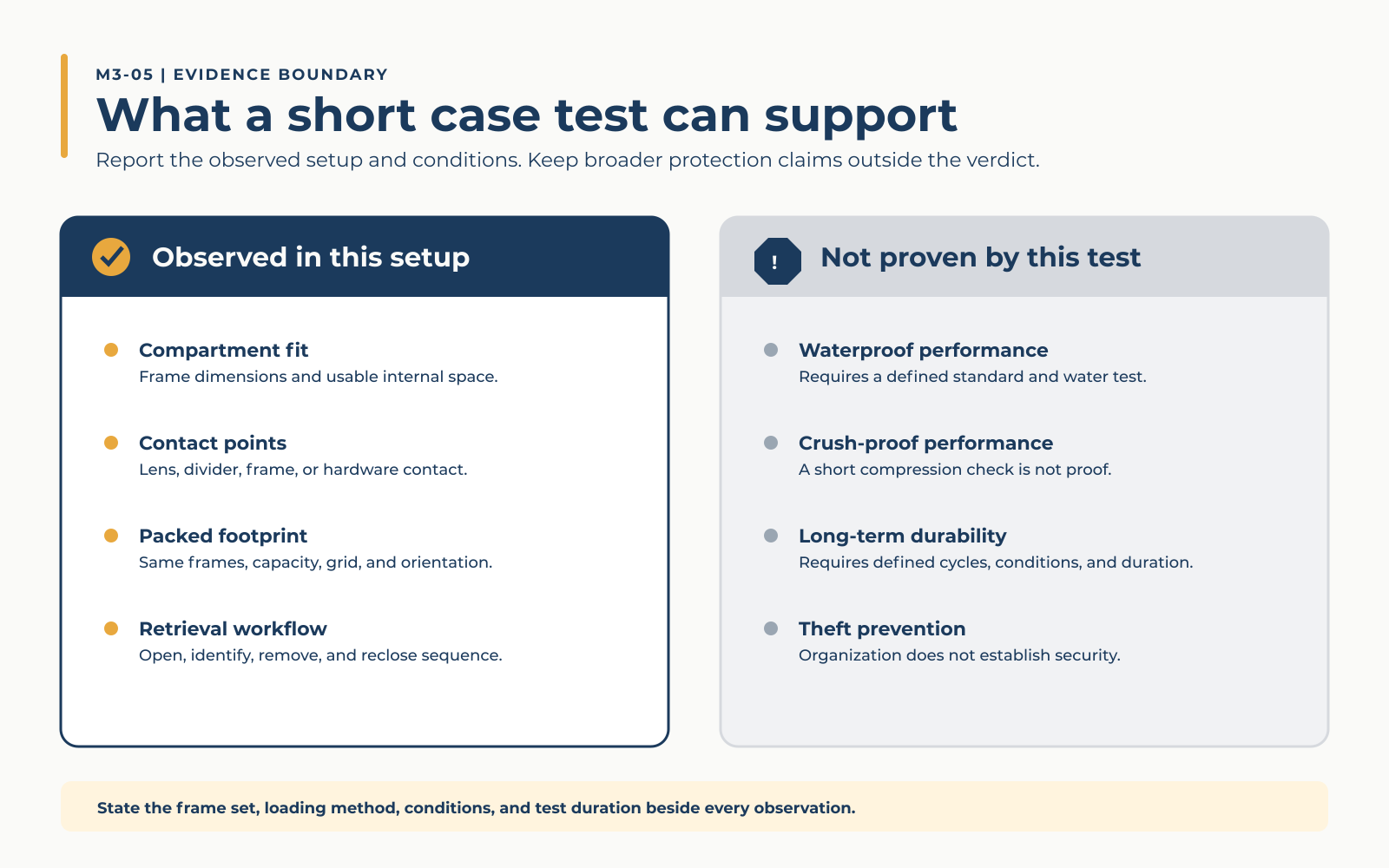
Measured fit and a controlled workflow do not prove every travel-protection claim. Original Lens InsiderS evidence-boundary graphic; it states what a future protocol can observe and what would still require separate evidence.
Best for / Not ideal for
Best for: adults carrying progressives plus readers, office glasses, or sunglasses who can inventory each pair, measure the largest frame, verify internal dimensions, and accept the space tradeoff of their chosen format.
Not ideal for: oversized or strongly wrapped frames without verified clearance; users who need certified impact or waterproof protection; buyers who want an airline-approval claim; or anyone seeking a product ranking before equivalent documentation and hands-on testing exist.
Check current dimensions and compartment layout
Use the four Amazon links only after completing your pair-role inventory and measurements. On the live destination, confirm the exact brand, title, ASIN, size, color, slot count, seller, internal dimension convention, closure layout, and current warranty or return route. Stop if the listing changes or Amazon presents a substitute.
At this stage, Lens InsiderS is not naming a winner. The most defensible shortlist is the one that fits your largest frame with visible clearance, separates lenses from hard contact points, keeps the essential pair accessible, and states what remains unknown. Those checks remain useful even if every commercial link is removed.
Sources and further reading

About Ho Truong
Ho Truong is a trained optician at a family optical practice established in 1991. Lens InsiderS explains lens design and fitting choices for buyers. It does not diagnose eye conditions or replace an eye examination.