Quick answer
Mild peripheral blur and new head-and-eye movement habits can occur early with progressives. Persistent straight-ahead blur, severe or worsening symptoms, unstable clear zones, or clarity that changes when the frame moves should be checked rather than dismissed as adaptation.
Mild side blur and new gaze habits can occur with progressives. Persistent central blur, headaches, imbalance, or worsening symptoms need a prompt recheck.

“Give it time” is common advice after dispensing progressive lenses. Sometimes that is reasonable. A new wearer may need to learn a different relationship between eye position, head movement, and viewing distance.
But adaptation is not an explanation for every problem. If the prescription is wrong, the frame is unstable, or the progressive zones are misplaced relative to the pupils, wearing the glasses longer may not solve the cause.
The useful question is not “Do progressives always feel strange?” It is: Is the experience improving, does clear vision appear in the expected zones, and does a small frame movement reveal a likely fitting issue?
What progressive adaptation actually involves
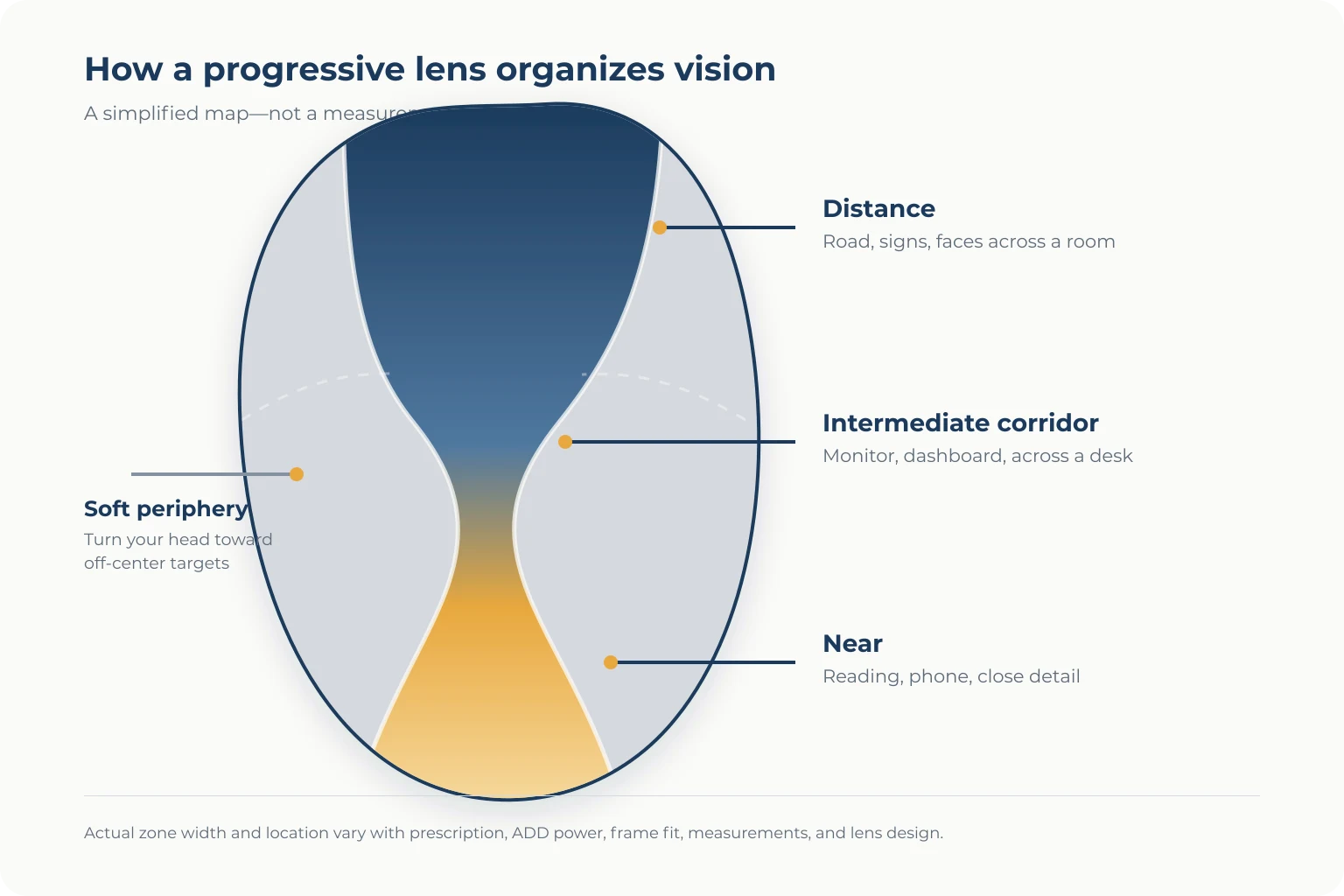
A progressive lens changes power gradually from distance through intermediate to near. The central viewing corridor is surrounded by areas that are less useful for clear detail. New wearers learn to direct the face and gaze toward the task rather than relying on large sideways eye movements through the lens periphery.
A small study of people new to progressive lenses found that participants recruited more head movements during visual tasks as they adapted. Another study found differences in vergence adaptation between people who adapted and those who did not. These findings support the idea that adaptation is not purely about “willpower”; visual and movement strategies differ between people.
A 2026 systematic review concluded that progressive lens design has advanced toward more customized approaches while challenges remain in clinical fitting, neural adaptation, and standardization. That is a good reason to avoid one universal adaptation deadline.
Experiences that may occur early and should improve
Some new wearers notice:
- soft or distorted vision when looking far to the side without turning the head;
- needing to point the nose more directly toward an object;
- searching briefly for the clearest reading position;
- a different sense of floor or stair position when looking through the lower lens;
- a narrower monitor area than expected; or
- awareness that the new frame and prescription feel different from the old pair.
These experiences are more consistent with adaptation when straight-ahead distance vision is clear, near print becomes clear in a repeatable lower position, the frame stays stable, and the discomfort becomes less noticeable with use.
Use extra care on stairs, curbs, escalators, and unfamiliar ground. Look through the distance portion when walking and use a handrail while learning the new lens. Do not drive until distance vision and spatial judgment feel reliably clear and the prescription professional has not advised otherwise.
Signs the glasses should be checked rather than simply tolerated
Request a prompt recheck if you notice:
- distance vision is blurred while looking straight ahead;
- one eye is consistently clearer than the other with both eyes open;
- the clear reading area is extremely difficult to locate or disappears when the frame settles naturally;
- the monitor is only clear when lifting the chin or holding an unusual posture;
- the frame slides, tilts, or sits at a different height during the day;
- moving the frame a few millimeters noticeably improves clarity;
- double vision, substantial headache, nausea, or imbalance persists or worsens; or
- the experience is not trending better.
Do not wait through severe symptoms because someone quoted a fixed adaptation period. A correctable fitting or prescription problem is better found early while remake or return coverage is available.
Five common problem categories
1. Frame position
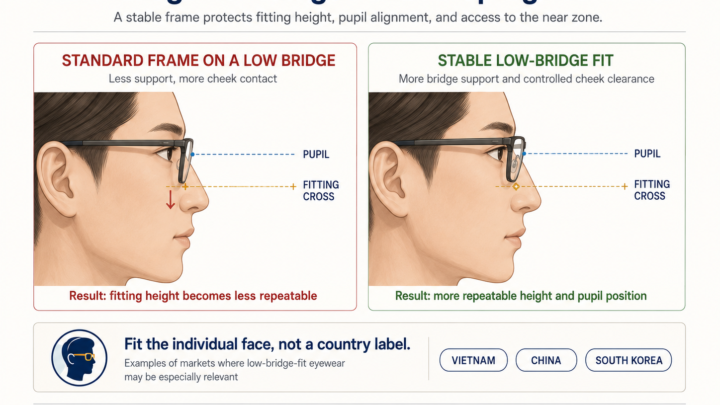
The lens can only stay aligned if the frame stays aligned. A loose bridge, uneven temples, incorrect tilt, or sliding frame changes the relationship between the pupils and the progressive zones.
Adjust the frame before judging the lenses and before taking final fitting measurements. If clarity changes when you push the frame higher, lower, closer, or farther away, report that specific observation.
2. Horizontal centering
Monocular pupillary distance positions each progressive corridor horizontally. A total PD can hide facial asymmetry because the two eyes may not sit equally far from the bridge center.
Ask the dispenser to verify the lens reference markings and compare them with the wearer’s pupils after the frame is adjusted.
3. Vertical fitting position
If the fitting position is too high or too low, the wearer may enter the wrong part of the power progression during normal gaze. Symptoms can include chin lifting at the monitor, distance interference, or difficulty finding near.
Vertical fitting cannot be judged from the prescription alone. It depends on the chosen frame and its adjusted position on the face.
4. Prescription or lens verification
The finished lenses should be checked against the ordered prescription and progressive design. Large changes in sphere, cylinder, axis, ADD, prism, lens material, base curve, or frame shape can all contribute to a different experience.
A recheck should separate three questions: Was the written prescription appropriate? Was the order entered correctly? Were the finished lenses manufactured and fitted as ordered?
5. Task mismatch
An everyday progressive divides lens space among distance, intermediate, and near. Someone who spends eight hours at a large monitor may want a wider intermediate area than an all-day design provides.
If distance and reading work but the computer remains uncomfortable, measure the actual monitor distance and consider whether a dedicated office lens is more appropriate. Our guide to progressive lenses for computer work explains that decision.
A practical, low-risk way to learn the lenses
- Begin in a familiar, well-lit space. Test a clear object across the room, a normal monitor, and ordinary reading material.
- Check one distance at a time. Look straight ahead for far, slightly lower for intermediate, and lower for near.
- Turn toward side targets. Point the nose closer to the object instead of making a large sideways glance.
- Use your real tasks. A giant test letter does not reveal whether normal email, labels, or dashboard information is comfortable.
- Keep the frame in its adjusted position. Do not evaluate while it is sliding down the nose.
- Record specific problems. Note the distance, direction, eye, posture, and whether moving the frame changes clarity.
- Follow the prescriber or dispenser’s wearing advice. If symptoms are significant, contact them rather than forcing longer wear.
Consistent practice can help the movement strategy become more automatic, but practice cannot relocate a corridor that is incorrectly centered.
How to describe the problem at a recheck
Replace “They feel weird” with observations such as:
- “Distance is clear in the right eye but soft in the left while I look straight ahead.”
- “My monitor is clear only when I raise my chin.”
- “Reading becomes clear when I push the frame upward.”
- “The center is clear, but side targets distort until I turn my head.”
- “The frame slides after ten minutes and I lose the reading area.”
Specific feedback helps distinguish a normal peripheral limitation from frame position, centering, prescription, or task mismatch.
Remake, adjustment, or refund?
An adjustment is appropriate when the frame position is the main problem and the lens zones become usable after the frame is stabilized.
A remake may be appropriate when verified measurements, design selection, prescription entry, or manufacturing do not match what is needed. The dispenser should document what will change; repeating the same order without identifying a cause may repeat the result.
A refund or different lens strategy may be reasonable when the retailer cannot provide a suitable remedy, the task is mismatched to the design, or the wearer and prescriber decide another correction is more appropriate. Review the adaptation, remake, and return policy before purchase—not after the window is almost closed.
For an example of conflicting published return periods and online measurement questions, see our independent GlassesUSA progressive lenses review.
Symptoms that need eye care, not just a lens adjustment
Sudden vision loss, new flashes or floaters, a curtain-like shadow, eye pain, sudden double vision, a new field defect, weakness, facial droop, or a severe sudden headache should not be treated as routine progressive adaptation. Seek urgent medical evaluation according to local emergency guidance.
New glasses can make an existing vision problem more noticeable, but they do not explain every new symptom.
Frequently asked questions
How long should progressive adaptation take?
There is no single deadline that proves success or failure. Some people become comfortable quickly, while others need longer. Improvement, repeatable clear zones, stable frame position, prescription complexity, and symptom severity are more useful than counting days alone.
Is peripheral blur normal with progressives?
Progressive designs have areas outside the main corridor that are less useful for clear detail. Mild side blur that improves when you turn toward the target can be expected. Central straight-ahead blur should be checked.
Should I wear new progressives all day immediately?
Follow the advice of the prescribing or dispensing professional who knows your prescription and safety needs. Do not force wear through severe dizziness, pain, double vision, or worsening symptoms.
Why is my computer blurry when distance and reading are clear?
The intermediate area may be too narrow for the task, the monitor may be too high or at the wrong distance, or the fitting position may be wrong. Measure the workstation and have the lens alignment checked.
Can a premium progressive eliminate adaptation?
No label guarantees immediate comfort. Customization and design can improve the distribution of usable vision for some wearers, but accurate prescription, frame fit, measurements, and task matching remain essential.
The bottom line
Progressive adaptation is a real learning process, but it should not become a reason to dismiss every complaint. Mild peripheral effects and new head-and-eye movement habits may improve. Persistent straight-ahead blur, unstable clear zones, severe symptoms, or clarity that changes with frame movement deserve a structured recheck.
Start by verifying the frame, then the centering and fitting height, then the finished prescription and task match. “More time” should come after those basics—not instead of them.
Sources and further reading

About Ho Truong
Ho Truong is a trained optician at a family optical practice established in 1991. Lens InsiderS explains lens design and fitting choices for buyers. It does not diagnose eye conditions or replace an eye examination.