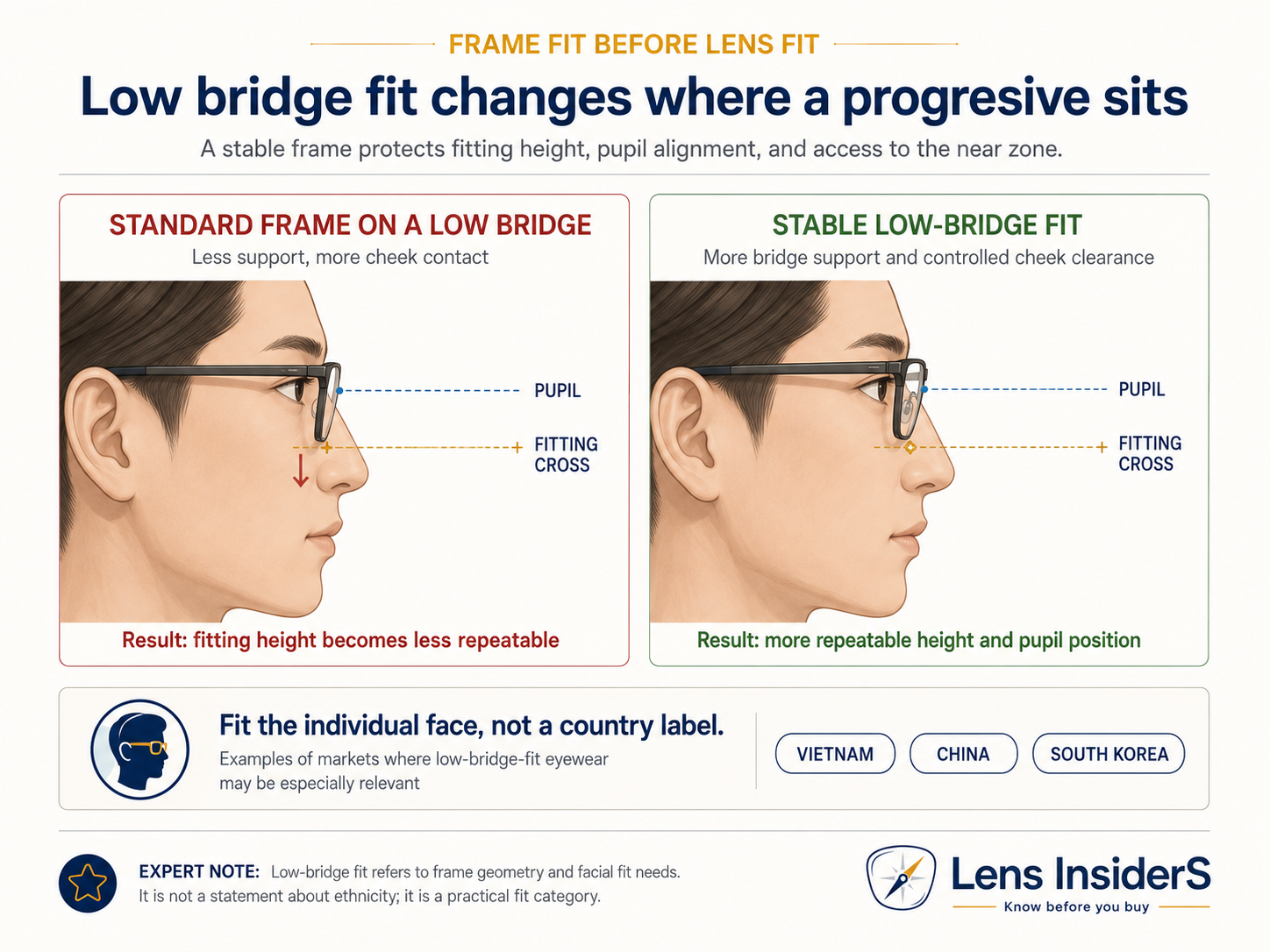
A progressive lens can be measured perfectly and still fail if the frame settles 4 mm lower during normal wear. For people with a lower or flatter nasal bridge, higher cheekbones, or limited bridge contact, frame stability is part of the optical design.
Quick answer
A low-bridge fit frame can help a progressive wearer when standard molded bridges slide, place the pupils too high in the lenses, allow eyelashes to touch, or let the lower rims rest on the cheeks. People from Vietnam, China, South Korea, and other Asian countries may encounter these fit patterns more often, but country or ancestry cannot determine the correct frame. Test the actual bridge contact, cheek clearance, pupil position, and stability.
Why this matters more for progressive lenses
A single vision lens is usually more tolerant of small vertical frame movement. A progressive lens assigns different powers to different vertical positions. Distance sits toward the top, intermediate power develops through the center, and the full near addition appears lower down.
If the frame slides, the eyes no longer pass through the intended locations. The wearer may notice:
- distance blur unless the frame is pushed down or tilted;
- a computer zone that requires an unusual chin position;
- near vision that clears only when the frame is lifted;
- one eye reaching a clear zone before the other;
- frequent pushing up that makes the visual experience inconsistent.
A more expensive lens does not fix an unstable bridge.
What low-bridge fit actually means
Retailers use “low bridge fit” for frames shaped to sit more securely on faces that are not well served by many standard bridge designs. Common features include larger or differently angled nose pads, more bridge contact, altered frame curvature, extra cheek clearance, and temple geometry intended to hold the front at a higher, more stable position.
“Asian fit” has been used for a similar retail category. Low bridge fit is the more useful term because it describes the problem. A person does not need to be Asian to need it, and an Asian wearer does not automatically need it.
What research says about population differences
Anthropometric studies do find average differences in nasal and facial measurements among populations. A study of 119 young Han Chinese adults, for example, documented external nasal soft-tissue dimensions for that sample. Comparative craniofacial research has also reported differences between Chinese and White young adults.
Averages cannot fit an individual frame. Vietnam includes many regional and ancestral backgrounds. China and South Korea each contain substantial variation too. Sex, age, weight, surgery, injury, and individual development all affect bridge shape and cheek position.
Use population data to improve the range of frames offered. Do not use it to skip fitting.
Six signs a standard bridge is not working
- The frame slides during normal head movement. It should not require constant pushing up.
- The lower rims touch the cheeks at rest or when smiling. Cheek movement can lift or tilt the lenses.
- Eyelashes brush the lenses. This suggests insufficient lens-to-eye clearance or unsuitable bridge geometry.
- The pupils sit very high in the openings. There may be too little usable distance area above the fitting cross.
- The bridge contacts at one small pressure point. A narrow contact area can be uncomfortable and unstable.
- Clear vision changes when the frame is held in place. This points to a position problem that should be checked before blaming the lens design.
Bridge width printed on the temple does not answer the fit question
A frame marked 52□18 tells you the lens width and distance between lenses under a standard boxing system. The “18” is not a measurement of your nose. Two frames with the same printed bridge size can have different bridge shapes, pad projection, keyhole geometry, and contact points.
Compare the shape and support, not only the number.
Integrated bridge or adjustable nose pads?
| Frame feature | Potential advantage | Check before ordering |
|---|---|---|
| Low-bridge molded acetate support | Broad contact and a clean appearance | The contour must match the actual bridge; molded plastic has limited adjustment |
| Adjustable metal pad arms | Height, angle, and spacing can be tuned | Pad arms need enough range and must stay symmetrical |
| Larger silicone nose pads | More contact and grip | They can collect oil and need periodic replacement |
| Longer or adjustable temples | Can improve retention behind the ears | Over-bending temples can pull the frame out of alignment |
| Reduced lower-rim projection | Improves cheek clearance | Confirm clearance while smiling, not only at rest |
Neither molded bridges nor adjustable pads are universally better. The best option is the one that holds the fitted frame in a repeatable position without painful pressure.
Current product examples and what they prove
Low-bridge fit is not a niche concept. Warby Parker publishes a dedicated low-bridge fit guide for frames intended to reduce sliding and cheek contact. Oakley currently identifies products such as Pitchman Low Bridge Fit and several Holbrook, Centerboard, Crosslink, and Frogskins variants with explicit bridge-and-nosepad fit labels.
These are examples of available frame geometry, not automatic recommendations for progressive lenses. A product still needs enough lens depth, appropriate prescription eligibility, correct width, stable temples, and a remake path.
How a low bridge affects progressive fitting height
Fitting height is recorded after the frame is adjusted. The reference must match where the frame will live during normal wear.
Consider a frame measured with 18 mm below the pupil. If it later slides 4 mm, the effective relationship between the pupil and lens changes substantially. The wearer may begin looking through intermediate power while aiming at distance. The near zone also moves lower relative to the eye.
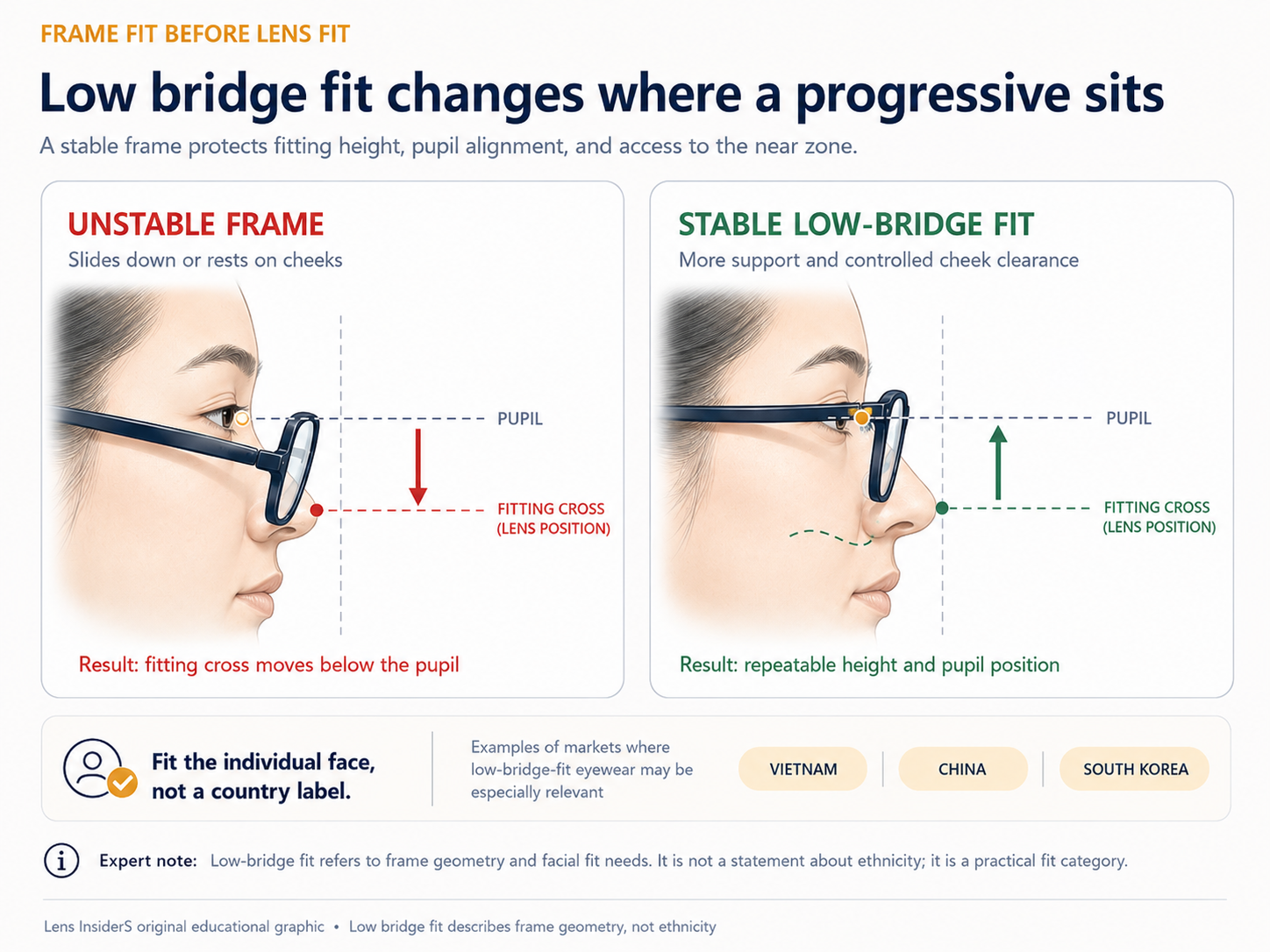
This is why measurements taken from a selfie or generic frame dimensions are risky for progressive orders. The corridor and fitting height must be chosen after the bridge position is stable.
Frame depth still matters
A low-bridge fit frame can sit higher and more securely, but it does not automatically provide enough vertical lens space. Check the pupil position and usable depth below it.
A shallow low-bridge frame may require a short corridor. That can be appropriate, but it creates a more compressed progression. A medium-depth low-bridge frame often gives a first-time wearer more options.
Cheek clearance is an optical measurement
When the lower rims rest on the cheeks, smiling can push the frame upward and change pantoscopic tilt. The lenses move relative to the pupils. Makeup and skin oil can also collect on the lower lens surfaces.
Check the frame while speaking and smiling. A static mirror pose can miss the problem.
Temple and frame width can undo a good bridge
A frame that is too narrow may spread at the temples and lever the bridge forward. A frame that is too wide can drift and rotate. The end pieces, hinge position, temple length, and bend behind the ear all contribute to retention.
Low-bridge fit is not one nose-pad feature. It is a complete frame relationship.
A fitting sequence for Vietnamese, Chinese, Korean, and other wearers
The sequence is the same for every nationality:
- Choose several frames with promising bridge and cheek geometry.
- Adjust each frame before judging its position.
- Check bridge contact, lash clearance, and cheek clearance at rest and while smiling.
- Confirm the frame remains level during walking and normal head movement.
- Inspect pupil position inside both lens openings.
- Measure monocular PD and right/left fitting height in the selected frame.
- Select a progressive corridor that fits the available depth.
- Record position-of-wear values when the lens design uses them.
- Recheck the same position when the finished glasses are collected.
The country examples matter because retailers and opticians serving these populations should stock enough geometry to make this process possible. They do not replace the process.
Who should actively look for low-bridge fit?
Consider it when two or more standard frames repeatedly slide, touch the cheeks, sit too close to the lashes, or place the pupils unusually high. It is also worth exploring when clear progressive vision changes as you push the frame back into place.
Do not choose it only because a product page says “Asian fit.” A high or prominent bridge, lower cheekbones, or a different facial width may fit a standard frame better.
Buying online: what photos and virtual try-on cannot verify
Virtual try-on can help with style and approximate width. It cannot reliably show pressure distribution, cheek contact during movement, temple tension, vertex distance, or the final fitting height.
Before ordering progressives online, ask:
- Is the exact frame labeled low bridge fit, and what design changes create that fit?
- What is the vertical lens height?
- How will monocular PD and fitting height be obtained?
- Can right and left fitting heights differ?
- Can a local optician adjust the bridge and temples without affecting the warranty?
- What happens if the frame fit makes the progressive measurements unusable?
- Does the remake policy cover a frame change as well as a lens change?
Use our full progressive frame checklist and online ordering checklist before paying.
Frequently asked questions
Are low-bridge fit and Asian fit the same?
Retailers have used the terms for overlapping frame categories. Low bridge fit is more precise because it describes frame geometry. Product details still vary by brand and model.
Do all Vietnamese, Chinese, or Korean people need low-bridge frames?
No. Population averages do not predict one person’s bridge, cheekbones, width, or temple fit. Try and measure the individual frame.
Can larger nose pads fix a sliding progressive?
Sometimes. The pad size, angle, separation, temple fit, frame width, and weight all interact. The frame should be adjusted and then the progressive position rechecked.
Can I change to low-bridge nose pads after the lenses are made?
A small adjustment may help, but a major height or tilt change can invalidate the original fitting relationship. Have the finished glasses checked through the design markings after the change.
Is a low-bridge frame automatically good for progressives?
No. It must also have enough usable lens depth, suitable prescription eligibility, correct width, stable temples, and a corridor compatible with the measured fitting height.
Sources and further reading
- Anthropometric measurement of external nasal soft tissue in 119 young Han Chinese adults
- European Journal of Orthodontics: Chinese and Caucasian craniofacial comparison
- Warby Parker: Low-bridge fit and frame slipping
- Oakley Pitchman Low Bridge Fit product specifications
- Progressive lens performance and individual fitting parameters
Professional note: Frame fit does not replace a current prescription or eye examination. Persistent blur after frame and lens verification, or sudden vision change, pain, double vision, flashes, or new floaters needs professional assessment.

About Ho Truong
Ho Truong is a trained optician at a family optical practice established in 1991. Lens InsiderS explains lens design and fitting choices for buyers. It does not diagnose eye conditions or replace an eye examination.