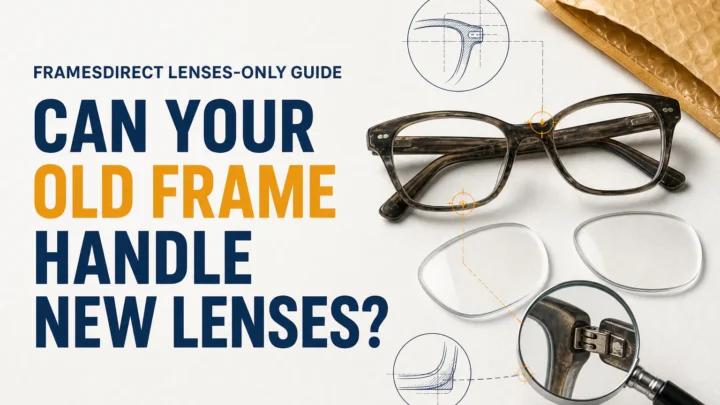
An independent optician-led look at FramesDirect prescription lenses: lens types, materials, coatings, progressive-order risks, return terms, and the questions to ask before checkout.
Review scope: This is an independent editorial assessment of FramesDirect’s published lens choices, ordering guidance, optician support, and return policy as checked on July 26, 2026. Lens InsiderS did not purchase a pair for hands-on wear testing, so this article does not rate the optical performance of a delivered pair.
FramesDirect presents a broad lens menu: single vision, no-line progressives, bifocals, readers, non-prescription lenses, several materials, branded sun lenses, Transitions options, and coating packages. That selection can be useful, but a long menu does not automatically produce a good pair of glasses.
A finished prescription lens succeeds only when six things agree: the prescription, lens design, fitting measurements, lens material, frame position, and remedy if something is wrong. This guide separates those decisions so you can compare FramesDirect with another retailer using the same specification.
Quick verdict
FramesDirect is most compelling for shoppers who want designer-frame choice, access to recognizable branded lens options, and the ability to contact trained opticians before ordering. Its published 30-day return and exchange policy and stated one-year warranty create a clearer remedy than a final-sale prescription order.
The main risk is the same one that applies to every online progressive order: a prescription alone does not provide the complete horizontal and vertical fitting position of the lenses in the selected frame. First-time progressive wearers, people with prism, high ADD, strong prescriptions, large differences between the eyes, or previous adaptation problems should confirm how fitting measurements will be handled before paying.
What FramesDirect currently offers
The FramesDirect Lens Hub organizes its choices in three stages:
- Vision need: single vision, progressive, bifocal, readers, or non-prescription.
- Lens material: a thickness and material choice based on prescription and use.
- Lens package: treatments such as anti-reflective coating, blue-violet light filtering, Transitions, or polarization.
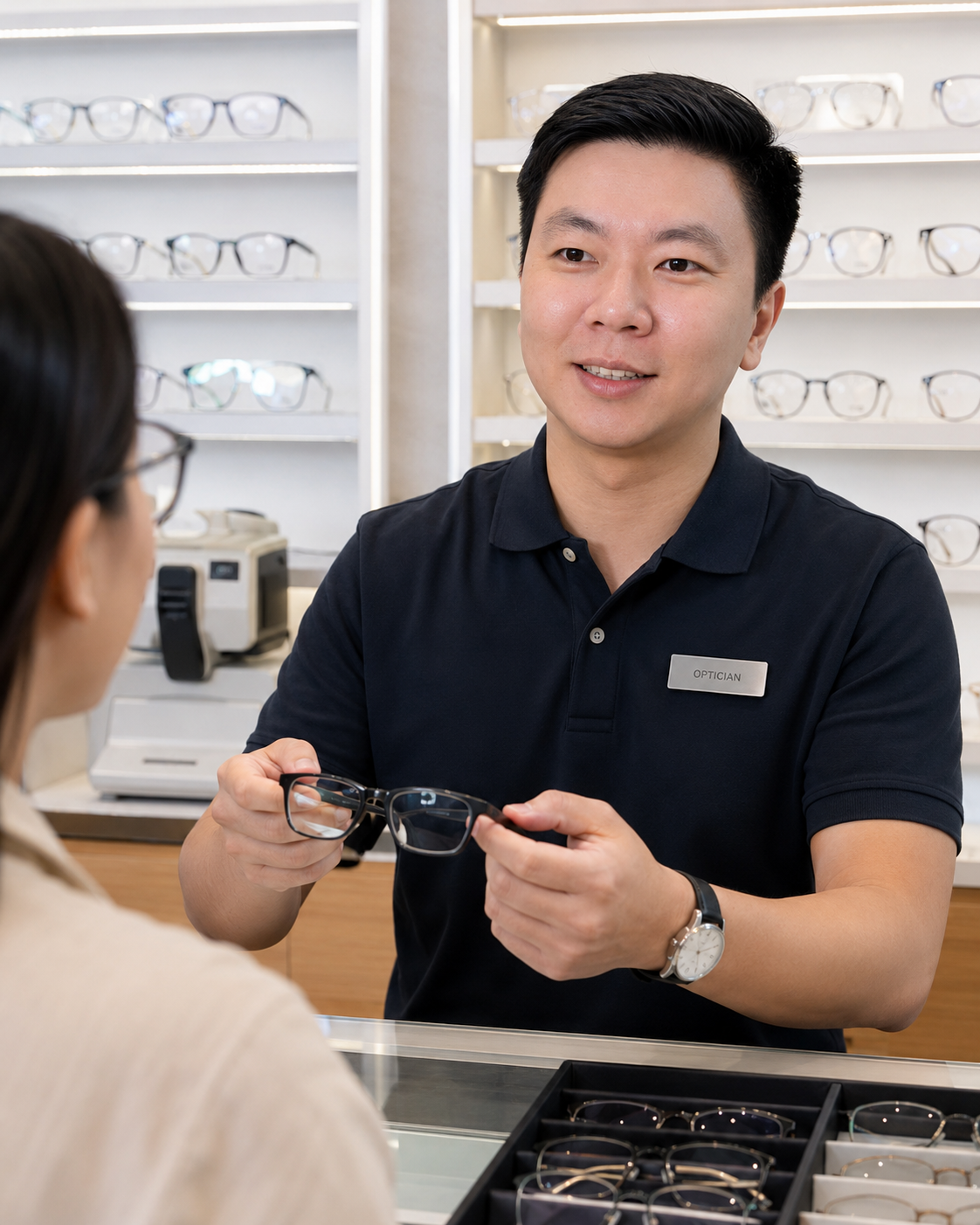
FramesDirect also states that certified opticians review eyewear orders and are available by phone or contact form. That is a useful support signal, but buyers should still ask what the review actually checks. Confirm whether the optician verifies frame eligibility, prescription entry, lens material, monocular PD, and any vertical fitting input required for the selected progressive design.
Lens type: solve the viewing task first
| Lens type | Best suited to | Main limitation |
|---|---|---|
| Single vision | One primary distance: far, computer, or near | Does not combine multiple focal ranges |
| Progressive | Distance, intermediate, and near in one no-line lens | Needs accurate fitting and has narrower side zones |
| Bifocal | Distance and near with a defined reading segment | Visible line and no gradual intermediate corridor |
| Readers | Near tasks such as books, menus, and a phone | Not a general distance solution |
| Non-prescription | Style, sun protection, or selected coatings without correction | Does not correct refractive error |
Do not start by choosing the most expensive package. Start with your actual distances. A person who spends eight hours at two monitors may need a dedicated computer or office solution more than a premium everyday progressive. See our comparison of office lenses versus everyday progressives.
Progressive lenses: the missing questions
FramesDirect describes progressive lenses as no-line lenses for near, intermediate, and far vision. That is accurate at a category level, but it does not identify the progressive design, corridor length, usable-zone width, or personalization inputs in each package.
Before ordering progressives, ask FramesDirect:
- Can I provide separate right- and left-eye distance PD values?
- How is the vertical fitting height established for this exact frame?
- Which progressive design is included in each package?
- Does the design use frame measurements or position-of-wear inputs?
- What minimum lens height is required?
- What happens if distance is clear but the intermediate or near zone sits too high or too low?
- Will an optician review the frame and measurements before production?
For a progressive order, use actual measurements rather than a population average. A total PD can hide facial asymmetry: two people can share the same total value while having different right- and left-eye distances. Our guide explains PD for online progressive glasses and where self-measurement becomes risky.
Material and thickness: what the labels do not tell you
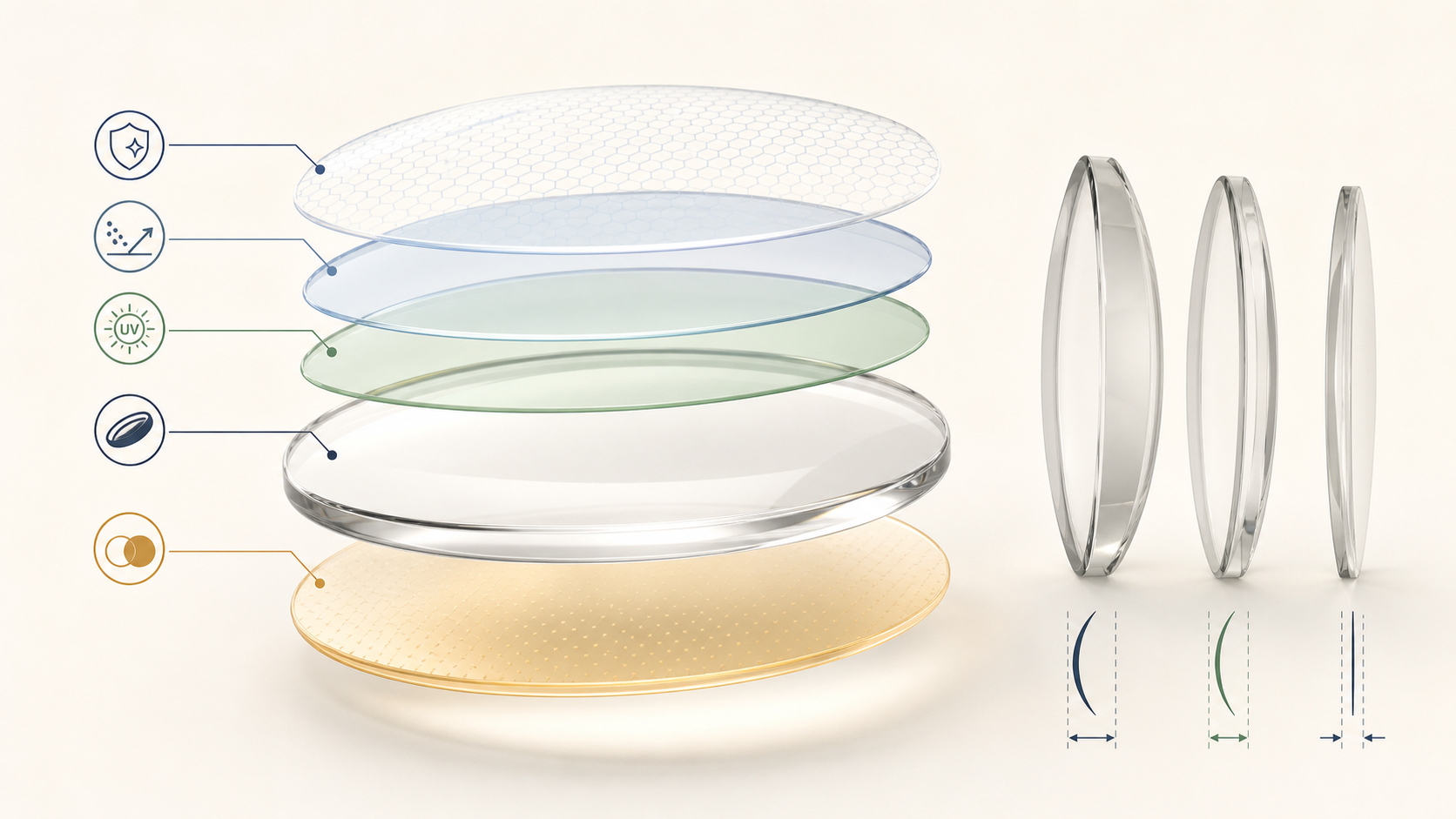
FramesDirect lists standard plastic (CR-39), polycarbonate, high-index 1.67, and high-index 1.74. Its Lens Hub markets these options using increasing thinness. That is useful as a starting framework, but material should not be selected from prescription strength alone.
| Material | Common reason to choose it | Tradeoff to check |
|---|---|---|
| CR-39 plastic | Good optical clarity and value for many lower prescriptions | Usually thicker and less impact resistant than polycarbonate |
| Polycarbonate | Impact resistance, children, safety-conscious or active use | Optical characteristics and chromatic effects differ from CR-39 |
| High-index 1.67 | Thinner profile for stronger prescriptions | Often costs more and benefits from a good anti-reflective coating |
| High-index 1.74 | Maximum thinning for selected very strong prescriptions | Highest price is not automatically the best balance of optics, weight, frame, and durability |
Final thickness also depends on frame size and shape, pupil position, prescription sign, cylinder, decentration, and laboratory finishing. A smaller, well-centered frame can reduce edge thickness in a minus prescription more effectively than paying for a higher index in an oversized frame.
Ask for a like-for-like total price using the same frame, index, progressive design, coatings, tint, shipping, and return terms. The frame price alone is not a valid comparison.
Coatings: separate useful functions from package language
FramesDirect says scratch-resistant coating is included on prescription lenses and presents options for UV protection, anti-reflective coating, blue-violet light filtering, Transitions, and polarization.
- Scratch-resistant coating: improves surface durability, but no plastic lens is scratch-proof.
- Anti-reflective coating: reduces reflections and can improve appearance and clarity, especially on high-index lenses.
- UV protection: should be confirmed for the finished clear or sun lens, not inferred from tint darkness.
- Photochromic treatment: changes tint with light conditions; activation behind a windshield varies by product.
- Polarization: reduces reflected glare outdoors and is different from ordinary tint.
- Blue-violet filtering: ask for the exact product and transmission specification rather than relying on a broad screen-comfort claim.
Choose coatings around a real use case. Night driving emphasizes reflection control. Outdoor water use may favor polarization. Frequent indoor-outdoor movement may favor photochromic treatment. A package that bundles every feature can cost more without solving your primary visual problem.
Branded lenses: when they add value
FramesDirect highlights branded lens options associated with Oakley, Costa, Maui Jim, Wiley X, Randolph, and Transitions. Brand-specific lenses can be valuable when the lens technology is a core part of the product, such as sport tint, polarization, impact requirements, or a frame-lens system designed together.
Do not assume a logo guarantees the best prescription result. Ask what the branded option changes:
- lens material and impact standard;
- tint or polarization technology;
- progressive or single-vision design;
- coating warranty;
- frame-specific geometry;
- available prescription range; and
- remake or return coverage.
Return, remake, and warranty: the part to save before payment
The current FramesDirect returns and exchanges policy states a 30-day return and exchange period for eyeglasses and sunglasses. It also says that if prescription lenses are not accurate, the company can replace the same lens package at no additional cost or provide store credit after evaluating the returned order.
The same policy says orders made accurately to the submitted prescription may be treated differently from lenses shown to be incorrect. This distinction matters. A lens can match the written prescription while still feeling unusable because of fitting position, frame adjustment, progressive corridor choice, or an input that was never collected.
Before checkout, save or confirm:
- the return deadline and when the clock starts;
- whether refund shipping is deducted;
- whether a progressive fitting problem qualifies for remake, exchange, store credit, or refund;
- whether the same lens package must be used for a replacement;
- what measurements are rechecked during evaluation; and
- what the stated one-year lens and frame warranty covers.
FramesDirect’s published warranty information includes confirmed defects such as coating peeling and certain lens cracks, while excluding rough handling, improper cleaning, and environmental damage. Keep the original packaging, order specification, prescription copy, and policy screenshot.
Who is a reasonable candidate for FramesDirect?
FramesDirect may be a practical option when most of these statements are true:
- you have a current and stable prescription;
- you already understand the lens type you need;
- you can provide accurate monocular PD values;
- you are choosing a frame with a stable bridge and suitable lens depth;
- you value access to designer or branded lens-frame combinations;
- you are prepared to contact an optician before production;
- you have saved the complete checkout specification; and
- you understand the return and remake remedy.
When an in-person fitting is safer
Consider in-person measurement and troubleshooting if this is your first progressive or if you have prism, a high ADD, a strong or highly asymmetric prescription, previous adaptation failures, a very wrapped frame, unusual occupational distances, or a frame that requires frequent adjustment.
An online retailer can manufacture eyewear, but it cannot replace a medical eye examination. Seek professional care for sudden blur, double vision, flashes, new floaters, eye pain, or a sudden field-of-vision change.
FramesDirect ordering checklist
- Confirm the prescription. Check SPH, CYL, AXIS, ADD, and prism for each eye.
- Use real monocular PD. Avoid averages for progressive orders.
- Choose the visual task. Decide whether you need distance, everyday progressive, computer, near, or sun use.
- Choose the frame before chasing index. Check bridge stability, lens depth, pupil position, width, and adjustability.
- Ask what each upgrade changes. Separate design, material, coating, tint, and brand benefits.
- Contact the optician team. Confirm fitting inputs and frame eligibility before production.
- Save the itemized order. Record total price, lens specification, shipping, return, remake, and warranty terms.
- Test by zone after delivery. Check distance straight ahead, normal monitor distance, and normal reading distance with the frame sitting level.
- Describe problems precisely. Identify the blurred zone and whether moving the frame changes clarity.
Frequently asked questions
Does FramesDirect sell progressive lenses?
Yes. FramesDirect lists no-line progressives for distance, intermediate, and near use. Confirm the exact design, fitting inputs, and package differences before ordering.
Does FramesDirect have opticians?
FramesDirect states that certified or trained opticians review eyewear orders and are available by phone or contact form. Ask what measurements and compatibility checks are included in that review.
What lens materials does FramesDirect offer?
Its current Lens Hub describes CR-39 plastic, polycarbonate, high-index 1.67, and high-index 1.74. Availability can depend on prescription, frame, and lens type.
Can prescription glasses be returned?
FramesDirect currently publishes a 30-day return and exchange policy for eyeglasses and sunglasses, with conditions. Verify the policy shown for your order and save it before payment.
Are FramesDirect lenses tested by Lens InsiderS?
Not yet. This article evaluates published choices and policies, not a delivered pair. It will be updated if Lens InsiderS completes a documented order and fitting assessment.
The bottom line
FramesDirect offers a useful combination of designer selection, multiple lens materials, branded technologies, optician support, and a published remedy. Those are meaningful reasons to include it in an online eyewear comparison.
The safest decision still depends on the inputs. Choose the task first, provide accurate measurements, select a stable frame, separate lens design from material and coating upgrades, and confirm what happens if a progressive lens matches the prescription but does not work at your real viewing distances.
Explore FramesDirect lens options
About Ho Truong
Ho Truong is a trained optician at a family optical practice established in 1991. Lens InsiderS explains lens design and fitting choices for buyers. It does not diagnose eye conditions or replace an eye examination.