Pupillary distance is one of the most important numbers used to center eyeglass lenses. With progressives, “close enough” can produce narrow vision, eye strain, or one eye reaching the reading zone before the other.
Quick answer
For progressive glasses, request monocular distance PD—one number for the right eye and one for the left—rather than relying only on a single binocular total. PD alone is not a complete progressive fitting: the finished frame also needs an appropriate fitting height, stable bridge position, and a lens design compatible with the frame. Professional measurement in the selected frame is the lower-risk choice, especially for high prescriptions, prism, facial asymmetry, or a previous non-adapt.
What PD actually measures
PD is the horizontal distance between the visual axes, usually recorded in millimeters. A binocular PD might be written as 63 mm. Monocular PD splits that distance from the center of the nose to each pupil—for example, 31 mm right and 32 mm left. Faces are not perfectly symmetrical, so dividing 63 by two would lose useful information.
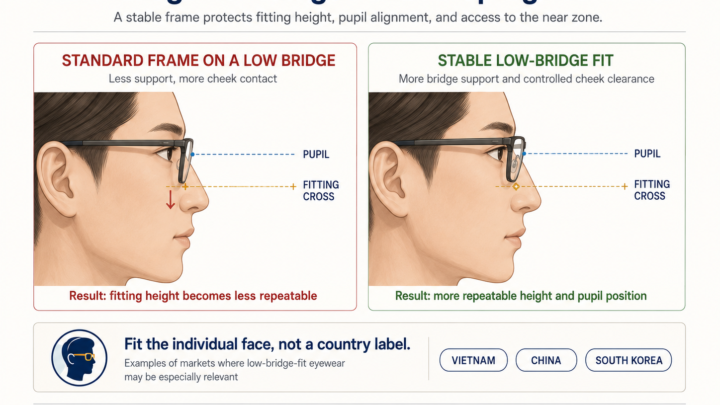
PD is not the same as fitting height. PD centers the lens horizontally; fitting height positions the progressive design vertically in the actual frame. Both affect whether each eye reaches the intended distance, intermediate, and near zones.
Why progressives need more than one number
| Measurement | What it controls | Common online-order risk |
|---|---|---|
| Monocular distance PD | Horizontal centering for each eye | Using half of a binocular PD despite facial asymmetry |
| Fitting height | Vertical placement of the fitting cross and corridor | Estimated before the chosen frame sits on the face |
| Frame lens height | Space available for distance, corridor, and near zones | Choosing a shallow frame that compresses the design |
| Vertex distance, tilt, wrap | Position of wear for customized designs | Not collected or changed after frame adjustment |
Best ways to get your PD
1. Ask the practice that measured it
If your eye-care or optical practice measured your PD, ask for the recorded monocular values. In the United States, the FTC Eyeglass Rule requires a copy of the eyeglass prescription after a refraction, but most states do not require PD to appear on that prescription. The FTC notes that online buyers need PD and encourages providers who take the measurement to supply it.
2. Have an optical professional measure you
A pupilometer or a carefully performed frame-based measurement reduces alignment uncertainty. This is especially valuable when the prescription is strong, the eyes have different powers, prism is present, the nose is asymmetric, or the wearer previously had progressive-lens problems.
3. Use a validated retailer tool
Some online retailers use a phone camera and a reference object. Follow the instructions exactly: use even lighting, keep the head level, remove tinted lenses, and repeat the measurement. If repeat results vary by more than about 1 mm, do not average blindly—get a professional measurement.
4. Manual ruler measurement
This is the least controlled option. If you must use it, ask another person to measure while you look at a distant target. Hold a millimeter ruler level at the bridge, measure from the center of the nose to each pupil, and repeat at least three times. Avoid measuring your reflection at close range because convergence can change pupil position.
Distance PD versus near PD
Near PD is smaller because the eyes converge for reading. Most online progressive orders ask for distance PD and use the design’s inset calculation for near alignment. Do not enter near PD into a field labeled simply “PD” unless the retailer explicitly requests it. If the form asks for two numbers, confirm whether it expects right/left monocular PD rather than distance/near PD.
PD mistakes that cause trouble
- Entering centimeters instead of millimeters.
- Using a contact-lens prescription; it does not contain eyeglass lens powers or fitting measurements.
- Swapping right and left monocular PD.
- Dividing a binocular total equally when the face is asymmetric.
- Measuring through thick, reflective, or tinted lenses.
- Assuming PD is enough while ignoring frame height and vertical fitting.
When online measurement is higher risk
Choose an in-person fitting or obtain professional help when the order includes prism, large anisometropia (substantially different right and left powers), a very high prescription, an unusually wrapped frame, a shallow frame, or a previous progressive remake. The goal is not to make online ordering sound impossible; it is to match the purchasing method to the cost of a measurement error.
Before you submit the order
- Confirm the prescription is current and not for contact lenses.
- Enter OD (right) and OS (left) values exactly as written.
- Confirm ADD and prism fields.
- Use monocular PD when accepted.
- Check whether the seller measures or estimates fitting height.
- Verify the frame is approved for the selected progressive design.
- Save screenshots of all measurements and the final configuration.
- Read the progressive-specific remake and refund terms.
For the rest of the process, use our progressive glasses online checklist and learn what ADD means on your prescription.
Frequently asked questions
Can the PD on old glasses be reused?
Your anatomical PD generally does not change much in adulthood, but the old order may contain optical-center data rather than the exact values you need. Ask for the original record and confirm whether it is monocular distance PD.
Is 1 mm important?
The effect depends on lens power, design, and whether the error is shared or concentrated in one eye. Stronger powers are less forgiving. Do not diagnose a remake from PD alone; frame position and prescription verification also matter.
Does GlassesUSA need PD?
Retailer input requirements can change. Check the current order form and support documentation at the time of purchase rather than relying on an old screenshot or review.
Sources and further reading
- FTC: Your rights when buying prescription glasses
- FTC: Complying with the Eyeglass Rule
- ZEISS: Frame and fitting-height considerations
Health note: PD is a dispensing measurement, not an eye-health examination. Use a current prescription and seek professional care for unexplained blur, pain, double vision, or sudden visual changes.

About Ho Truong
Ho Truong is a trained optician at a family optical practice established in 1991. Lens InsiderS explains lens design and fitting choices for buyers. It does not diagnose eye conditions or replace an eye examination.