Four lenses can all be made from clear plastic and still organize vision in completely different ways. The choice is not a ladder from basic to premium. It is a decision about how many viewing distances you need, where you need them, and which optical compromise you prefer.
Quick answer
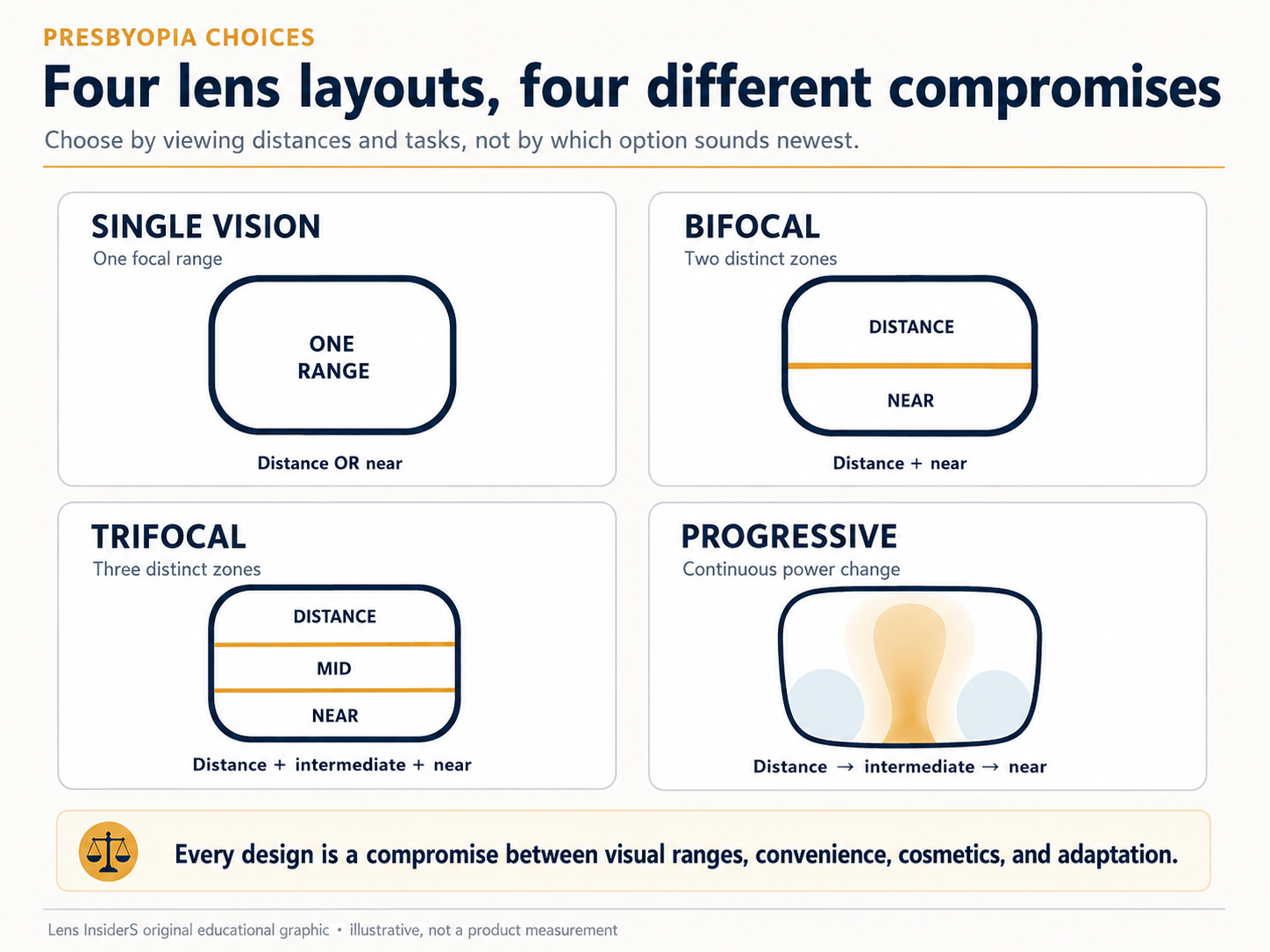
Single vision is simplest when one focal range is enough. Bifocals give clear distance and near through two distinct zones. Trifocals add a lined intermediate segment. Progressives provide a continuous change from distance to near without visible lines, but their intermediate channel and lower side areas are less forgiving.
The four lens types at a glance
| Lens type | Viewing ranges | Visible line | Main compromise |
|---|---|---|---|
| Single vision | One prescribed range | No | A second distance may require another pair |
| Bifocal | Usually distance and near | Yes | No continuous computer range |
| Trifocal | Distance, intermediate, and near | Yes, usually two | Image jump and fixed segment locations |
| Progressive | Continuous distance through near | No | Narrower intermediate path and peripheral blur |
Single vision lenses: one correction across the lens
A single vision lens carries one prescribed correction across its main area. It can be made for distance, reading, or an intermediate working range. The phrase does not mean “distance only.”
Because the lens does not need to divide space among multiple powers, it usually provides the widest usable field for the selected distance. A single vision computer pair can be more comfortable across two large monitors than an everyday progressive. A single vision reading pair can provide a wide page area.
Best for
- people who need correction at only one distance;
- tasks that demand a wide, stable field at a defined range;
- wearers who are comfortable switching between separate pairs;
- distance-only safety glasses or task-specific work eyewear.
Not ideal for
Someone with presbyopia who moves constantly between road, room, screen, and phone may find frequent switching inconvenient. A distance pair can make close print harder, while a reading pair is not suitable for walking or driving.
Bifocal lenses: two zones with a visible boundary
A traditional bifocal usually places the distance prescription in the main lens and the near addition in a visible lower segment. Common segment shapes include flat-top and round designs. The exact segment affects width and image jump.
The near area can be wide, stable, and easy to find. Power changes abruptly at the line. That jump can make an object appear to shift as the gaze crosses the segment boundary.
Best for
- wearers who want a large, predictable reading segment;
- people who mainly need distance and near, with little computer demand;
- previous successful bifocal wearers who value familiar segment placement;
- buyers who prefer a simpler multifocal design and accept a visible line.
Not ideal for
A standard distance-near bifocal does not create a continuous arm’s-length range. The upper distance area may be too weak for close monitors, while the lower reading segment may be too strong. Segment height also matters on stairs because looking down can place the near power over the floor.
Trifocal lenses: a third lined zone for intermediate vision
A trifocal adds a distinct intermediate segment between the distance and near portions. This can support a monitor, dashboard, shelves, or room-distance work without relying on a narrow progressive corridor.
The intermediate power and segment position are fixed. The wearer crosses two visible boundaries when moving from distance to near. Each boundary can create an image shift.
Best for
- wearers who want three clearly separated ranges;
- people who need a predictable intermediate band;
- successful long-term trifocal wearers who do not mind visible lines;
- tasks where fixed distances matter more than smooth transitions.
Not ideal for
Trifocals are less suitable when the working distance changes continuously or appearance without visible segments is a priority. The intermediate band may not match a modern monitor setup unless its power and height are chosen for the actual distance.
Progressive lenses: continuous power without visible lines
A progressive addition lens increases power gradually as the gaze moves down. The upper area supports distance, the central progression supports intermediate tasks, and the lower area reaches the prescribed near addition.
The smooth power change avoids a visible segment line and provides more distances than a standard bifocal. The optical cost is unwanted astigmatism toward the lower sides. The intermediate area is a corridor, not a full-width band.
Best for
- people who change distance frequently during the day;
- wearers who want one general-purpose pair without visible lines;
- tasks that need occasional distance, intermediate, and near access;
- buyers who can obtain accurate fitting measurements and follow-up adjustment.
Not ideal for
An everyday progressive may not be the best single tool for eight hours across multiple large monitors. It can also frustrate a wearer who expects the entire lower lens to be a wide reading area. Incorrect PD, fitting height, or frame position can make a suitable design perform poorly.
Which lens is best for computer work?
For a short email or occasional dashboard glance, a general-purpose progressive often provides enough intermediate access. For sustained screen use, single vision computer glasses or an occupational lens can give a wider field at the measured working distance.
A standard bifocal usually skips the computer range. A trifocal provides a fixed intermediate band, but the band’s power and height must match the monitor. Read our office lens vs progressive guide if screen work is the deciding task.
Which lens is best for reading?
A single vision reading pair usually provides the widest near field. A flat-top bifocal can provide a wide and obvious reading segment while preserving distance above it. Trifocals keep that near segment and add a middle range.
Progressives provide near vision without a line, but the clear near width is design dependent. ADD power, corridor strategy, inset, frame depth, and fitting accuracy all affect how much of the page is clear without moving the head.
Which lens is best for walking and driving?
Single vision distance lenses provide a broad distance field, but the dashboard may be blurred for someone with presbyopia. General-purpose progressives add dashboard and navigation access while preserving road distance.
Bifocal and trifocal segments can cover the ground or steps when the wearer looks down. Progressive near power can do the same. New multifocal wearers should practice in a safe environment, use handrails, and point the face toward important side targets rather than relying on the lens edge.
A 2025 secondary analysis of the VISIBLE trial examined falls among older bifocal, trifocal, and progressive wearers. Lens type is only one part of fall risk. Prescription changes, environment, balance, health, and how the lower lens is used all matter.
How adaptation differs
| Lens | New habit | Common early complaint |
|---|---|---|
| Single vision | Switch pairs or remove glasses for another range | The uncorrected distance is still blurred |
| Bifocal | Learn the segment boundary | Image jump at the line |
| Trifocal | Find two segment boundaries | Fixed bands feel restrictive |
| Progressive | Aim the eyes and head through changing zones | Side blur, swim, or narrow intermediate vision |
Adaptation should not become an excuse for persistent central blur. If clarity changes when the frame is pushed up, down, or sideways, check the frame and fitting measurements. Our progressive adaptation checklist separates common learning effects from likely fitting problems.
Frame and measurement requirements
Every lens needs an accurate prescription and optical centering. Multifocals add vertical placement requirements.
- Single vision: optical center and position-of-wear considerations still matter, especially with stronger prescriptions or wrap.
- Bifocal: segment height must put the near area where the wearer can use it safely.
- Trifocal: segment height controls access to both intermediate and near bands.
- Progressive: monocular PD, right and left fitting height, corridor compatibility, and stable frame position are central to performance.
A frame that slides changes the effective segment or fitting height. This is why bridge stability is an optical issue, not just a comfort detail.
Price and product labels
Single vision is often the least expensive because the optical layout is simpler. Bifocals and trifocals add segmented powers. Progressives can cost more because design calculation, personalization, and fitting support vary widely.
Do not compare only “single vision” with “premium progressive.” Material, index, coating, photochromic treatment, polarization, frame, warranty, and remake protection can cost more than the lens layout itself.
Ask for the exact product, material, coating, and policy in writing. A higher price cannot compensate for the wrong lens type.
A decision guide by daily task
| Main need | Strong starting option | Question to resolve |
|---|---|---|
| Driving and outdoor distance | Single vision distance or general progressive | Do you need clear dashboard vision? |
| Wide reading field | Single vision near or bifocal | Do you need distance in the same pair? |
| Three fixed distances | Trifocal | Do the segment powers match your real working distances? |
| Frequent movement across many distances | General progressive | Can the frame be fitted and measured reliably? |
| Large or multiple monitors | Single vision computer or occupational lens | What is the measured screen distance? |
Questions to ask before ordering
- Which distances must be clear without changing glasses?
- What are the actual reading, monitor, and work distances?
- Do you accept visible segment lines?
- How wide must the near or computer field be?
- Will the frame remain at a repeatable bridge position?
- What vertical and horizontal measurements does this lens require?
- What does the remake policy cover if the lens type does not match the task?
Frequently asked questions
Are progressives the same as trifocals without lines?
No. Both provide distance, intermediate, and near vision, but a trifocal uses distinct fixed segments. A progressive changes power continuously and has peripheral optical tradeoffs that a lined trifocal does not share in the same way.
Can a bifocal be made for computer and reading instead of distance and reading?
Special task prescriptions are possible. The prescriber and dispenser must define the intended working distances and label the glasses so they are not used for driving when distance vision is limited.
Can I use single vision lenses after developing presbyopia?
Yes. Many people use separate distance, computer, and reading pairs. The tradeoff is switching glasses rather than sharing multiple powers in one lens.
Are trifocals outdated?
No. They are less common in some retail channels, but a fixed intermediate band and wide near segment can still suit a wearer’s tasks better than a progressive.
Sources and further reading
- National Eye Institute: Eyeglasses for refractive errors
- Fall rates in bifocal, trifocal, and progressive addition lens wearers
- Progressive powered lenses and unwanted astigmatism
Health note: This guide does not replace an eye examination. Sudden vision loss, new flashes or floaters, eye pain, sudden double vision, or a curtain-like shadow needs prompt professional assessment.

About Ho Truong
Ho Truong is a trained optician at a family optical practice established in 1991. Lens InsiderS explains lens design and fitting choices for buyers. It does not diagnose eye conditions or replace an eye examination.