Evidence label: Independent analysis Last checked: August 22, 2026
Editorial note: This independent analysis is based on SportRx’s published sport, fitting, frame-trial, and guarantee guidance. No cycling, golf, frame, or lens test was performed, and no affiliate or tracking link is included.
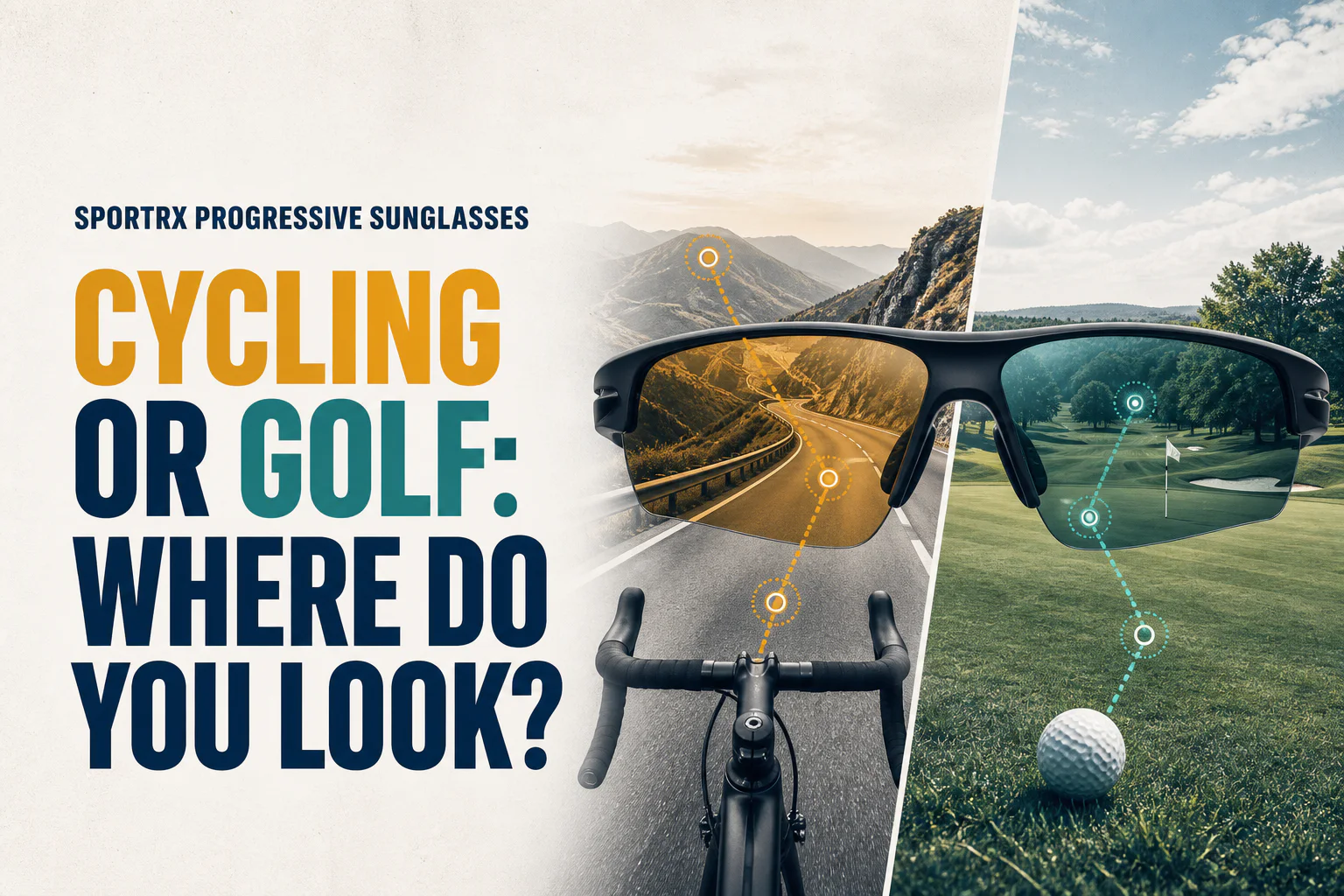
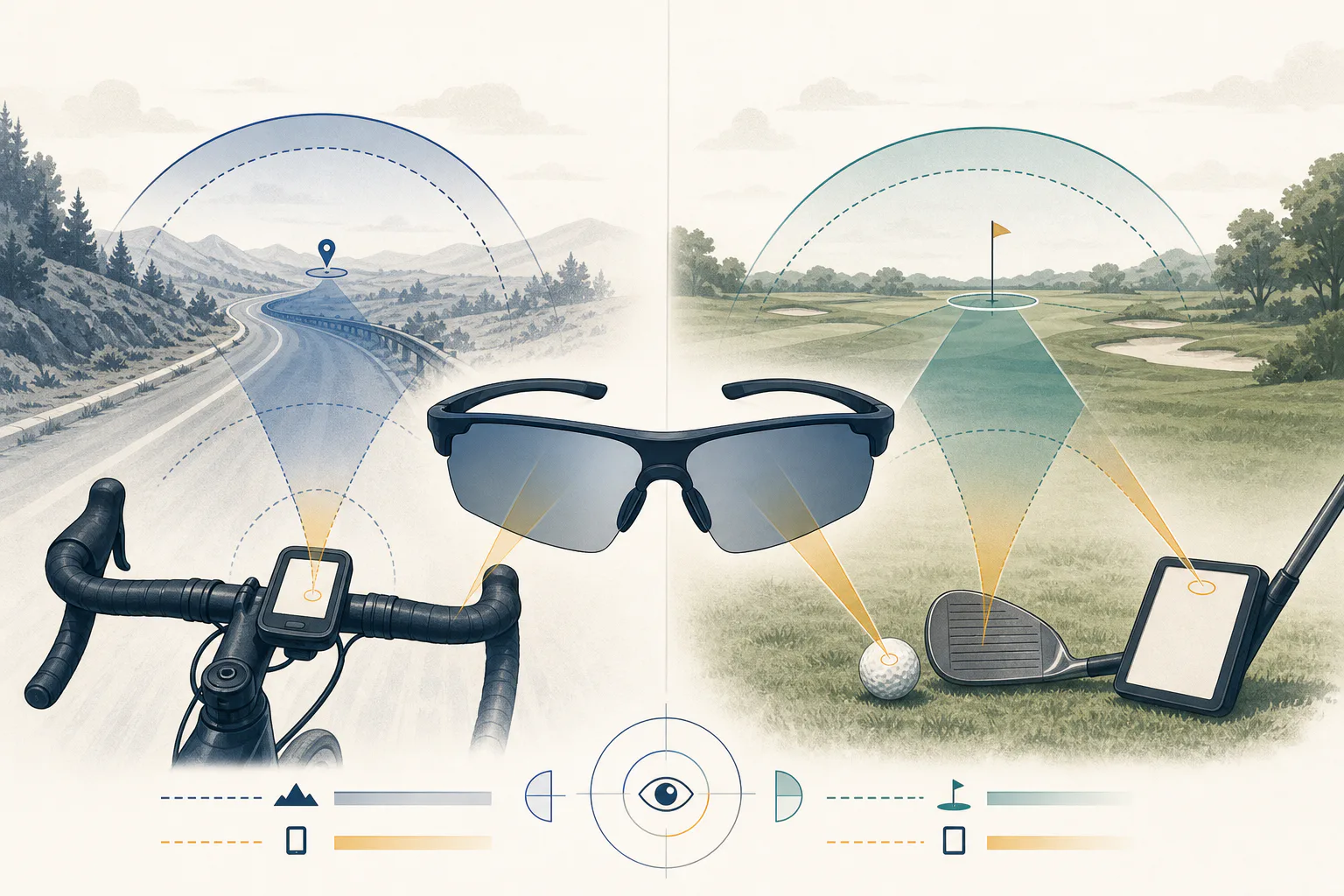
A cyclist glances down at a computer and returns to the road. A golfer looks down at a ball while the eyes may move through the lower or side of the lens during the swing. The same progressive layout can help one gaze pattern and complicate another.
Short answer
SportRx progressives may be useful for an experienced cyclist who needs a close bike computer or map, provided forward and peripheral vision remain usable in riding posture. Golf is different: looking down and sideways at the ball can cross the near or peripheral portions of a progressive, so distance single vision may be the cleaner sport-specific choice for some golfers. Decide from actual gaze and fit, not sport labels alone.
How this sport-lens comparison was evaluated
I reviewed SportRx’s official cycling, golf, wrap, Test Run, and guarantee guidance, then compared the distance, near, downward, and side-gaze demands of each activity. This is an independent task-and-fit analysis, not a hands-on activity test or a universal safety ranking.
Main findings
SportRx identifies a cycling use case for progressives when the wearer needs to see a handlebar computer, map, or close repair task. Its cycling guide otherwise describes single vision as the simpler option when close focus is not essential (SportRx cycling guide).
For golf, SportRx says the lower reading area and peripheral distortion can affect the down/side gaze used to address the ball. It does not generally recommend progressives for golf, while acknowledging that established progressive wearers may prefer to keep a familiar design (SportRx golf progressives). These are retailer recommendations, not universal performance findings.
Cycling-versus-golf gaze matrix
| Visual moment | Cycling | Golf | Progressive question |
|---|---|---|---|
| Primary distance gaze | Road/trail ahead | Target/fairway ahead | Is straight-ahead distance clear in actual posture? |
| Repeated near gaze | Bike computer, GPS, phone while stopped | Scorecard, phone | Is near access essential or occasional? |
| Repeated down gaze | Short glance toward bars/computer | Sustained view of ball/ground | Does the eye enter the near zone at the wrong task distance? |
| Side/peripheral gaze | Traffic, trail edge, group riders | Ball/club alignment and swing movement | Does progressive side blur interfere with the task? |
| Head/equipment interaction | Helmet, vents, sweat, riding angle | Cap/visor, stance, repeated head motion | Does the frame remain fixed? |
| Fallback | Stop and use reader/phone enlargement | Reader for scorecard; distance-only sport pair | Is switching acceptable? |
Decision table
| Scenario | Option to investigate first | Why |
|---|---|---|
| Experienced progressive cyclist; computer is essential | Activity-fitted progressive | Multiple distances may justify the zone tradeoff. |
| Cyclist rarely needs near vision | Distance single vision | Consistent correction across the lens may better match the dominant task. |
| Golfer already plays comfortably in progressives | Replicate known setup only after fit review | Familiarity may outweigh a redesign. |
| Golfer loses ball clarity when looking down/sideways | Distance single vision or another optician-directed design | Removes the progressive near corridor from the sport pair. |
| First-time progressive wearer | Adapt in daily low-risk settings before sport-specific use | Do not make an event the first evaluation environment. |
No option is called universally safer. The question is which design produces the most usable, predictable view for the individual activity and prescription.
High-wrap and fit questions
SportRx says it uses digital wrap compensation to account for curved sport frames (wrap compensation). Ask:
- Is the prescription compatible with the selected wrap, lens size, and material?
- Will the design be direct-in-frame or use an insert?
- How are monocular PD and segment/fitting height obtained?
- Is height measured in normal cycling posture or golf stance?
- Does helmet, cap, bridge fit, or sweat move the frame?
- Can the wearer test the non-prescription frame through SportRx Test Run before committing?
SportRx’s Test Run allows up to three frames for a limited home fit trial and offers a PD-photo flow (SportRx Test Run). A frame trial tests fit, not the finished progressive optics. PD also does not replace vertical fitting height.
Progressive-order essentials
Use a current prescription and ADD, accurate monocular PD where available, appropriate lens/frame height, activity-relevant fitting height, stable fit, correct task distances, compatible wrap design, and a clear return/remake plan.
Pros and limitations
Progressives: access to multiple distances and familiar correction for established wearers; however, gaze must find the intended zone and peripheral blur remains a design tradeoff.
Distance single vision: consistent power across the sport lens; however, close computers, scorecards, or phones may need a separate strategy.
Best for / not ideal for
Best progressive candidate: experienced wearer with a necessary near target, compatible stable frame, and verified activity-posture measurements.
Not ideal: first-time wearer, unstable high-wrap fit, golfer whose ball view crosses an unusable zone, or cyclist who does not need close access.
For road-use questions, read the guide to progressive lenses for driving. For service and fit context, see the SportRx prescription replacement-lenses review and the guide to progressive corridor length and fitting height.
Return and remake considerations
SportRx’s See Better Guarantee currently provides 45 days to start a remake, exchange, or refund and states a prescription-change remake window of 60 days, with conditions (SportRx guarantee). Test static gaze and fit in a controlled setting before full-speed use and contact the retailer promptly if a zone or frame position fails.
Do not cycle at speed, drive, or play near hazards when distance, side, or downward vision is not clear and predictable. Persistent blur, headaches, double vision, pain, flashes, new floaters, or sudden vision changes should be assessed by an appropriate eye-care professional; urgent or sudden symptoms may require prompt care.
Alternatives
- Distance single-vision sport sunglasses plus readers used while stopped.
- Low-set bifocal or another design recommended by the prescriber/optician.
- Flatter frame or prescription insert if direct high-wrap lenses are unsuitable.
Primary sources
- SportRx sport progressives
- SportRx cycling guide
- SportRx golf progressives
- SportRx wrap compensation
- SportRx Test Run
- SportRx See Better Guarantee
Sources and further reading

About Ho Truong
Ho Truong is a trained optician at a family optical practice established in 1991. Lens InsiderS explains lens design and fitting choices for buyers. It does not diagnose eye conditions or replace an eye examination.