A short progressive corridor can rescue a shallow frame. It can also compress the same ADD power into less vertical space. A long corridor gives that change more room, but only if the frame and pupil position leave enough usable lens below the fitting cross.
Quick answer
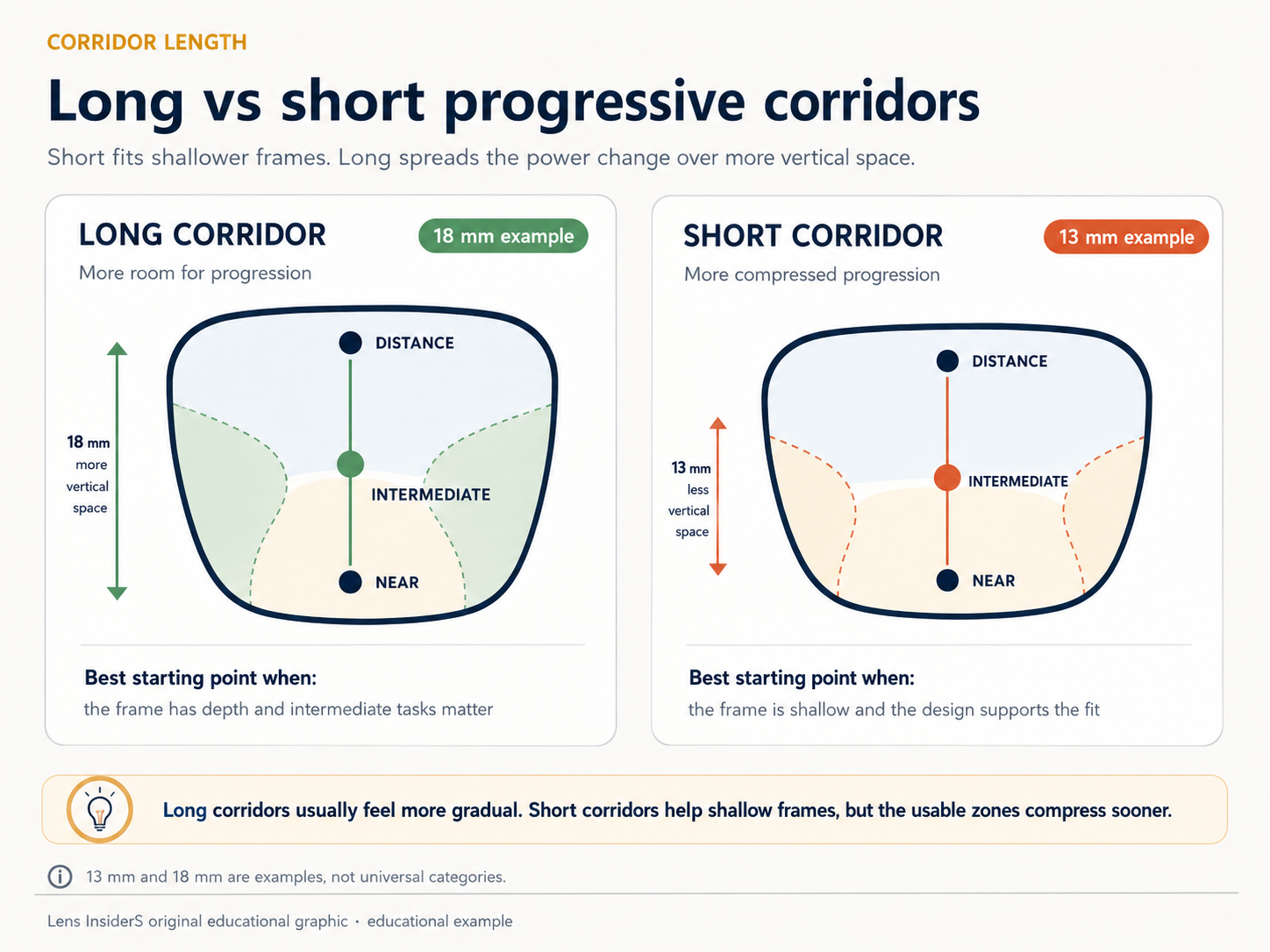
Choose a longer corridor when the fitted frame has enough depth and you want a less compressed progression, especially when intermediate vision matters. Choose a short corridor when the actual fitting height is limited and the exact lens design supports that geometry. Short does not mean more advanced. Long does not mean universally better.
Corridor length and fitting height are not the same measurement
The two values are related, which is why they are often confused. They describe different parts of the order.
| Term | What it describes | Why it matters |
|---|---|---|
| Fitting cross | The design reference aligned with the pupil in the adjusted frame | Sets the vertical and horizontal placement of the progressive |
| Fitting height | The measured position from the fitting reference to the usable lower frame area, following the lab’s method | Shows how much lens space is available on this wearer |
| Corridor length | The design distance over which power progresses toward the full near addition | Affects where intermediate and near power develop |
| Minimum fitting height | The least vertical space specified for a design or corridor option | Helps prevent the near area from being cut off |
A frame catalog may list a 34 mm lens height. That is not your fitting height. Your pupil may sit high, central, or low in that opening. The bridge, nose pads, frame tilt, wrap, and temple adjustment decide the final position.
What “long” and “short” mean in real products
There is no single industry boundary that makes every 13 mm corridor short and every 18 mm corridor long. Product systems use their own reference points and choices.
Current examples show the range:
- HOYA lists fixed 11 mm, 13 mm, 15 mm, and 17 mm corridor options for Array 2, plus a variable option. Other HOYA designs publish different numbers of corridor choices and minimum fitting heights.
- The ZEISS SmartLife fact sheet lists 14 mm short, 16 mm medium, and 18 mm long minimum fitting-height options for selected products, while several higher-tier designs use a variable 13 mm minimum.
- ZEISS Progressive Individual 2 publishes a variable corridor suitable for fitting heights from 13 mm to 35 mm.
These figures are not directly interchangeable. HOYA notes that, for its designs, corridor length is measured from the fitting height to the point where 100% of the ADD is reached. Always use the exact manufacturer’s fitting guide for the ordered product.
What changes when the corridor is shortened?
The lens still needs to reach the prescribed near addition. If +2.00 D must develop across 13 mm instead of 18 mm, the average power change per millimeter is steeper. The final surface is more complex than a simple division, but the geometric pressure is real.
A shorter corridor can change three parts of the experience:
- Intermediate access: the usable computer or dashboard path may feel more compressed.
- Eye position: smaller gaze changes move the eye through more power.
- Peripheral gradients: unwanted astigmatism may be distributed more aggressively around the corridor.
That does not make a short corridor defective. Modern short designs can work very well when selected deliberately. The risk comes from choosing a shallow frame first and asking the optics to solve every consequence later.
What changes when the corridor is lengthened?
A longer corridor gives the design more vertical room to distribute the power change. Many wearers find the transition easier to locate during intermediate tasks. A longer corridor can also support a less compressed relationship between distance, computer, and near gaze.
The near zone sits lower. A wearer with limited downward eye movement, a low pupil position, or a frame that does not provide enough depth may struggle to reach it. More length is useful only when the finished frame preserves the whole design.
Who is more likely to suit a long corridor?
A longer corridor is often a strong starting point when:
- the frame provides generous usable depth below each pupil;
- intermediate vision for screens, dashboards, shelves, or conversation is important;
- the wearer has a higher ADD and wants to avoid unnecessary compression;
- a previous successful progressive used a similar corridor and frame position;
- the wearer can lower the eyes comfortably to reach the near area.
Long is not ideal if the near zone will be cut off or placed below a comfortable gaze. Check the actual fitting height before choosing the design.
Who is more likely to suit a short corridor?
A short corridor is often appropriate when:
- the preferred frame is shallow but still meets the exact minimum fitting height;
- the wearer values compact frame styling and accepts a more compressed progression;
- the chosen product has a short option optimized for the prescription and frame;
- the fitting cross is high enough to preserve the near area without sacrificing necessary distance space.
First-time progressive wearers, people with stronger ADD powers, and heavy computer users deserve a careful explanation before being placed into the shortest available option. They may still succeed. The tradeoff should be intentional.
ADD power changes the corridor decision
A +1.00 D ADD requires less total power change than a +2.50 D ADD. With the stronger ADD, the designer must manage more change across the same physical area. Peripheral blur, corridor width, and zone location can become more noticeable.
This is why “my friend wears the same small frame” is not enough. Two wearers can have different ADD powers, prescriptions, pupil positions, and gaze habits.
Soft and hard design are separate choices
A short lens may use a softer or harder distribution of unwanted astigmatism. A long lens can do the same. Corridor length tells you how power develops vertically. Soft and hard describe how optical error is distributed around the useful zones.
Our soft vs hard progressive design guide shows how to read those contour maps without confusing them with material or corridor labels.
Why low-bridge frame fit can change the effective corridor
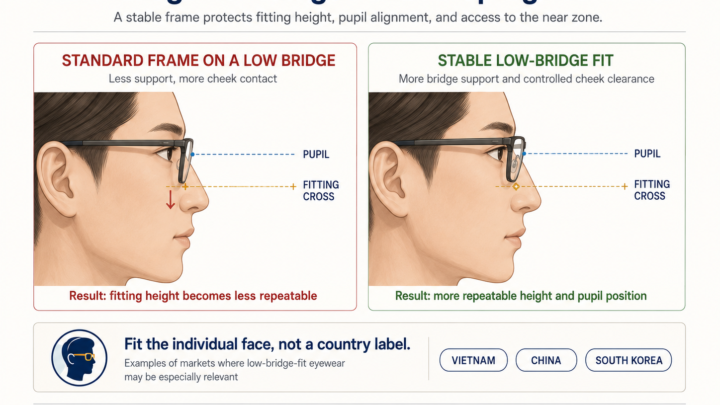
If a frame slides 4 mm after the fitting height is recorded, the pupil no longer sits at the intended cross. The wearer may enter intermediate power while looking straight ahead and lose easy access to the near area at the bottom.
This is especially relevant for anyone whose frame needs low-bridge support, larger nose pads, or better cheek clearance. The issue is not ethnicity. It is repeatable geometry. Read our guide to progressive lenses and low-bridge frame fit.
The correct fitting sequence
- Choose a frame that is eligible for the prescription and lens design.
- Adjust the bridge, nose pads, temple angle, level, tilt, and vertex position.
- Confirm the frame remains stable during normal head movement.
- Measure monocular distance PD for each eye.
- Measure the right and left fitting heights using the exact lab protocol.
- Record position-of-wear values if the selected design uses them.
- Select a fixed or variable corridor that fits the measured geometry.
- After glazing, verify the design markings, prescription, height, and final adjustment.
Reversing steps two and five is a common source of trouble. Measurements taken on an unadjusted frame describe a position the wearer may never use.
Symptoms that can point to corridor or vertical placement
| What the wearer notices | What should be checked |
|---|---|
| Distance clears when the frame is pushed down | Fitting may be high, but verify prescription and frame tilt too |
| Near clears only when the frame is lifted | Near area may sit too low or the frame may be sliding |
| Computer vision requires a chin-up posture | Intermediate zone may be too low, narrow, or mismatched to monitor distance |
| Reading appears quickly but the computer range feels missing | Progression may be compressed or the task may need an office lens |
| Right and left eyes reach near at different gaze positions | Check monocular heights, PD, frame level, and prescription |
These are troubleshooting clues, not a self-diagnosis. A dispenser should verify the frame and finished lenses before recommending a remake.
Long corridor, short corridor, or office lens?
An everyday progressive must preserve distance vision. It divides the lens among road, room, intermediate, and near tasks. An office lens gives up true driving distance to make the desk and room zones wider.
If a dual-monitor setup is the main problem, changing from a 13 mm to an 18 mm everyday corridor may help, but it may not create enough horizontal computer width. Compare the task with an office lens before ordering a second general-purpose pair.
Questions to ask before buying
- What is the exact product and corridor option?
- How does this manufacturer define corridor length?
- What is the minimum fitting height for my chosen option?
- What are my measured right and left fitting heights in this adjusted frame?
- Does the design use vertex distance, pantoscopic tilt, or face-form angle?
- Why is this corridor being recommended for my ADD and main task?
- Will the remake policy cover a corridor or frame change if the fit fails?
Frequently asked questions
Is an 18 mm corridor always better than a 13 mm corridor?
No. An 18 mm design needs enough frame depth and comfortable downward gaze. A 13 mm design can be the correct choice for a shallow frame when it is fitted and optimized properly.
Does a short corridor give a wider reading area?
Not automatically. Near width depends on the complete design, ADD, prescription, inset, and fitting. Short describes vertical progression, not guaranteed horizontal width.
Can the corridor be changed after the lenses are made?
No. A different corridor requires a remake using a different design or fitting configuration.
Should a first-time wearer avoid short corridors?
Not as a rule. A first-time wearer should avoid an unexplained compromise. If the frame requires the shortest option, ask how the product protects intermediate and near utility and what follow-up is available.
Sources and further reading
- HOYA: Current progressive products, minimum heights, and corridor options
- HOYA: How corridor length is selected and defined
- ZEISS SmartLife progressive fact sheet
- ZEISS Progressive Individual 2 fitting and dispensing guide
- Sheedy et al.: Progressive powered lenses and unwanted astigmatism
Professional note: Product-specific corridor and fitting rules take priority over generic numbers. Persistent central blur, unsafe walking or driving, double vision, pain, or sudden vision change needs professional assessment.

About Ho Truong
Ho Truong is a trained optician at a family optical practice established in 1991. Lens InsiderS explains lens design and fitting choices for buyers. It does not diagnose eye conditions or replace an eye examination.