Varilux and ZEISS are not single lens designs—they are progressive-lens portfolios with multiple tiers, customization levels, and task priorities. A useful comparison starts with the exact product, measurements, and wearer needs rather than the brand name printed on an invoice.
Quick answer
Neither Varilux nor ZEISS is universally better. Both offer established progressive portfolios, including more personalized designs. The result depends on the exact model, prescription, frame, fitting data, and how the lens priorities match your work. Compare a written product name, included measurements, material/coatings, remake policy, and total price—not “Varilux vs ZEISS” as two undifferentiated labels.
First, correct the comparison
Varilux is a progressive-lens brand associated with Essilor, while ZEISS is an optical manufacturer with its own progressive portfolio. “Varilux vs ZEISS vs Essilor” double-counts one side of the comparison. A fair quote might compare one specified Varilux design with one specified ZEISS design at a similar customization level.
What to put side by side
| Quote detail | Why it matters |
|---|---|
| Exact lens model and generation | Each portfolio contains designs with different zone priorities |
| Design tier | Entry, optimized, and individualized products should not be compared as equals |
| Measurements used | Monocular PD and fitting height are basic; personalized designs may use vertex distance, tilt, wrap, frame shape, or behavioral inputs |
| Material and index | Thickness, weight, optical properties, impact needs, and availability change |
| Coatings and photochromic options | They can account for a meaningful part of the total quote |
| Remake/adaptation policy | A technically good lens still needs a path to correction if fitting or adaptation fails |
What “personalized” should mean
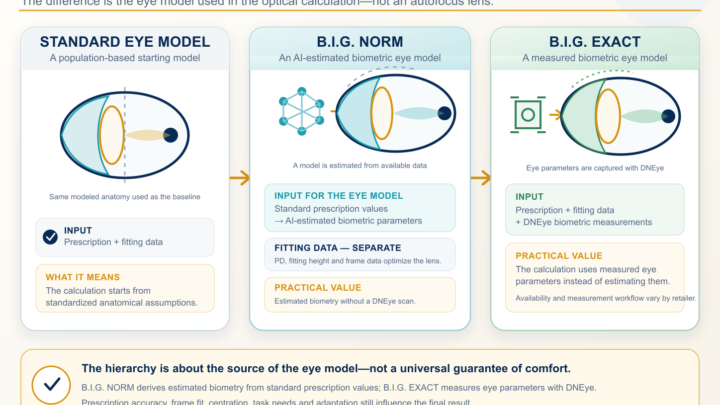
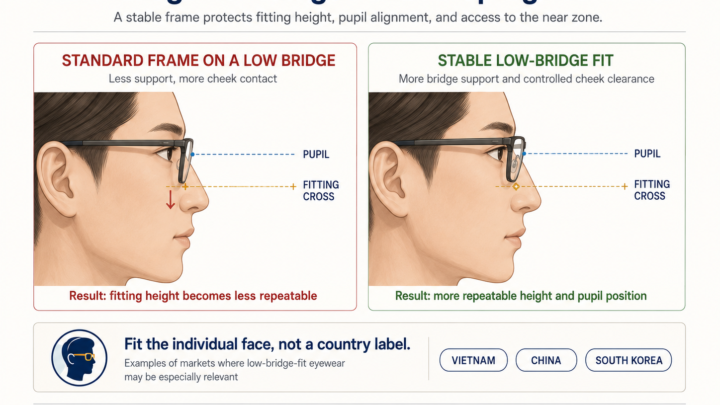
A personalized progressive may be calculated using more than the distance prescription and ADD. Depending on the product, the design can incorporate how the selected frame sits: vertex distance, pantoscopic tilt, face-form angle, fitting height, frame shape, and sometimes task or visual-behavior information.
Ask the dispenser which values are actually measured and entered. A premium design ordered with default or estimated parameters may not deliver the same benefit as one fitted with accurate position-of-wear data. Conversely, a correctly fitted mid-tier design can outperform an expensive lens placed incorrectly.
Zone width claims need context
Manufacturers publish claims about wider distance, intermediate, or near areas. These are usually comparisons within a defined product family and test method. Do not transfer a percentage from one prescription and fitting condition to every wearer. More width in one zone may reflect a deliberate redistribution of unwanted astigmatism rather than blur disappearing entirely.
Start with task priorities:
- Driving: stable, wide distance and useful dashboard range.
- Computer work: wider intermediate may matter more than maximum reading width.
- Fine near tasks: near-zone accessibility and working distance are critical.
- First-time wear: a smoother transition and accurate fit may be more important than the most aggressive zone width.
Can you compare by price?
Only after normalizing the quote. One price may include a premium anti-reflective coating, thinner material, photochromic treatment, frame, warranty, measurements, and follow-up adjustments; the other may be lens-only. Ask for an itemized quote and compare the same prescription, material, treatment, and service level.
Our guide to why progressive prices vary so much explains the full cost stack.
How to run a fair in-store comparison
- Describe your real working distances and previous problems.
- Choose the frame before final measurements.
- Request the exact model name in writing.
- Confirm all right/left measurements and position-of-wear inputs.
- Compare included coatings and material.
- Ask who verifies the finished lenses and adjusts the frame.
- Read the non-adaptation/remake window.
Red flags
- The quote says only “premium progressive” with no model.
- The seller claims one brand has no peripheral blur.
- Measurements are taken before the frame is fitted.
- Brand marketing replaces a discussion of your main tasks.
- The return or remake terms are unclear.
Frequently asked questions
Is Varilux made by Essilor?
Yes. Varilux is an Essilor progressive-lens brand. Ask for the exact Varilux model because the portfolio contains multiple designs.
Will changing brands fix non-adaptation?
Sometimes a different design distribution helps, but first verify prescription, measurements, frame position, markings, and task needs. A brand switch without diagnosing the cause may repeat the problem.
Are premium progressives worth it?
They can be when the added customization matches a demanding prescription, frame, or visual task and the measurements are collected accurately. The label alone is not evidence of value.
Sources and further reading
- ZEISS progressive lens portfolio
- ZEISS: Individualized freeform lenses
- Peer-reviewed study: Optical performance of progressive addition lenses
Editorial note: Lens InsiderS has no paid relationship with either manufacturer in this comparison. Product portfolios and names can change; confirm current specifications with the dispensing practice.

About Ho Truong
Ho Truong is a trained optician at a family optical practice established in 1991. Lens InsiderS explains lens design and fitting choices for buyers. It does not diagnose eye conditions or replace an eye examination.