New progressives can feel unfamiliar, but “just adapt” is not a complete answer. Use this structured check to separate a learnable viewing pattern from a prescription, measurement, frame, or manufacturing problem.
Quick answer
Mild swimming, narrower side vision, or needing to point your nose toward the target can be normal during early progressive-lens adaptation. Persistent central blur, one eye consistently worse, a reading zone that cannot be found, double vision, headaches that escalate, or a problem that remains unchanged deserves a fitting and prescription check.
Do not wait out a return or remake window. Contact the seller promptly, keep the frame in its fitted position, and document exactly which distance and lens area fails.
First: map the blur
A useful complaint is specific. Instead of “everything is blurry,” test one task at a time with both eyes open, then each eye separately only long enough to describe the pattern.
| Where blur occurs | Possible area to check | Useful description |
|---|---|---|
| Straight ahead at distance | Prescription, optical center, frame position | Road sign or television remains soft through the upper center |
| Computer only | Intermediate power, corridor position, screen distance | Clear only when chin is raised or lowered |
| Reading only | ADD power, fitting height, near inset, reading distance | Text clears only at an unusually high/low point |
| One side or one eye | Monocular PD, prescription, lens orientation | Right eye is consistently less clear at the same target |
| Peripheral “swim” | Expected progressive optics, design, frame shape | Center is clear; sides distort during eye-only movement |
| Double vision | Prescription, prism, binocular vision, health | Two images rather than general softness |
12 checks before accepting a remake
1. Confirm the glasses match the order
Compare the written prescription, order confirmation, lens type, ADD, prism, material, and coatings. A transcription error can happen before manufacturing begins.
2. Clean both lens surfaces
Coating residue, fingerprints, and a film from packaging can imitate optical haze. Use the recommended cleaning method and inspect under even light.
3. Put the frame in its fitted position
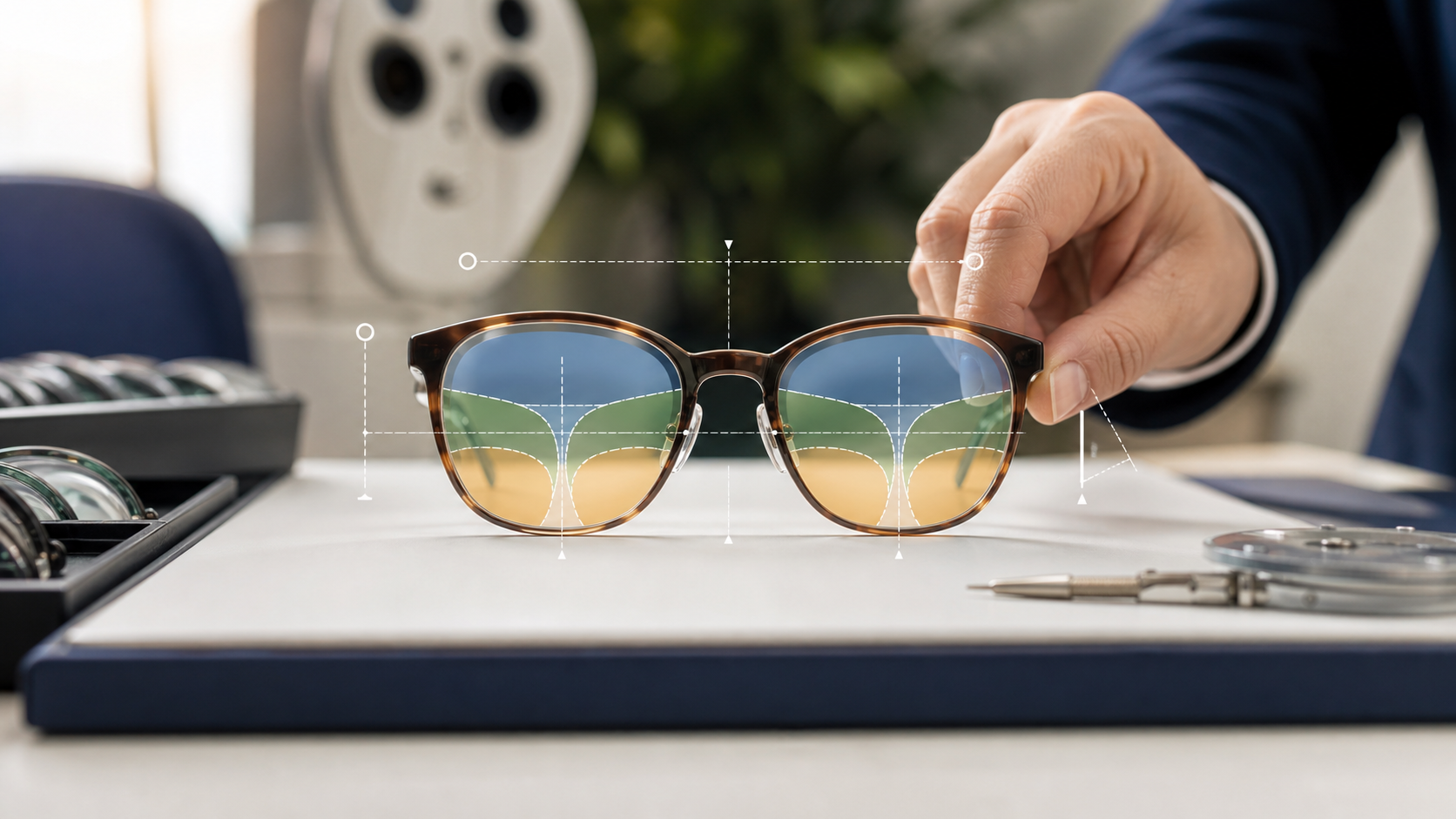
Progressive zones move with the frame. If the glasses slide down, sit crooked, or stand too far from the eyes, the pupils no longer meet the intended zones. Have the frame adjusted before judging the lens design.
4. Check straight-ahead distance vision
Look at a stable distance target through the upper central portion. Do not tilt the chin to hunt for clarity. If the central distance view is persistently blurred, record whether one or both eyes are affected.
5. Test the screen at its real distance
Move only enough to identify the clear zone. If the screen becomes clear only with an uncomfortable chin position, fitting height, frame position, screen height, or the chosen design may need review. See our dual-monitor glasses guide.
6. Test near vision at the intended reading distance
Hold text at your normal distance, not as close as possible. Move the eyes down and turn the head toward the line. Note whether the near area exists but is narrow, or cannot be found at all.
7. Compare one eye at a time
A brief comparison can reveal a large difference between eyes. Do not diagnose the cause yourself; report the observation to the prescriber or dispenser.
8. Check monocular PD and fitting height
A total PD alone does not show facial asymmetry. Progressive fitting commonly needs the horizontal position of each pupil and a vertical height in the selected frame. Ask what measurements were used and how they were obtained.
9. Check frame tilt, wrap, and vertex distance
The angle of the frame, its curvature, and distance from the eye affect how the wearer looks through the lenses. A substantial difference from the intended position can change the experience, especially in stronger prescriptions or personalized designs.
10. Confirm the design suits the frame
A shallow frame may require a shorter corridor. A very large frame can expose more peripheral blur. The laboratory and dispenser should confirm that the design, minimum fitting height, and frame dimensions are compatible.
11. Review changes from the previous pair
Ask how much sphere, cylinder, axis, ADD, prism, material, base curve, and frame position changed. Multiple changes at once can make adaptation harder and can also help identify the source of trouble.
12. Know the remedy deadline
Read the seller’s remake, exchange, and refund terms immediately. Ask for a written case number and instructions. Continue a reasonable adaptation trial only if symptoms are tolerable and the deadline is protected.
What normal adaptation may feel like
- the clear side-to-side field feels narrower than single vision;
- stairs or floors appear different when viewed through the lower lens;
- you need to turn your head more toward side targets;
- near vision is easiest when the nose points toward the text;
- the new frame position feels unfamiliar.
These sensations should trend in the right direction. The exact timeline varies with prescription, previous design, task, and wearing pattern. Adaptation is not a reason to ignore an obvious measurement or prescription error.
Red flags for a prompt professional check
- central distance vision is not acceptably clear;
- one eye is consistently much worse;
- you cannot locate the near or intermediate zone;
- the frame is visibly crooked or the pupils sit at unequal positions;
- double vision, severe headache, nausea, or imbalance is significant;
- the problem does not improve or gets worse;
- the symptoms occur without the new glasses as well.
Urgent safety note: Seek urgent medical evaluation for sudden vision loss, new persistent double vision, severe eye pain, flashes with a sudden increase in floaters, a curtain-like shadow, or visual symptoms with weakness, confusion, speech difficulty, or a severe unusual headache.
What to bring to the recheck
- the new glasses and previous comfortable pair;
- the written prescription and order confirmation;
- your screen and reading distances;
- notes describing blur by distance, eye, and lens area;
- photos of how the frame sits naturally;
- the retailer’s remake or return deadline.
Ask the dispenser to verify the finished lens powers, prism, fitting marks, monocular PD, fitting heights, frame alignment, and position of wear. A remake should correct a defined cause, not repeat the same specifications blindly.
Adaptation or fitting error?
| Pattern | More consistent with learning the design | More reason to recheck |
|---|---|---|
| Peripheral blur | Center clear; improves with head movement | Blur invades the central target |
| Reading | Clear zone found with a natural downward gaze | Must push frame or hold text unusually close/far |
| Computer | Clear at intended distance after setup change | Requires sustained chin lifting or lowering |
| Time course | Daily trend toward easier use | No improvement or worsening |
| Eyes | Similar experience in both eyes | Large persistent one-eye difference |
Frequently asked questions
How long should I try new progressives?
There is no universal number. A short, consistent wearing trial can help when central vision is clear and symptoms are mild. Contact the dispenser early so a trial does not consume the remedy period.
Should I switch between old and new glasses?
Frequent switching can make learning a new design harder, but safety and function come first. Follow the prescriber’s advice, and do not drive or perform hazardous work in glasses that do not provide reliable vision.
Can the frame adjustment really fix blur?
Yes. Raising, leveling, or changing the frame’s position can realign the progressive zones. Adjustment cannot correct an incorrect prescription or manufactured lens, so both fit and optics may need checking.
What if the online retailer only has my total PD?
Ask whether separate right and left PD and vertical fitting height were used. Review our guide to measuring PD for online progressives and the pre-order checklist.
Bottom line
Give adaptation a fair chance only after confirming the frame sits correctly and the central zones perform as intended. Map the blur, protect the remedy deadline, and request a measured verification. The most useful remake is one based on a documented prescription, measurement, fit, or design change.

About Ho Truong
Ho Truong is a trained optician at a family optical practice established in 1991. Lens InsiderS explains lens design and fitting choices for buyers. It does not diagnose eye conditions or replace an eye examination.