Buying progressive glasses online can save money and expand frame choice, but it transfers more measurement and fit decisions to the buyer. This checklist helps you decide whether your order is low enough risk—and records the details needed if something goes wrong.
Quick answer
Order progressives online only after confirming a current eyeglass prescription, right/left ADD, monocular PD, the seller’s vertical-fitting method, frame eligibility, total configured price, and progressive-specific remake terms. Choose in-person dispensing for prism, a strong or highly asymmetric prescription, previous non-adaptation, or a frame that requires precise position-of-wear measurements.
Step 1: confirm the prescription
- Use an eyeglass prescription, not a contact-lens prescription.
- Check exam date and expiration.
- Match OD/right and OS/left sphere, cylinder, axis, prism, and ADD exactly.
- Ask the prescriber to clarify any missing or ambiguous field.
In the United States, the FTC requires prescribers to provide a copy of the eyeglass prescription after a refraction. PD is needed for ordering glasses but is not required on prescriptions in most states.
Step 2: assess your order risk
| Lower-risk signals | Higher-risk signals |
|---|---|
| Moderate, balanced prescription | High sphere/cylinder, prism, or large right/left difference |
| Experienced progressive wearer | First pair after a difficult prior fitting |
| Stable medium-depth frame | Shallow, oversized, rimless, or strongly wrapped frame |
| Professional monocular PD and fitting data | One self-measured binocular PD and estimated height |
| Clear remake/non-adapt policy | Final sale or vague progressive exclusions |
Step 3: choose a frame that can hold the design
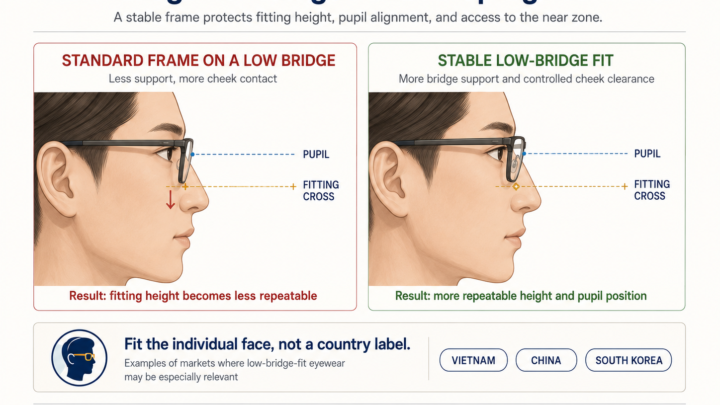
Record lens width, bridge, temple length, total frame width, and vertical lens height. Compare with a frame that already fits. Virtual try-on helps with appearance but cannot confirm bridge stability, pupil height, or corridor space.
Use our progressive frame guide and ask the seller to confirm the exact frame is eligible for your prescription and selected lens tier.
Step 4: collect fitting measurements
- Prefer monocular distance PD.
- Ask how vertical fitting height is determined in the chosen frame.
- Confirm whether separate right/left heights are supported.
- For personalized designs, ask whether vertex distance, pantoscopic tilt, and wrap are measured or defaulted.
Read the complete PD guide and corridor/fitting-height explanation.
Step 5: compare the final configuration—not “starting at”
Add the frame, progressive upgrade, prescription surcharge, material/index, anti-reflective coating, photochromic/tint, shipping, and taxes. Then compare the exact configured price with a local quote that includes fitting and adjustments.
A low headline price can change after the required progressive and material options. Save screenshots of the cart before payment.
Step 6: read policies before ordering
- How many days do you have to report a problem?
- Is the progressive lens remade, refunded, or exchanged for another design?
- Does the policy cover non-adaptation?
- Who pays return shipping?
- Are prescription or coating upgrades excluded?
- Can a local adjustment affect eligibility?
- What evidence—photos, prescription, measurements—is required?
Step 7: create an order record
Keep one folder containing:
- Prescription image.
- Entered OD/OS values.
- PD and fitting data.
- Frame model, size, and color.
- Exact progressive tier, material, and coatings.
- Cart price and policy screenshots with date.
- Order confirmation and support conversations.
Step 8: inspect the delivered glasses
Before driving or committing to long wear:
- Check frame color/model and physical damage.
- Confirm the frame sits level, does not slide, and has even temple contact.
- Check straight-ahead distance with each eye and both eyes.
- Locate intermediate and near zones at your real working distances.
- Have an optical professional verify prescription and alignment when possible.
Step 9: distinguish adaptation from a remake issue
Some peripheral blur and a learning period are expected. Constant straight-ahead blur, one-eye-only clarity, severe dizziness, or vision that improves only when you move the frame should be reported promptly. Do not wait beyond the return window hoping a centering or prescription problem will disappear.
Use our adaptation-versus-fitting checklist.
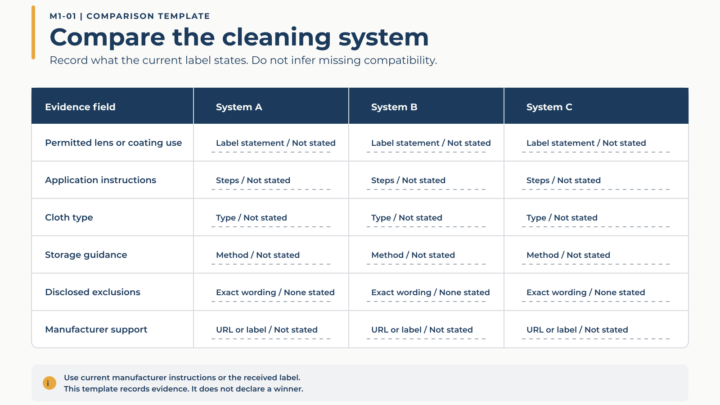
Retailer comparison worksheet
| Field | Retailer A | Retailer B |
|---|---|---|
| Exact progressive model/tier | ||
| Vertical fitting method | ||
| Configured total price | ||
| Non-adapt/remake window | ||
| Return shipping/fees | ||
| Local adjustment available |
Our current GlassesUSA progressive ordering analysis shows how to apply this framework to one retailer. It is an editorial analysis, not proof that one seller fits every prescription.
Frequently asked questions
Is it safe to buy progressives online?
It can be reasonable for suitable prescriptions and well-documented measurements. “Safe” also depends on eye-health examination, accurate manufacture, frame fit, and not driving until vision is comfortable.
Should I buy the widest or premium tier?
Ask what changes technically and which measurements are used. A premium label does not correct bad fitting data.
Can a local optician adjust online glasses?
Many will adjust frames for a fee or as a courtesy, but policies vary. Ask before ordering and understand that some alterations can affect the retailer’s return terms.
Sources and further reading
Affiliate note: This checklist contains no paid links. If affiliate links are added later, Lens InsiderS will disclose them and preserve the same measurement, policy, and evidence standards.

About Ho Truong
Ho Truong is a trained optician at a family optical practice established in 1991. Lens InsiderS explains lens design and fitting choices for buyers. It does not diagnose eye conditions or replace an eye examination.