Quick answer
GlassesUSA is a reasonable online option for an experienced progressive wearer with a current prescription, actual monocular PD, a stable frame, and verified return terms. First-time wearers, complex prescriptions, high ADD, prism, or past adaptation failures may benefit from an in-person fitting.
Independent GlassesUSA progressive lenses review: Standard vs Office, measurement risks, frame fit, pricing, return policy, and fit for most online buyers.
Review scope: This is an independent editorial assessment of GlassesUSA’s published lens options, ordering guidance, catalog, and policies as checked on July 26, 2026. Lens InsiderS did not purchase a pair for hands-on testing, so this article does not rate optical performance from personal wear.
That distinction matters. A progressive lens is not a finished product that performs the same for every buyer. It is a power design placed into a particular frame and aligned to a particular wearer. A retailer can offer a capable design and still deliver a poor experience if the measurements, frame position, prescription, or task choice are wrong.
This review therefore asks a more useful question than “Is GlassesUSA good?” It asks: Who is a reasonable candidate for ordering GlassesUSA progressives online, what information should be confirmed before checkout, and when is an in-person fitting the safer choice?
Quick verdict
GlassesUSA is a reasonable option for an experienced progressive wearer who has a current prescription with an ADD value, accurate right- and left-eye pupillary distance measurements, a stable frame choice, and a clear understanding of whether an everyday or office lens is needed.
The main strengths are a large eligible-frame catalog, both standard and office progressive options, digital lens production, online prescription submission, and a stated return remedy. The main limitations are that the final progressive price depends on choices made during customization, the public information does not make every fitting input transparent, and GlassesUSA’s own pages currently show conflicting return periods.
For a first progressive, a high ADD, prism, a large prescription difference between the eyes, persistent adaptation problems, or a frame that needs frequent adjustment, an in-person optician can provide measurement and troubleshooting advantages that an online flow may not replace.
What GlassesUSA currently offers
GlassesUSA’s dedicated progressive lens page describes two main multifocal choices:
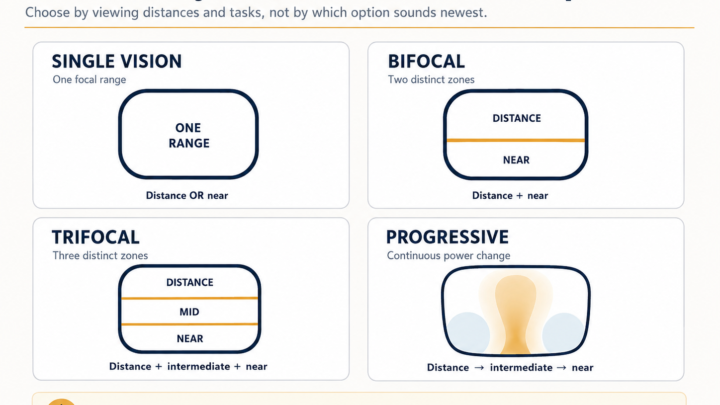
- Standard progressives: intended to combine far, intermediate, and near vision for everyday use, including driving.
- Office progressives: intended for intermediate and near tasks, with published working range up to about five feet. GlassesUSA states that office lenses are not suitable for driving.
The company’s multifocal help page says its progressive lenses are digitally surfaced. Its lens marketing also describes standard and premium packages with different coating and transition claims. However, labels such as “premium,” “smooth transition,” and “easy accommodation” do not tell a buyer the corridor length, usable-zone width, or exact personalization inputs.
Ask what changes between packages in practical terms. A higher price may reflect thinner material, coatings, a different progressive design, or some combination of those. Lens index and coating should not be treated as proof that the progressive geometry is better suited to your eyes.
What appeared at the top of the GlassesUSA catalog
When checked on July 26, 2026, GlassesUSA’s progressive pages displayed a large and changing catalog. The first “Most Relevant” results included house-brand frames such as Muse Eloquence, Amelia E. Nettle, Muse Elliot, Muse Campbell, Revel Tactics, and Muse Jojo, alongside Ottoto models and premium Ray-Ban and Oakley frames.
Displayed frame prices in the first results ranged from roughly the high-$60s to more than $200. Those are not reliable total progressive prices. The prescription type, lens package, index, coatings, tint, and current discount can change the final amount during customization.
Lens InsiderS does not rank those frames from the listing alone. A frame becomes a better progressive candidate when it:
- fits the bridge without sliding;
- keeps both pupils comfortably inside the lens shape;
- has enough vertical depth for the chosen design;
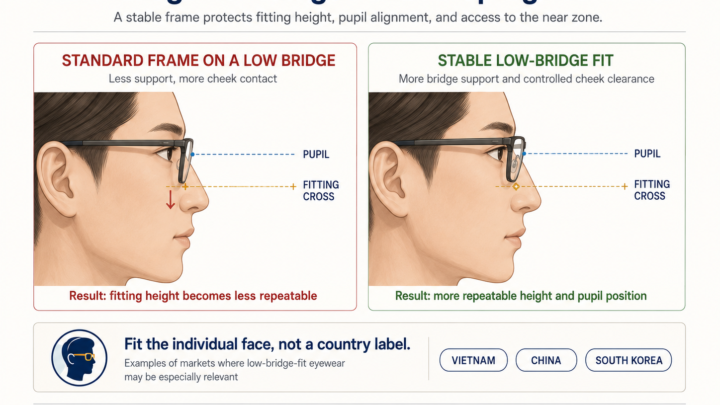
- can be adjusted to a repeatable position; and
- matches the wearer’s real distance, computer, and reading priorities.
GlassesUSA’s own frame eligibility guidance says frames with a lens height of 30 mm or less are not eligible for progressives. That filter is useful, but more height does not guarantee a good fit. The pupil position within the frame and the adjusted wearing position still matter.
The biggest issue is measurement—not the brand name
A progressive order needs horizontal and vertical alignment. The prescription supplies optical power, but it does not tell a laboratory exactly where the wearer’s pupils sit inside the selected frame after adjustment.
GlassesUSA correctly explains that pupillary distance should be accurate and that two PD measurements may matter for multifocal orders. However, another GlassesUSA help article says an order without a supplied PD may be produced using an adult average of 62 mm.
Lens InsiderS does not recommend relying on an average PD for a progressive order. Two people can have the same total PD but different right- and left-eye measurements. Using actual monocular PD values gives the laboratory better information about where each eye sits relative to its lens.
Before checkout, ask GlassesUSA support:
- Can I enter separate right- and left-eye distance PD values?
- How is the vertical fitting position determined for this frame and order?
- Which progressive design and corridor are included in each package?
- Can the order be remade if the distance, intermediate, or near zone is vertically misplaced?
- What measurements should be rechecked before requesting a remake?
If you only have a total PD, ask an eye-care professional or optician for the individual measurements. A phone tool or ruler can be a useful cross-check, but a difficult prescription deserves more than one self-measurement.
Standard progressive or office progressive?
| Question | Standard progressive | Office progressive |
|---|---|---|
| Distance vision | Designed to include far vision | Limited indoor range; not for driving |
| Computer use | Uses a narrower intermediate corridor | Usually prioritizes a wider intermediate and near area |
| Best use | Driving, walking, meetings, screens, and reading in one pair | Desk work, reading, crafts, and defined indoor tasks |
| Main compromise | Screen zone may feel narrow during long computer sessions | Cannot replace an everyday distance pair |
If your priority is eight hours at a fixed workstation, do not automatically buy the most expensive everyday progressive. A task-specific office lens may solve the real problem more directly. See our guide to progressive lenses for computer work for monitor-distance and posture checks.
If this is your first multifocal, begin with our plain-English guide to how progressive lenses work before comparing packages.
Pricing: compare the finished order, not the frame price
GlassesUSA publishes many frame prices before lens customization. Its general lens page says a standard single-vision package starts from $29 before discounts, but that does not establish the cost of a finished progressive order.
For a meaningful comparison, record the same specification at each retailer:
- exact frame model and size;
- standard or office progressive;
- lens material and index;
- anti-reflective and scratch-resistant coatings;
- photochromic, tint, or sunglass options;
- shipping and tax;
- discount code restrictions; and
- return or remake coverage for prescription lenses.
A large coupon applied to the frame may produce a smaller saving than expected once a progressive package is added. Take a screenshot or save the itemized checkout price before paying, especially when comparing a promotion with another retailer.
Return policy: verify the rule attached to your order
This is the clearest reason not to rely on a marketing banner alone. At the time of review:
- the dedicated progressive page stated a 30-day free return period for progressive lenses;
- the GlassesUSA Help Center stated a 45-day risk-free policy for eyeglasses;
- other GlassesUSA page footers displayed a 60-day return or exchange message; and
- the current terms and conditions described a 45-day eyeglass return period, with additional limits and conditions.
Because those statements conflict, confirm the period that applies to your specific progressive order before payment. Save the order confirmation and policy shown at checkout. Also confirm whether the remedy is a refund, equal-value exchange, store credit, or remake, and whether free return shipping applies outside the continental United States.
A return window is valuable, but it is not a substitute for good measurements. Reordering with the same wrong inputs can reproduce the same problem.
Who is most likely to have a good online-ordering experience?
GlassesUSA may be a practical option when most of the following are true:
- you already wear progressives successfully;
- your prescription is current and stable;
- your prescription includes ADD and any prism information;
- you have accurate monocular PD measurements;
- you understand how your current frame fits and can compare dimensions;
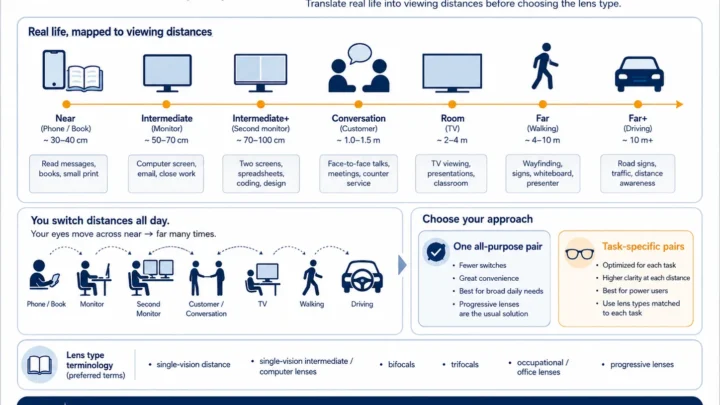
- your work and reading distances are known;
- you are willing to have the frame adjusted locally after delivery; and
- you have verified the return or remake terms.
An experienced wearer can also compare a successful old pair with the new order. Keep the old frame measurements, lens type, prescription, and any information about the progressive design. “Same prescription” does not guarantee the same visual experience if the frame, corridor, or fitting position changes.
When an in-person fitting is the safer choice
Consider in-person help if this is your first progressive or if you have:
- a high ADD or rapidly changing prescription;
- prism or a complex binocular-vision requirement;
- a large difference between the two eyes;
- previous progressive adaptation failures;
- a very narrow, highly wrapped, or difficult-to-adjust frame;
- unusual occupational distances or safety requirements; or
- symptoms that may require an eye examination rather than a lens remake.
An online retailer can manufacture prescription eyewear, but it cannot diagnose eye disease or determine why vision has changed. Obtain a current eye examination when due, and seek professional care promptly for sudden blur, double vision, flashes, new floaters, eye pain, or a sudden field-of-vision change.
A safer GlassesUSA ordering checklist
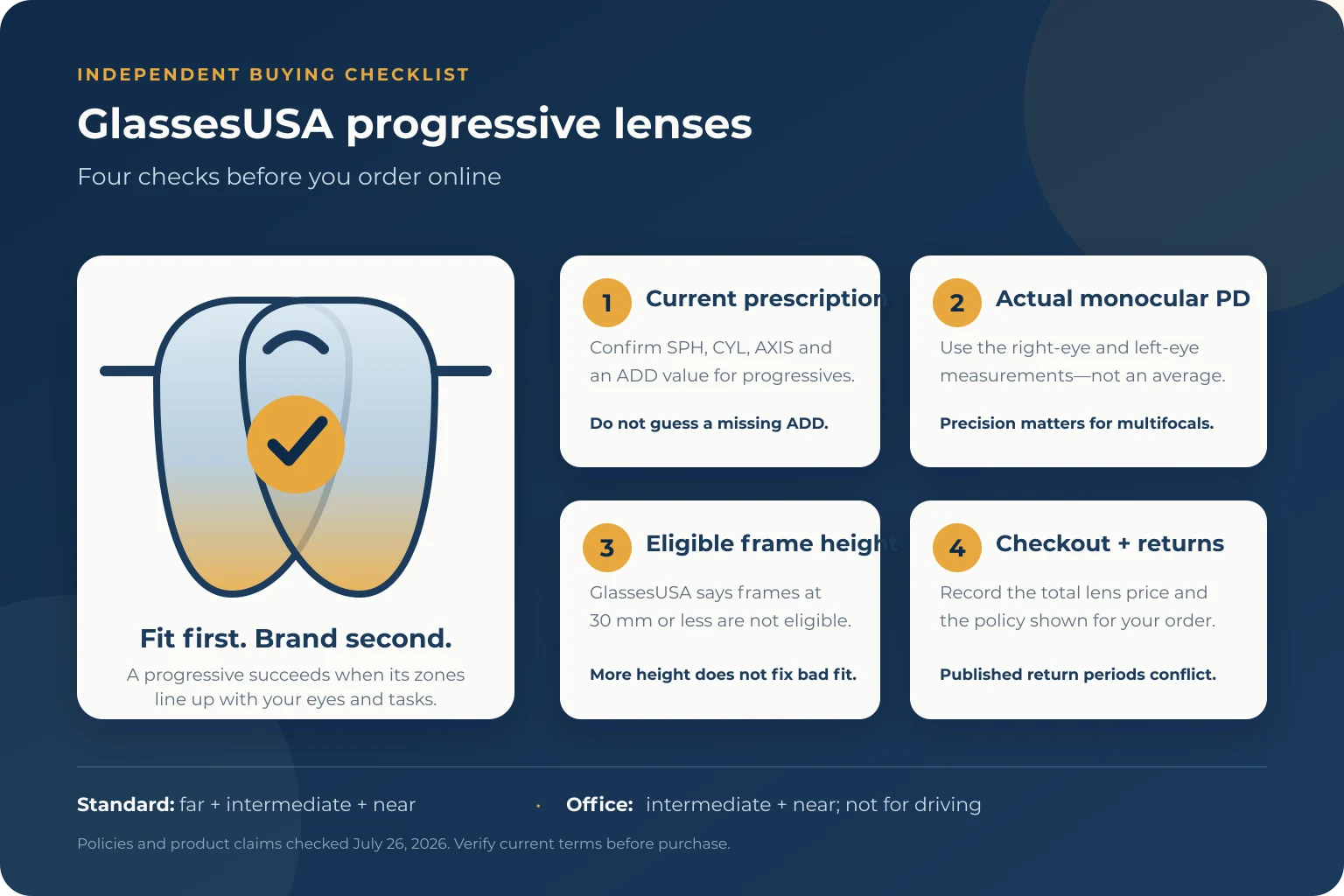
- Start with a current prescription. Confirm SPH, CYL, AXIS, ADD, and prism if present. Do not guess a missing ADD.
- Use actual monocular PD. Enter separate right- and left-eye values when the order flow allows it. Do not accept an adult average as a fitting measurement.
- Choose the task before the package. Standard is for far through near; office is for intermediate and near and should not be used for driving.
- Choose a stable frame. Confirm lens height is eligible, then consider bridge fit, pupil position, frame depth, and adjustability.
- Ask what the upgrade changes. Separate lens design, material/index, and coating benefits.
- Capture the checkout details. Save the total price, expected production time, return window, remake terms, and shipping conditions.
- Test by zone after delivery. Check straight-ahead distance, your normal monitor distance, and your normal reading distance with the frame sitting level.
- Describe problems specifically. Report whether distance, intermediate, or near is blurred and whether moving the frame up, down, left, or right changes clarity.
Frequently asked questions
Are GlassesUSA progressive lenses digitally surfaced?
GlassesUSA states that all progressive lenses it produces are digitally surfaced. That describes how the lens surface is produced; it does not by itself tell you the design geometry, corridor length, usable-zone width, or personalization inputs.
Does GlassesUSA offer office progressive lenses?
Yes. GlassesUSA describes office lenses for near and intermediate tasks up to about five feet. They are not intended for distance driving.
Can every GlassesUSA frame use progressive lenses?
No. GlassesUSA says frames with a lens height of 30 mm or less are not eligible. Eligible height is only the first screen; fit and pupil position still affect the result.
What if my prescription does not include PD?
GlassesUSA offers self-measurement guidance and says it may use an adult average when PD is missing. Lens InsiderS recommends obtaining actual right- and left-eye distance PD measurements for a progressive order rather than relying on an average.
How long is the GlassesUSA return period?
The company’s public pages showed 30-, 45-, and 60-day statements when checked. Its Help Center and terms described 45 days for eyeglasses, while its dedicated progressive page stated 30 days. Verify and save the policy attached to your order.
The bottom line
GlassesUSA combines broad frame choice with standard and office progressive options, making it a credible retailer to compare. The decision should not be based on catalog size, a premium label, or a discount percentage alone.
The safest buyer is the one who brings accurate measurements, chooses the lens around real tasks, understands the final specification, and preserves a clear remedy if the result is not usable. If those inputs are uncertain, pay for measurement and fitting help before paying for a more expensive lens package.
View GlassesUSA progressive options
Sources and further reading

About Ho Truong
Ho Truong is a trained optician at a family optical practice established in 1991. Lens InsiderS explains lens design and fitting choices for buyers. It does not diagnose eye conditions or replace an eye examination.