Quick answer
Progressive lenses combine distance, intermediate, and near correction without a visible bifocal line. Their success depends on the prescription, lens design, frame fit, accurate monocular measurements, and follow-up—not the brand name alone.
Learn how progressive lenses work, which fitting measurements matter most, what adaptation can feel like and what to ask before buying a first pair.
Progressive lenses place distance, intermediate, and near correction in one lens without a visible bifocal line. The result depends on more than the brand: the prescription, frame, fitting measurements, design choice, and final adjustment all affect how the usable zones line up with your eyes.
What progressive lenses are
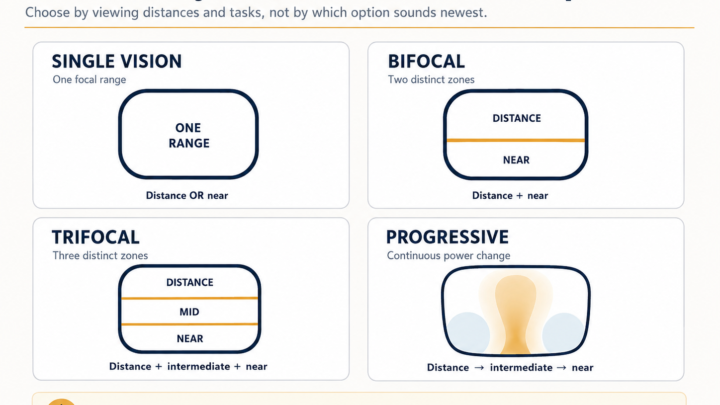
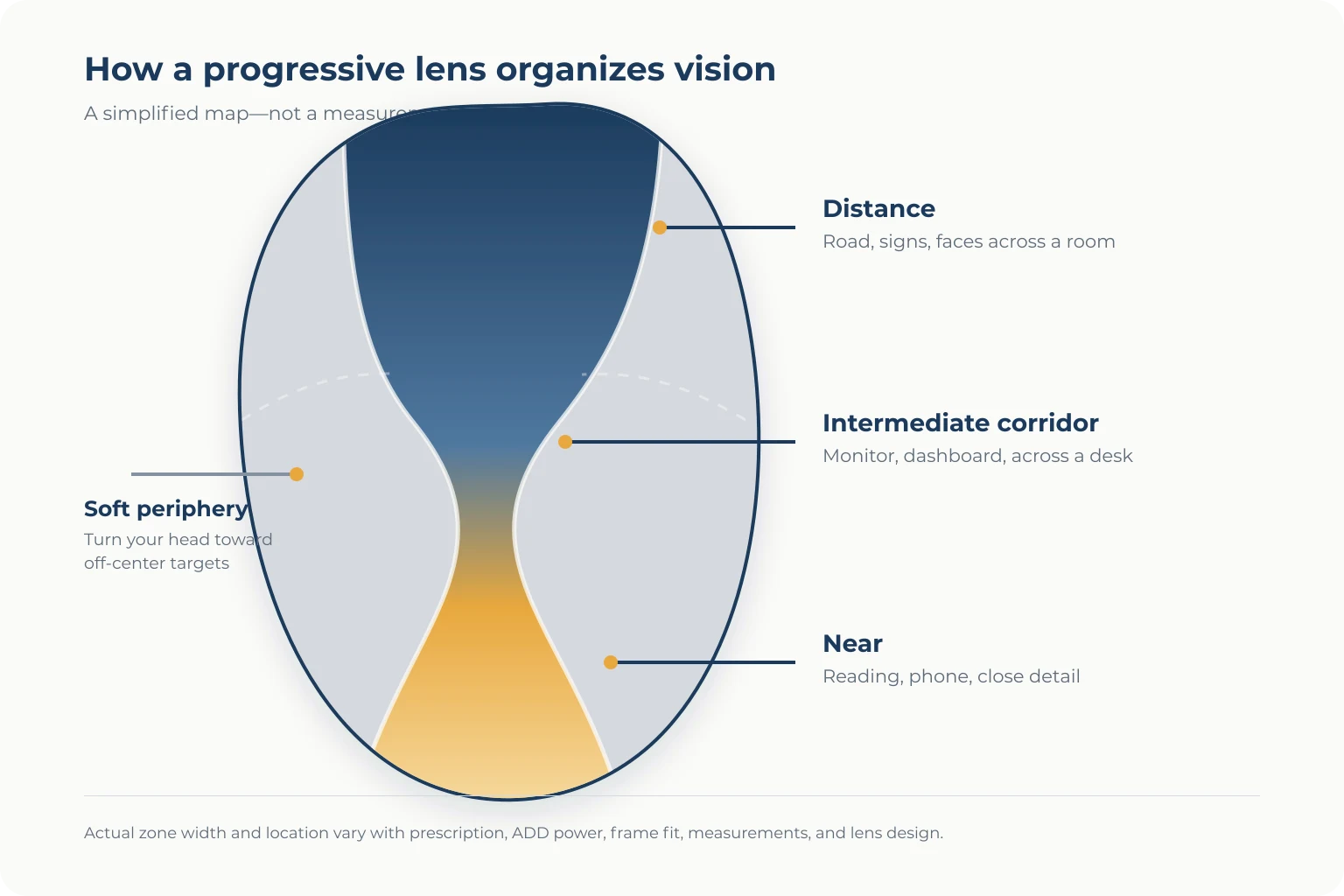
Progressive addition lenses—often called progressives, PALs, multifocals, or varifocals—change power gradually across the lens. The upper area is generally used for distance, the middle corridor supports intermediate tasks such as a dashboard or computer, and the lower area supports reading and other close work.
Unlike a lined bifocal, there is no abrupt visible boundary between distance and near power. The tradeoff is that the gradual power change creates areas away from the main corridor that are less useful for clear vision. Lens designers manage this unwanted blur and distortion differently, but no progressive design can make every part of the lens equally clear at every distance.
Why people need them
Many adults begin to notice near blur as the eye’s natural lens becomes less flexible with age. This normal age-related change is called presbyopia. Common signs include holding a phone or menu farther away, needing more light, eye strain, or difficulty changing focus between far and near.
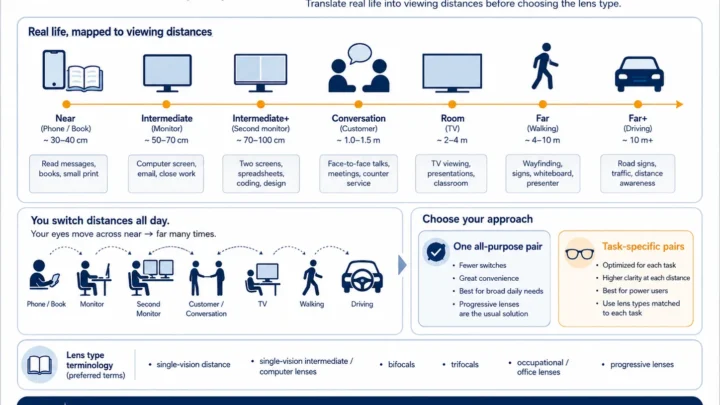
Progressive lenses are one way to combine a distance prescription and near support in the same pair. Other options can include separate reading glasses, lined bifocals, task-specific computer glasses, or contact-lens strategies. The most suitable option depends on your prescription, eye health, daily activities, and tolerance for visual tradeoffs.
How the three viewing zones work
Distance zone
The upper portion is normally used for driving, television, signs, and faces across a room. You look through this area with a natural straight-ahead gaze.
Intermediate corridor
As your gaze moves lower, the power increases through a corridor used for arm’s-length and room-distance tasks. This zone matters for computers, dashboards, shelves, cooking, and conversations across a desk. It is often the zone people notice most when they work at a screen all day.
Near zone
The lower portion provides the prescribed near addition for reading, phones, labels, and detailed handwork. The useful width and location depend on the lens design, ADD power, fitting height, frame, and working distance.
What “ADD” means on your prescription
ADD is additional plus power used for near vision. It is combined with the distance prescription to produce the near portion of a multifocal lens. A larger ADD does not mean a better lens; it reflects the near support prescribed after an eye examination.
As ADD power increases, fitting and design choices may become more noticeable because the change in power must be managed within the available lens area. That is one reason a person’s previous lens design, frame size, reading distance, and screen habits should be discussed before ordering.
Need help reading the numbers? See our plain-English guide to what ADD means on an eye prescription.
The measurements that affect the result
A progressive order needs more than the numbers printed on a prescription. The lens must also be positioned correctly in front of each eye.

- Monocular pupillary distance: the horizontal position of each pupil relative to the frame.
- Fitting height: the vertical position used to align the progressive design in each lens.
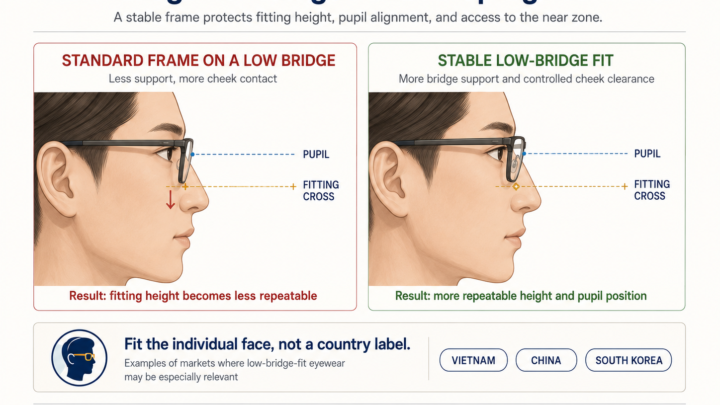
- Frame fit: how the bridge, temples, and frame front hold the lenses in a repeatable position.
- Frame dimensions: enough usable depth is needed for the selected corridor and near zone.
- Position-of-wear measurements: some customized designs also use frame tilt, wrap, and the distance from the lens to the eye.
If the frame is adjusted after measurements—or slides to a different position during wear—the eyes may no longer pass through the intended parts of the lens. A premium design cannot compensate for measurements taken on an unstable frame.
Standard, premium, and personalized designs
Retail labels are not standardized. One seller’s “premium” lens may not match another seller’s option with the same label. Ask for the exact design name and what input data the laboratory uses.
In general, price differences may reflect:
- how the lens distributes blur away from the main viewing zones;
- how much the design can be optimized for your prescription and frame;
- whether position-of-wear measurements are used;
- lens material, thickness, photochromic features, or polarization;
- coating durability and ease of cleaning;
- the retailer’s fitting support, warranty, and remake policy.
The best value is the least expensive option that meets your actual viewing needs with reliable fitting and follow-up. Someone with moderate use and a forgiving prescription may do well with a simpler design. Someone with long screen hours, a stronger prescription, a higher ADD, a challenging frame, or a history of adaptation difficulty may benefit more from customization.
What adaptation can feel like
At first, you may be more aware of where each viewing zone is located. Side areas can feel soft, and you may need to point your nose more directly toward an object instead of looking far through the side of the lens. Stairs and curbs can feel different when seen through the near portion.
Use new progressives in familiar, safe settings first. Keep the frame properly adjusted and avoid repeatedly switching between an old and new pair unless your eye-care professional recommends it. For reading, lower your eyes into the near zone. For a computer, raise or reposition the screen so your posture remains comfortable while you use the intermediate zone.
For a practical symptom checklist, read what is normal during progressive-lens adaptation and what may signal a fitting problem.
Adaptation is not a reason to ignore every problem. Return for a check if:
- distance vision is not clear when looking straight ahead;
- one eye feels consistently worse than the other;
- the clear channel seems extremely narrow;
- you must tilt or turn your head into an uncomfortable position;
- the frame slides, sits crooked, or leaves one lens higher than the other;
- walking or driving feels unsafe;
- symptoms are severe, worsening, or not settling with use.
How to troubleshoot a problem
Do not begin by assuming you “cannot wear progressives.” A useful recheck separates several possible causes:
- Frame adjustment: Is the frame level, stable, and sitting at the intended height?
- Lens verification: Do the finished lenses match the ordered powers, design, and markings?
- Measurement verification: Are the monocular positions and fitting heights correct on your face?
- Prescription review: Is the blur caused by the prescription rather than the progressive layout?
- Design match: Does the selected corridor and zone balance suit the frame and your most important tasks?
Bring the actual device, book distance, or task details that cause trouble. “The computer is blurry at about 70 centimetres” is much more actionable than “the glasses feel wrong.”
Progressives versus office lenses
General-purpose progressives include true distance vision and are designed for moving through a range of everyday distances. Office or occupational lenses usually give more lens area to near and intermediate work by limiting the farthest clear distance.
An office lens may be more comfortable for prolonged desk work, but it is not normally a substitute for distance glasses and may not be appropriate for driving. Some people use one general-purpose progressive and a second task-specific pair at the desk. See the full guide to progressive lenses for computer work before choosing between them.
A practical buying checklist
- Start with a current eye examination and prescription.
- Explain your main viewing distances and the tasks that matter most.
- Choose and adjust the frame before final measurements.
- Ask for separate right and left pupillary measurements and fitting heights.
- Request the exact lens design, material, coating, and corridor recommendation in writing.
- Compare the remake and non-adapt policy before comparing small price differences.
- At collection, confirm distance, screen, and reading vision while the frame is correctly adjusted.
- Know who will perform the recheck if something is not working.
Questions people ask
Are progressive lenses the same as bifocals?
Both provide more than one focusing power, but a traditional bifocal has a visible line and a distinct near segment. A progressive changes power gradually and includes an intermediate corridor.
Do expensive progressive lenses always work better?
No. More expensive designs may offer additional customization or different zone balance, but accurate prescription, frame fit, measurements, and follow-up remain essential. Pay for a feature only when the seller can explain how it supports your needs.
Can I order progressive lenses using only my prescription?
A prescription provides lens powers, but a progressive order also needs frame-dependent fitting measurements. The frame should fit securely before those measurements are taken.
Why is my computer blurry in progressive lenses?
The intermediate corridor may not match your monitor distance, height, or amount of screen use. Frame position, fitting height, prescription, and design choice should be checked before assuming you need a more expensive lens.
When should I return for a recheck?
Return when straight-ahead distance or normal reading vision is not clear, one eye is consistently worse, the frame will not stay positioned, or the glasses make walking or driving feel unsafe. Sudden vision changes, pain, flashes, new floaters, or loss of vision require prompt professional eye care.
If you are considering an online retailer, our independent GlassesUSA progressive lenses review shows how to evaluate measurement inputs, frame eligibility, total price, and return terms before ordering.
The bottom line
Progressive lenses are a system: prescription, design, frame, measurements, manufacturing, adjustment, and wearer habits all work together. Start with your daily viewing needs, insist on clear fitting information, and choose a seller with a specific follow-up process. That approach usually protects your purchase better than choosing by logo or price alone.
Next, save the questions to ask before ordering or return to the Start Here guide map.
This article is general educational information and is not medical advice. It does not replace a comprehensive eye examination or an individual recommendation from a qualified eye-care professional.
For a deeper look at why the side areas differ between products, read our soft vs hard progressive design and lens-map guide.
Sources and further reading

About Ho Truong
Ho Truong is a trained optician at a family optical practice established in 1991. Lens InsiderS explains lens design and fitting choices for buyers. It does not diagnose eye conditions or replace an eye examination.