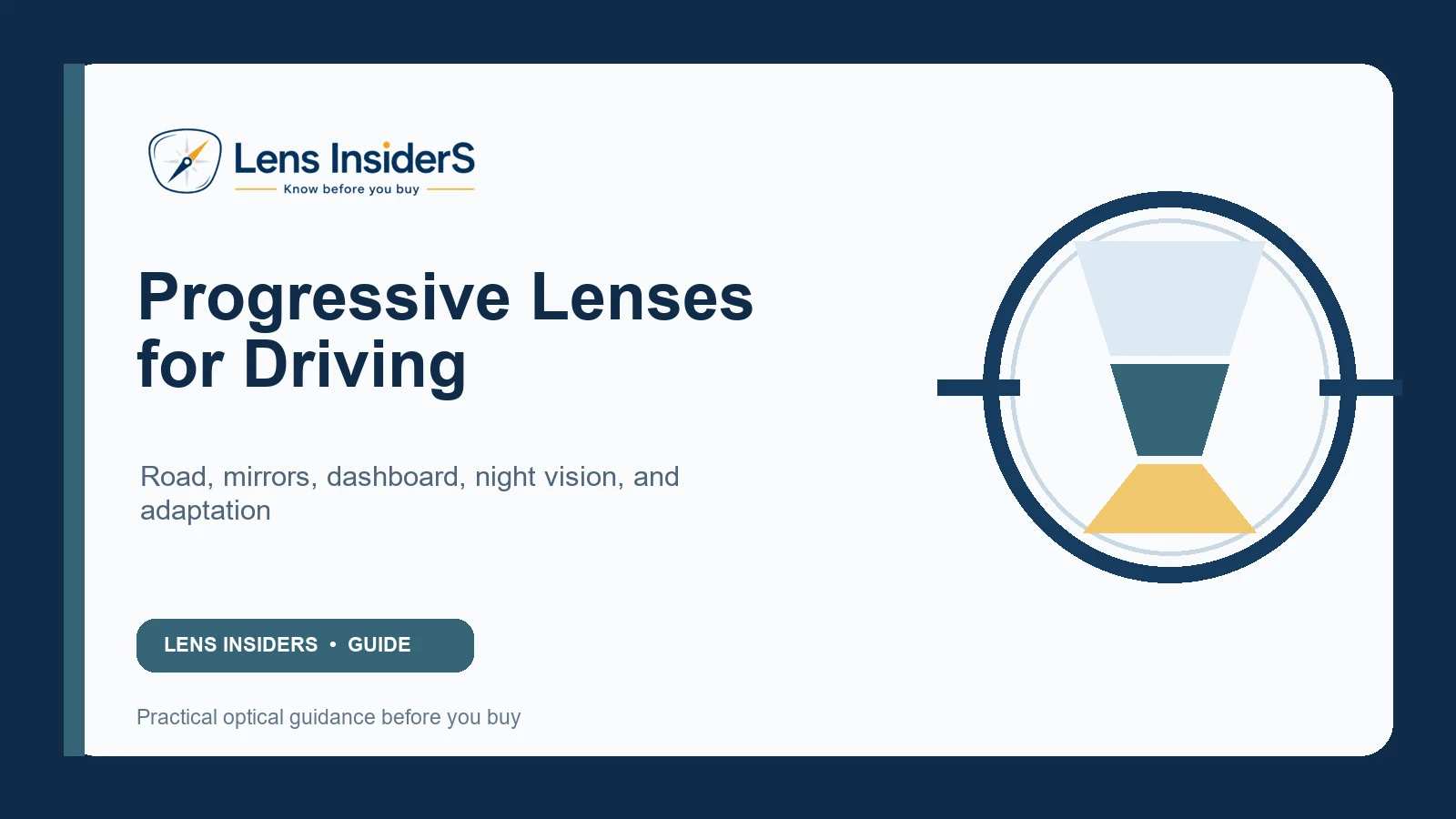
Progressive lenses can work well for driving because they combine road, mirror, dashboard, and navigation distances. The same multi-zone design also creates peripheral blur and a learning curve, so correct fitting and realistic expectations matter.
Quick answer
Properly prescribed and fitted progressive lenses can be suitable for driving. Use the upper distance zone for the road, turn your head toward side targets instead of looking through the blurred lens edge, and use the intermediate/near areas briefly for the dashboard. Do not drive in a new pair until distance vision is clear, the frame is stable, and you can scan mirrors and instruments comfortably in a safe setting.
What a driver needs from the lens
| Driving task | Typical lens area | Practical technique |
|---|---|---|
| Road and traffic | Upper distance zone | Keep head level and look through the central upper area |
| Side mirrors | Distance zone, sometimes toward its edge | Turn the head so the mirror enters the clearer zone |
| Dashboard | Intermediate zone | Use a brief downward eye movement |
| Phone/navigation mounted nearby | Intermediate or near, depending on distance | Place it where a brief glance aligns with a clear zone; never operate it while driving |
Why the sides can look distorted
Progressive power changes down the lens. The optical geometry produces unwanted astigmatism and blur toward the lower side areas. That is why scenery may seem to “swim” when a new wearer moves the head. The solution is not to eliminate all side blur—that is unrealistic—but to make sure the central zones are correctly positioned and to learn to point the nose toward important side targets.
A pilot clinical study found significantly reduced acuity when subjects viewed through a temporal peripheral area compared with the central lens area. This supports the practical habit of turning the head rather than relying on far peripheral gaze through a progressive.
Night driving: lens design is only one factor
Night vision is affected by prescription accuracy, cataract or other ocular conditions, pupil size, contrast sensitivity, dirty windshields, scratched lenses, glare, and frame fit. Anti-reflective treatment can reduce lens-surface reflections, but it does not correct an outdated prescription or eye disease.
A small closed-road study comparing presbyopia corrections found that progressive spectacle lenses performed well for distance-driving tasks among the tested options, while single-vision distance lenses created more errors when drivers viewed near dashboard targets. The study was small, so it should not be treated as proof that one design is best for every driver.
When not to drive in new progressives
- Distance vision is blurry straight ahead.
- You experience significant dizziness, double vision, or nausea.
- The frame slides or sits crooked.
- Mirror checks require an unsafe head position.
- You are still learning the zones and have not tested them while stationary.
- Your eye-care professional advised against driving because of acuity, field, or eye-health findings.
A safe adaptation sequence
- Wear the glasses indoors and confirm clear straight-ahead distance vision.
- Practice turning your head toward side objects.
- While parked, locate dashboard, mirrors, and navigation display through the correct zones.
- Begin in daylight on a familiar, low-demand route only when comfortable.
- Delay night, rain, highway, and unfamiliar driving until scanning feels natural.
Driving-specific progressives versus general-purpose designs
Some manufacturers offer designs that prioritize a wide distance area and intermediate viewing for dashboard and mirrors, sometimes reducing emphasis on the near zone. A task-prioritized design can help, but brand claims should be evaluated alongside the wearer’s prescription, fitting measurements, and actual vehicle setup.
If your day also involves long computer sessions, one pair may not optimize both driving and desk work. Compare a general-purpose progressive with a second office lens.
Frame and coating checklist for drivers
- Choose a stable frame with a useful distance-zone width and adequate vertical depth.
- Avoid excessive wrap unless the design is optimized for it.
- Keep lenses and windshield clean; fine scratches can worsen scatter.
- Consider a quality anti-reflective coating, especially for nighttime reflections.
- Verify whether photochromic lenses darken sufficiently inside a vehicle; many windshields reduce UV activation.
- Do not use lenses with a tint that violates local night-driving rules or reduces transmission too much.
Troubleshooting by symptom
| Symptom | First checks |
|---|---|
| Road blurry straight ahead | Prescription, distance-zone verification, fitting height, frame position |
| Mirror blur | Head-turn technique, distance-zone width, frame wrap and centering |
| Dashboard requires chin lift | Display distance, vertical zone position, design priorities |
| Glare at night | Lens cleanliness/scratches, coating, prescription, ocular health |
See what is normal during progressive adaptation. Persistent or unsafe symptoms should be checked before driving again.
Frequently asked questions
Are office lenses safe for driving?
Most office designs intentionally limit far-distance vision and are not intended for driving. Confirm the maximum clear distance and manufacturer instructions; use an appropriate distance correction for the road.
Should I tilt my head down to see the road?
No. The road should be clear through a natural, level head position. Needing an unusual posture suggests the frame or fitting should be checked.
Can I drive immediately after collecting progressives?
Only if vision meets legal requirements and you can use the zones safely. Many first-time wearers benefit from indoor and parked practice first.
Sources and further reading
- Optometry and Vision Science: Presbyopic corrections and nighttime driving performance
- Journal of Optometry: Progressive-lens peripheral image blur pilot study
- ZEISS: Progressive lenses and driving-oriented designs
Safety note: Do not drive if your vision is blurred, doubled, restricted, or otherwise unsafe. Follow local vision standards and professional advice.

About Ho Truong
Ho Truong is a trained optician at a family optical practice established in 1991. Lens InsiderS explains lens design and fitting choices for buyers. It does not diagnose eye conditions or replace an eye examination.