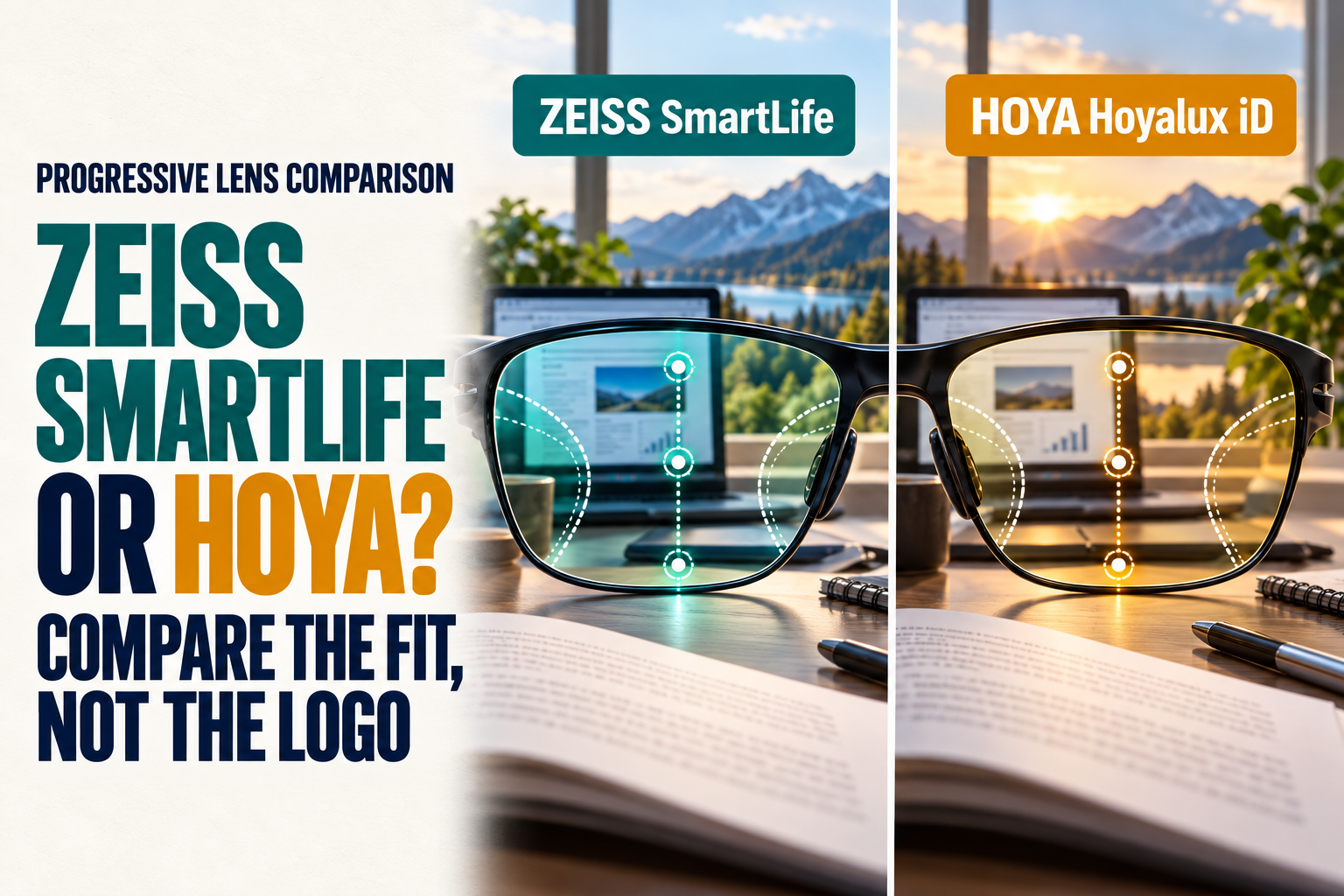
ZEISS SmartLife and HOYA Hoyalux iD should be compared by exact product, frame fit, measurements, visual behavior, and local service—not by the two portfolio names alone.
Quick answer
ZEISS SmartLife and HOYA Hoyalux iD are not single products. ZEISS lists SmartLife Individual 3, Superb, Plus, and Pure; HOYA lists several Hoyalux iD designs. A fair comparison needs the exact model, fitting data, frame, task priorities, material, coating, local price, and remake terms. If the quote omits those fields, it is not yet comparable.
What the current portfolio pages actually show
ZEISS’s professional portfolio describes SmartLife as a hybrid design with balanced clear and blurry zones and lists Individual 3, Superb, Plus, and Pure as different products. ZEISS describes SmartLife Individual 3 as adapted to the chosen frame, facial anatomy, and dynamic viewing needs. Those descriptions explain intended design inputs; they do not guarantee identical results for every prescription or practice.
HOYA’s international progressive page lists Hoyalux iD MySense, MySelf, MySelf Profile, MyStyle V+, LifeStyle 4, Balansis, and Daynamic. It also notes that readers should consult the relevant country site. A local dispenser may not offer every design, and the same family name should not be treated as proof of the same regional specification.
ZEISS SmartLife vs Hoyalux iD comparison grid
| Decision field | ZEISS SmartLife | HOYA Hoyalux iD |
|---|---|---|
| Exact products to clarify | Individual 3, Superb, Plus, or Pure; confirm the generation and configuration. | MySense, MySelf, MySelf Profile, MyStyle V+, LifeStyle 4, Balansis, or another local design. |
| Personalization | Ask which frame, facial-anatomy, and dynamic-viewing inputs are actually collected. | Ask which binocular, posture, wearer-behavior, or frame inputs the selected design uses. |
| Screen use | Define monitor, phone, and reading distances before selecting a general-purpose design. | Confirm the selected iD model’s intended visual priorities and customization process. |
| Frame risk | Verify minimum fitting height, stable adjustment, wrap, tilt, and vertex. | Verify the same fields; a tailored design still depends on a stable frame. |
| Availability | Portfolio pages are not a local price or stock guarantee. | HOYA explicitly routes visitors to local country information; verify local naming and availability. |
Read the official ZEISS progressive portfolio and HOYA progressive portfolio. Keep manufacturer language attributed and separate from Lens InsiderS’s fitting interpretation.
Build an apples-to-apples quote
- Write the full prescription and ADD.
- Use the same frame or frames with comparable depth, bridge, wrap, and stability.
- Request monocular PD and fitting height for each eye.
- Ask whether vertex distance, pantoscopic tilt, facial wrap, posture, and behavioral inputs are entered.
- Specify whether the main task is road, desk, phone, reading, walking, or frequent switching.
- Compare material, index, coating, photochromic options, warranty, remake terms, and final price.
The fitting-height guide explains why a portfolio name cannot substitute for measurement. For a first progressive or a previous non-adaptation, the dispensing process and remedy policy deserve as much attention as the design label.
Use-case decision support
| If your priority is… | Ask before selecting | Do not infer |
|---|---|---|
| Monitor and phone switching | How intermediate and near zones are prioritized for measured distances. | That every “digital” or “connected” portfolio is an office lens. |
| Driving and dashboard | Whether the general-purpose model covers road, mirrors, and dashboard comfortably. | That a desk-oriented lens is safe for driving. |
| Small frame | Minimum fitting height and how the frame will stay positioned. | That an individualized design makes any frame suitable. |
| Previous adaptation problem | Whether the practice will check prescription, frame, centration, and task mismatch before remaking. | That changing from ZEISS to HOYA, or the reverse, identifies the cause by itself. |
Price, service, and remake risk
International product pages are not local price lists. Compare the total quote after including the lens design, material, coating, frame, fitting, adjustments, warranty, and remake policy. Ask whether a remake is allowed for adaptation, measurement error, manufacturing defect, or only a narrow set of exclusions. Keep the written order details.
A premium label is less useful when the frame slips, the fitting height was guessed, or the seller cannot explain what happens after delivery. Conversely, a lower-priced design may be reasonable when the task is simple and the measurements and service are strong.
Alternatives and when to choose a different design
If desk work dominates, compare an office lens rather than forcing a general-purpose progressive to cover one fixed distance. If driving dominates, ask about a driving-specific design. If you want a third quote, include Varilux or another portfolio only when the practice can normalize model, measurements, material, coating, and remake terms. Our office-lens guide and adaptation troubleshooting guide cover these decision points.
Bottom line
ZEISS SmartLife and HOYA Hoyalux iD can both be sensible options, but the exact order determines the comparison. Ask for the model, measurements, task priorities, quote inclusions, and remedy in writing. Choose the practice that can explain and support the complete fitting—not the one with the most impressive portfolio label.
Next step: ask both practices to quote the same prescription and frame with the complete fitting sheet attached.
Sources and further reading
- ZEISS: Progressive SmartLife portfolio
- HOYA: Hoyalux iD portfolio
- Lens InsiderS: Varilux vs ZEISS
- Lens InsiderS: corridor and fitting height
Editorial note: This staging draft contains no commercial links. Confirm relationship status before adding retailer or referral links; disclose any commission near the first commercial recommendation.
About Ho Truong
Ho Truong is a trained optician at a family optical practice established in 1991. Lens InsiderS explains lens design and fitting choices for buyers. It does not diagnose eye conditions or replace an eye examination.