A decision guide to 1.50, Trivex 1.53, 1.56, polycarbonate 1.59, 1.60, 1.67, and 1.74 progressive lens materials – with finished lens weight and nose pressure treated as seriously as edge thickness.
Evidence label: Independent analysis. By Ho Truong. Last checked August 12, 2026. Material properties are approximate because formulations and product names vary by manufacturer and market. Lens suitability must be assessed for the exact prescription, progressive design, frame, fitting, safety need, and laboratory specification.
Quick answer
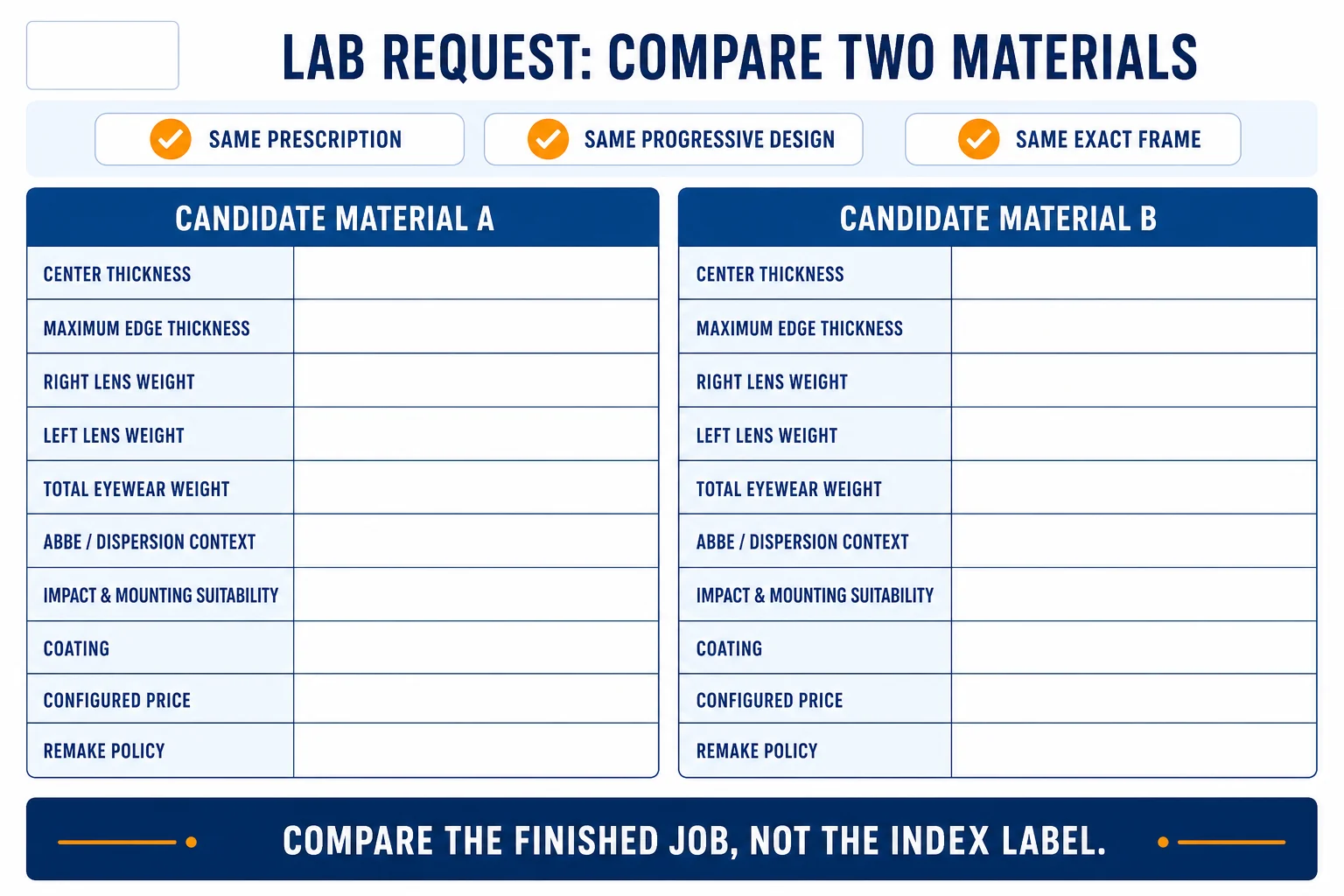
A higher refractive index can reduce the volume needed to make a given lens power, but it does not automatically produce the lightest, clearest, safest, or best progressive. Finished lens weight depends mainly on substrate density and the amount of substrate left after surfacing and edging; total eyewear weight also includes the frame and mounting hardware. Frame eye size, decentration, plus or minus geometry, minimum thickness, and frame construction can outweigh the index label. Ask the laboratory to compare predicted finished thickness and predicted finished lens weight for two candidate materials in the exact frame before paying for an upgrade. Evaluate coatings separately for reflections, durability, impact compatibility, and price.
Refractive index is not progressive design quality
Refractive index describes how strongly a material bends light. A higher-index material can create the prescribed power with flatter curves or less material than a lower-index option, all else equal. That is a material property, not a score for progressive performance.
A progressive design determines how power changes from distance through intermediate to near, where unwanted astigmatism is distributed, and how the usable zones are balanced. Corridor length, fitting height, monocular PD, frame position, prescription, ADD, and position-of-wear inputs can materially change the result. A well-fitted 1.60 progressive can be more useful than a poorly fitted 1.74 progressive, even though 1.74 is thinner on a like-for-like calculation.
Use our guides to soft versus hard progressive design and corridor length and fitting height to evaluate those design decisions separately.
Material comparison: what the numbers can and cannot tell you
The ranges below are orientation values, not a universal product specification. Refractive index, Abbe value, density, UV performance, impact behavior, coating compatibility, and minimum thickness can vary by resin and manufacturer. Obtain the technical sheet for the exact lens product being quoted.
| Common label | Typical material context | Approximate Abbe context | Weight and use considerations |
|---|---|---|---|
| 1.50 | Standard plastic, often CR-39-type resin | Often high-50s | Good dispersion performance, but more volume may be needed. Impact, frame, and minimum-thickness requirements still apply. |
| 1.53 | Trivex | Often low-to-mid 40s | Very low density and strong impact properties; may finish thicker than higher-index options in stronger prescriptions. |
| 1.56 | Mid-index resin offered in some markets | Formulation-dependent | Do not infer optical, impact, UV, or weight performance from 1.56 alone. Request the exact product data sheet. |
| 1.59 | Polycarbonate, commonly labeled 1.59 | Often around 30 | Low density and high impact resistance are important advantages; lower Abbe values may increase peripheral color fringing for some wearers. |
| 1.60 | High-index plastic; several formulations exist | Often upper-30s to low-40s | Can offer a useful thickness, optics, and weight balance, but density and impact properties must be checked by product. |
| 1.67 | High-index plastic | Often low-30s | Reduces lens volume versus lower indices in the same calculation, but the resin is commonly denser than Trivex or polycarbonate. |
| 1.74 | Ultra-high-index plastic | Often low-30s | Can reduce maximum thickness in demanding jobs; commonly denser and more expensive, so the finished weight saving may be smaller than the thickness saving. |
The professional EyeWiki lens-material review identifies refractive index, Abbe number, specific gravity, and UV absorption as separate material properties. PPG’s Trivex technical white paper reports approximately 1.11 specific gravity and an Abbe value around 45 for Trivex, while also showing that polycarbonate and high-index materials have different dispersion and density profiles. Manufacturer data are useful for identifying the specified material; they are not independent proof that it is best for every wearer.
Why thinner does not automatically mean proportionally lighter
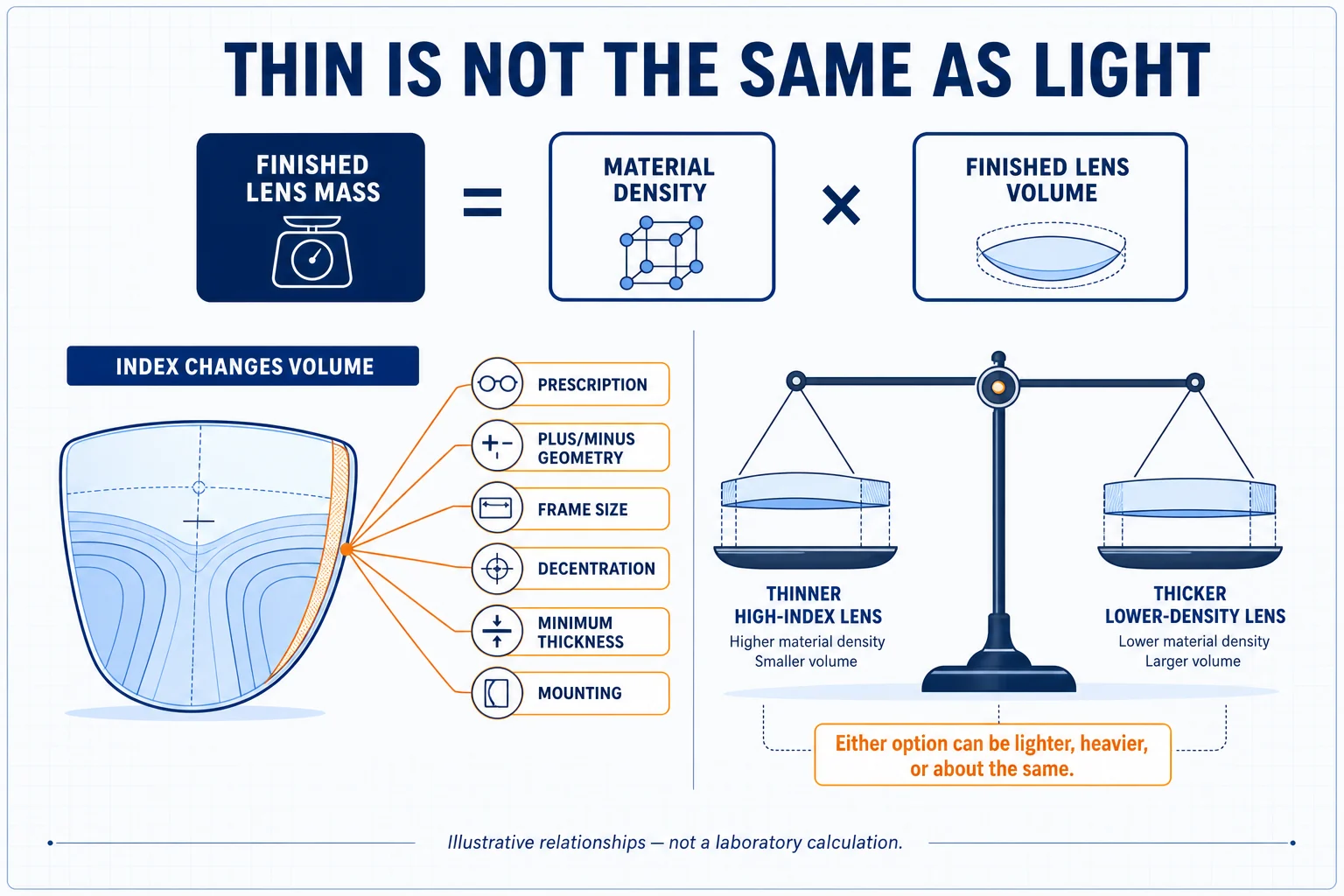
Lens mass is determined by material density multiplied by finished material volume. A higher refractive index can reduce volume, but a denser resin puts more mass into each unit of that volume. The finished lens is therefore the outcome of both factors, not the index number alone.
This is why two statements can both be true:
- A 1.74 lens may be thinner than a 1.60 lens for the same prescription, design, frame, and laboratory constraints.
- The percentage reduction in finished weight may be much smaller than the percentage reduction in maximum thickness.
The National Academy of Opticianry’s lens materials and design course explicitly notes that thinner does not necessarily mean lighter because high-index materials vary in specific gravity. Treat catalog weight claims as conditional unless the comparison uses the exact same prescription, blank, design, frame shape, size, decentration, and minimum thickness.
Finished lens weight: the number that reaches the nose
Uncut lens blanks are not worn. The laboratory surfaces and edges each lens to the frame, leaving a finished volume that depends on the full job. A useful quotation should therefore compare the finished pair, not two generic material samples.
Ask the laboratory or dispensing optician to calculate, for the exact frame:
- Predicted maximum edge thickness for each minus lens, or center thickness for each plus lens.
- Predicted finished weight of the right and left lenses in grams.
- Total finished eyewear weight after adding the frame, lenses, and relevant hardware.
- The assumptions used for minimum center or edge thickness, bevel or groove, and frame mounting.
- Whether changing the frame size or shape would save more thickness and weight than changing the material.
Question to take to the optical shop or laboratory: “For this exact prescription, progressive design, and frame, please compare predicted finished thickness and finished lens weight in these two materials. Which change matters more: the material or a smaller, better-centered frame?”
Frame size and decentration can dominate the result
A wide lens shape may require the optical reference points to sit far from the geometric center of the blank. That decentration increases the effective diameter needed to cut the lens. For minus prescriptions, a larger cut-out can leave substantially more edge thickness. A smaller frame centered closer to the pupils can sometimes reduce thickness, weight, and cost more efficiently than an index upgrade.
Do not choose a frame by the printed eye size alone. Bridge width, lens shape, PD, frame fit, and where the pupils sit within the shape all affect decentration. A narrow-looking frame that sits poorly or places the eyes off-center may not deliver the expected advantage.
Review the progressive frame-selection guide before comparing material upgrades.
Plus and minus prescriptions create thickness in different places
A minus lens is generally thinner in the center and thicker toward the edge. Frame size, effective diameter, decentration, base curve, and minimum center thickness strongly affect its maximum edge.
A plus lens is generally thicker in the center and thinner toward the edge. Finished center thickness is affected by power, blank and lens design, frame size, decentration, edge requirements, and how much of the thicker central area remains after edging. A smaller frame may help, but the result needs a laboratory calculation rather than a rule based only on sphere power.
Astigmatism also means thickness can vary by meridian. Right and left lenses may finish at different weights even when the spherical values look similar. This is another reason not to rely on a universal chart that assigns one index to a diopter range.
Minimum thickness, grooves, and drill mounts limit how thin a lens can be
A laboratory cannot remove material without considering safe manufacture and mounting. Full-rim, grooved semi-rimless, and drilled rimless frames impose different edge or hole requirements. Impact needs, lens diameter, prescription, local regulations, manufacturer instructions, and laboratory policy may set minimum thicknesses.
In the United States, spectacle lenses are subject to the FDA impact-resistance regulation. The FDA explains that impact-resistant lenses reduce injuries and generally must withstand the applicable impact test; see its impact-resistant lens guidance. Impact resistance should not be interpreted as unbreakable or shatterproof; PPG makes that limitation explicit in its Trivex technical guidance. Regulatory baseline compliance is not the same as selecting occupational safety eyewear or the best material for a drill-mounted frame.
For children, sports, safety-critical use, or rimless mounting, impact and mounting durability may outweigh the goal of achieving the smallest possible thickness. Confirm the exact product and applicable standard with the dispenser.
Abbe value and chromatic aberration belong in the decision
Abbe value is a measure related to optical dispersion. In general, a higher Abbe value indicates less chromatic dispersion. Lower-Abbe materials can produce more peripheral color fringing, although whether a wearer notices it depends on prescription, gaze position, lens design, centration, frame fit, and individual sensitivity.
Do not convert Abbe value into a promise of subjective clarity. A higher-Abbe material does not correct a poor prescription or fitting error, and a lower-Abbe material is not automatically intolerable. It is one tradeoff to discuss, especially for someone who previously noticed colored edges or off-axis blur.
ZEISS’s overview of plastic and glass lens materials explains that a higher Abbe number corresponds to lower dispersion. The final progressive experience still depends on more than material dispersion.
Nose pressure marks are a whole-eyewear problem
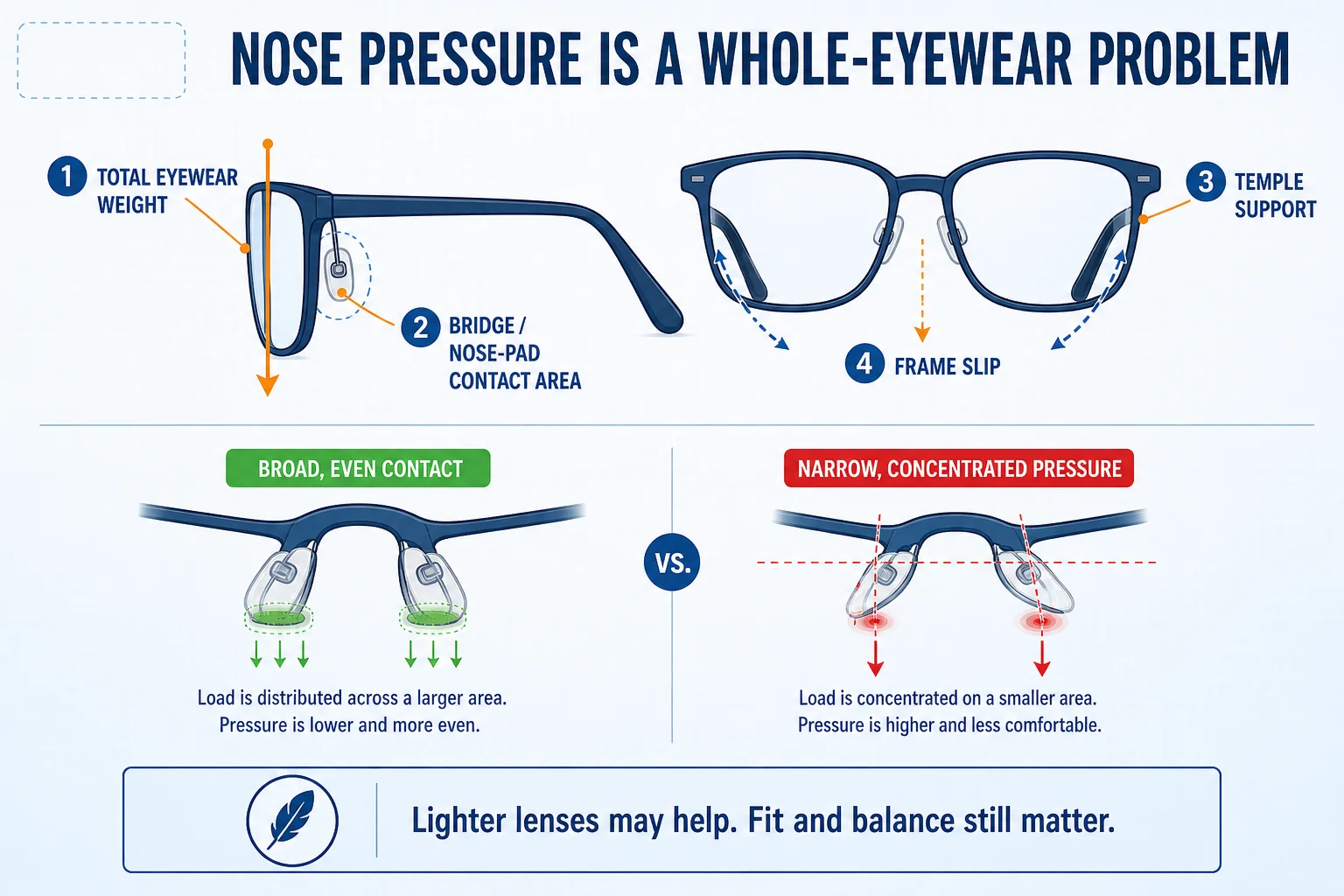
A lighter lens pair may help, but red marks or bridge pressure do not prove that the refractive index is wrong. The load reaching the nose depends on total eyewear weight and how the frame distributes it across the bridge, nose pads, temples, and ears.
Pressure rises when the same load is concentrated over a smaller or poorly aligned contact area. Narrow or tilted pads can create localized pressure even in a light frame. A bridge that does not match the nose can slip, causing the wearer to tighten the temples or repeatedly push the glasses upward. Heavy temples, a front-heavy frame, poor temple bend, or an oversized lens shape can also shift the balance.
A PubMed-indexed study on spectacle-frame weight and nose-pad area discusses the relationship between frame weight and recommended pad contact area. ZEISS’s fitting guidance advises maximizing nose-pad contact and adjusting the temples so part of the load is supported behind the ears rather than bearing entirely on the nose; see its spectacle-fit overview.
What to check when glasses leave nose marks
- Weigh the complete eyewear, not the lenses alone.
- Inspect whether both nose pads or the full bridge contact evenly.
- Check whether the frame slides, sits crooked, or needs frequent pushing up.
- Check temple width, bend, and pressure behind the ears.
- Compare frame-front weight and lens size with a comfortable existing pair.
- Ask whether a smaller frame, larger pad contact area, different bridge geometry, or refitting would help more than an index upgrade.
Do not self-bend a frame with lenses installed if you could damage the mounting or alter the progressive fitting position. Ask an optician to assess the complete frame on the face. Persistent pain, broken skin, swelling, or a new rash needs appropriate professional assessment rather than repeated adjustment alone.
Decision scenarios: compare the job, not a universal cutoff
Scenario 1: moderate prescription in a small, stable full-rim frame
A standard plastic, Trivex, polycarbonate, or 1.60 option may each be reasonable depending on impact needs, dispersion sensitivity, availability, cost, and predicted finished dimensions. Jumping automatically to 1.74 may produce little practical benefit.
Scenario 2: strong minus prescription in an oversized frame
First calculate a smaller, better-centered frame. Then compare 1.60, 1.67, or 1.74 using predicted edge thickness and finished weight. An index upgrade cannot fully compensate for excessive cut-out size and decentration.
Scenario 3: plus prescription with a large lens shape
Ask the laboratory to compare center thickness and finished weight in the exact frame. Frame size, shape, and decentration influence how much of the thick central region remains. Do not use a minus-lens edge-thickness rule.
Scenario 4: rimless, grooved, child, sport, or safety use
Impact behavior, mounting durability, minimum thickness, and the applicable safety standard may take priority. Trivex or polycarbonate may be discussed for impact-related reasons, but the exact choice belongs to the prescriber, dispenser, and laboratory based on the application.
Scenario 5: the glasses are thin but hurt the nose
Measure total eyewear weight and assess bridge, pad area, temple balance, and slipping before buying a higher index. A denser material in the same large frame may not solve the pressure distribution problem.
Best for – and not ideal for
A higher-index material may be worth comparing when:
- the laboratory predicts a meaningful finished thickness reduction in the exact frame;
- edge appearance or center profile is an important constraint;
- the prescription and frame leave substantial lens volume after edging;
- the coating, impact, mounting, and optical tradeoffs are acceptable; and
- the upgrade remains useful after considering a smaller frame.
The highest available index may not be ideal when:
- the prescription and frame already finish thin and light;
- a lower-density material produces a similar finished weight;
- impact or mounting requirements favor another material;
- the wearer is sensitive to peripheral color fringing;
- the price increase produces little predicted finished benefit; or
- the real problem is bridge fit, pad contact, temple balance, or progressive alignment.
The five-part quote to request
- Exact material and manufacturer: not only “thin,” “premium,” or an index number.
- Exact progressive design: including whether personalization and position-of-wear measurements are used.
- Predicted finished dimensions: center thickness, maximum edge thickness, and the location of the thickest point.
- Predicted finished weight: each lens and total eyewear in the selected frame.
- Tradeoffs and protection: Abbe/dispersion context, impact suitability, coatings, mounting limits, warranty, remake, and total price.
Use this quote alongside our guide to why progressive lens prices differ. A higher invoice is not evidence that the design, material, fitting, and service are better matched to the wearer.
Frequently asked questions
Is 1.74 always the thinnest progressive lens?
For an otherwise identical calculation, higher index can reduce required lens volume. The finished maximum thickness still depends on prescription, design, frame, decentration, base curve, minimum thickness, and mounting. Compare laboratory predictions rather than the label alone.
Is 1.74 lighter than 1.67?
Not automatically by a meaningful amount. A 1.74 lens may use less volume but the resin is commonly denser. The exact finished weight must be calculated after edging to the frame.
Is Trivex too thick for progressives?
Trivex has a lower refractive index than 1.60, 1.67, and 1.74, so it can finish thicker in stronger prescriptions. Its low density, impact properties, and higher Abbe context may still make it a useful option. Ask for finished thickness and weight.
Does high index improve the progressive corridor?
No. Index is a material property. Corridor behavior and usable-zone balance come from the progressive design, prescription, fitting, and frame geometry.
Will lighter lenses stop nose marks?
They may reduce front weight, but pressure also depends on bridge shape, contact area, nose-pad alignment, temple balance, slipping, and total frame weight. Have the complete eyewear fitted and balanced.
Bottom line
Choose progressive lens material by comparing the finished job, not by matching prescription power to a universal index chart. Separate refractive index from progressive design. Compare dispersion, impact needs, mounting, coatings, price, and the exact frame. Most importantly, ask for predicted finished thickness and finished weight for two candidate materials. If nose pressure is the problem, assess total eyewear weight and load distribution before assuming that a thinner lens is the cure.
Editorial note: This article does not prescribe a lens material or progressive design. The final specification should be confirmed by the prescriber, dispensing professional, and laboratory for the exact wearer and frame.
Primary and professional sources checked August 12, 2026: FDA impact-resistant lens guidance; EyeWiki lens-material review; PPG Trivex technical white paper; National Academy of Opticianry lens-material course; ZEISS material and frame-fitting education; PubMed record on spectacle-frame weight and nose-pad contact area. Product formulations and laboratory limits can change.
Sources and further reading

About Ho Truong
Ho Truong is a trained optician at a family optical practice established in 1991. Lens InsiderS explains lens design and fitting choices for buyers. It does not diagnose eye conditions or replace an eye examination.