Quick answer
ADD means addition: extra plus power prescribed for near vision. It helps create the near portion of bifocal, trifocal, office, or progressive lenses, but it does not replace the full prescription, pupillary distance, fitting height, or frame measurements.
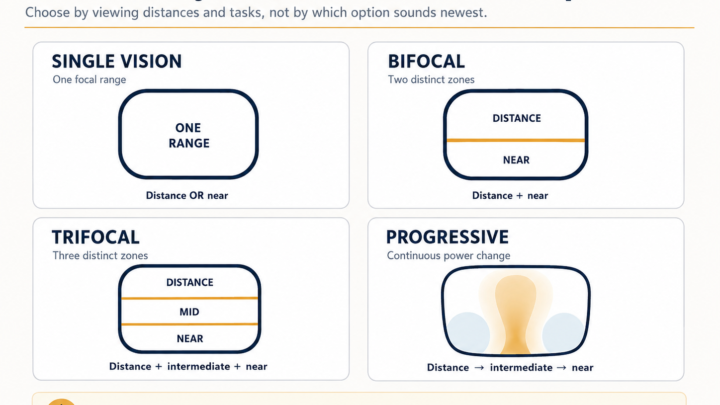
ADD is the extra plus power prescribed for near vision. It is also used to create the reading portion of bifocal, trifocal, office, and progressive lenses.

You may see ADD near the right edge of an eyeglass prescription, usually beside the values for the right eye and left eye. The number is easy to overlook, but it is essential when a lens must provide both distance and near correction.
ADD does not describe a brand, coating, lens index, or progressive corridor. It describes an amount of additional focusing power. The laboratory combines that value with the distance prescription to produce the near portion of the lens.
What ADD stands for
ADD means addition. It is additional plus power, measured in diopters, prescribed to support near vision. It is commonly written with a plus sign, such as +1.25, +1.75, or +2.25.
For example, if the distance sphere is +0.50 and the ADD is +2.00, the near portion needs two additional diopters of plus power relative to the distance portion. The finished lens design determines how that power is distributed between distance and near.
The American Academy of Ophthalmology’s EyeWiki describes progressive lenses as having intermediate and ADD power that gradually increases as the wearer looks lower through the lens. Its lensometry reference notes that the amount of add varies with the near correction required.
ADD is normally determined during refraction and near-vision testing. It should not be selected from age alone and should not be copied from someone else’s prescription.
Why ADD becomes more common after 40
Presbyopia is the normal age-related loss of the eye’s ability to focus up close. The National Eye Institute explains that reading glasses and multifocal lenses can help people who have difficulty with near and distance vision.
Common reasons someone may be tested for near support include:
- holding a phone, menu, or label farther away;
- needing more light for small print;
- difficulty changing focus between a monitor and reading material;
- near blur after prolonged work; or
- an existing near prescription no longer feeling comfortable.
Those symptoms can have more than one cause. A current examination matters because a new ADD should be considered alongside distance refraction, eye health, binocular vision, working distance, and the tasks that are actually difficult.
How to read the main parts of a prescription
| Field | Plain-English meaning | Why it matters |
|---|---|---|
| OD | Right eye | Keeps each eye’s values separate |
| OS | Left eye | Keeps each eye’s values separate |
| SPH | Overall spherical focusing power | Corrects myopia or hyperopia |
| CYL | Amount of astigmatism correction | Works together with AXIS |
| AXIS | Orientation of the cylinder correction | Written from 1 to 180 degrees when CYL is present |
| ADD | Extra plus power for near vision | Used for multifocal or near-support lenses |
| Prism / Base | Image-shifting power and direction | Used when specifically prescribed |
Sphere, cylinder, axis, ADD, and prism are prescription values. Pupillary distance, fitting height, frame tilt, wrap, and lens-to-eye distance are fitting measurements. A complete progressive order may need information from both groups.
A simple prescription example
| Eye | SPH | CYL | AXIS | ADD |
|---|---|---|---|---|
| OD | -1.50 | -0.75 | 090 | +1.75 |
| OS | -1.25 | -0.50 | 080 | +1.75 |
In this example, the wearer has a distance correction for each eye, an astigmatism correction, and +1.75 diopters of additional near support. It does not mean the lower portion of the finished lens simply contains a printed +1.75 lens. The laboratory combines the full prescription with the selected multifocal design.
The example also does not tell us the best frame, corridor, monitor distance, or fitting height. Those decisions require additional information.
Does ADD have to be the same for both eyes?
Many prescriptions show the same ADD for both eyes, but only the prescriber should determine the value. Do not “correct” a prescription because one row looks unusual. Confirm unclear handwriting, missing signs, or different values with the issuing office before ordering.
An online retailer may offer a field that applies one ADD value to both eyes. If your written prescription shows different instructions or prism, contact the retailer before checkout to make sure the order form can represent the prescription accurately.
How ADD changes the experience of a progressive lens
As the eye moves from the distance area toward the near area, a progressive design must distribute the prescribed change in power across the available lens space. ADD is therefore relevant to the optical design, but it is not the only factor that affects comfort.
The experience also depends on:
- the distance prescription and astigmatism correction;
- the progressive design and corridor;
- the frame’s usable vertical depth;
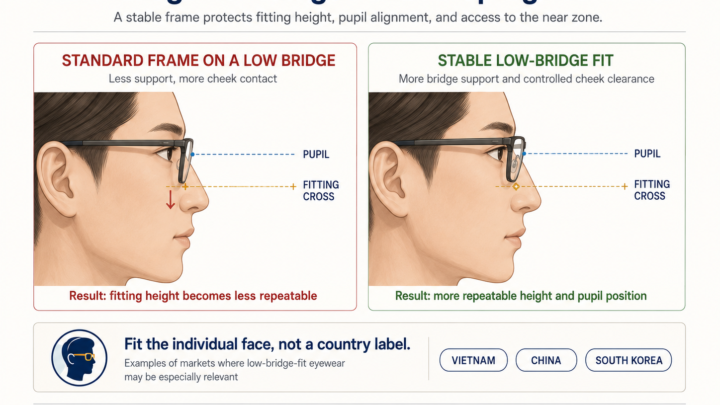
- monocular pupillary distance and fitting height;
- how the adjusted frame sits on the face;
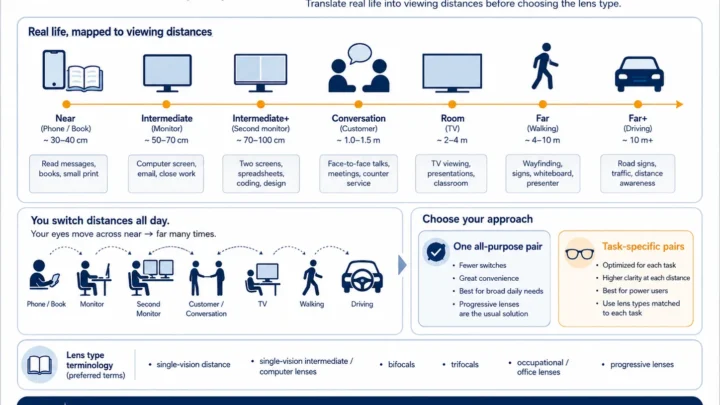
- reading and monitor distance; and
- previous multifocal experience.
A higher ADD is not a “better” or “stronger quality” lens. It means more near addition was prescribed. Do not increase it to make small text look larger without professional advice; too much near power can change the comfortable working distance and make intermediate tasks less useful.

What ADD does not tell you
ADD does not tell you:
- your pupillary distance;
- where the pupils sit vertically in the chosen frame;
- which progressive design should be used;
- whether an office lens is better for your workday;
- which lens index is appropriate;
- whether a coating is worth the price; or
- whether a vision change has an eye-health cause.
This is why an order form that accepts SPH, CYL, AXIS, and ADD is not automatically a complete fitting process.
Using ADD when ordering progressive lenses online
- Copy the prescription exactly. Keep plus and minus signs, eye labels, cylinder notation, axis, ADD, and prism unchanged.
- Confirm the prescription is current. Follow the expiration date and local requirements shown on the prescription.
- Use actual measurements. Obtain right- and left-eye PD values and ask how fitting height is established for the selected frame.
- Choose the lens by task. Everyday progressives include distance; office progressives prioritize intermediate and near and are not for driving.
- Save the finished specification. Record the design or package, index, coatings, frame size, total price, and remake policy.
Our GlassesUSA progressive lenses review shows how these questions apply to a real online ordering flow. For the overall lens layout, see Progressive Lenses Explained.
When to ask for a new examination
Schedule an eye examination as recommended by your eye-care professional and when near or distance vision changes. Seek prompt care for sudden vision loss, new flashes or floaters, eye pain, sudden double vision, a curtain-like shadow, or a sudden field-of-vision change. Those are not problems to solve by changing ADD on an online form.
Frequently asked questions
Is ADD the same as reading-glasses power?
Not exactly. ADD is the additional near power relative to the distance prescription. Over-the-counter readers use the same simple plus power in both lenses and do not include an individualized distance, astigmatism, prism, or unequal-eye correction.
Can I order progressives without an ADD value?
A progressive order normally needs an ADD or other clear multifocal instruction from the prescriber. Do not invent the value. Ask the issuing office for clarification or an updated prescription.
Does a larger ADD mean I need premium progressives?
No retail label can answer that by itself. A larger ADD can make design distribution and fitting choices more noticeable, but the best option depends on the full prescription, frame, measurements, tasks, and budget.
Why is my ADD written only once?
Some prescription formats show one ADD that applies to both eyes. Others repeat it on each row. If the layout is unclear, confirm it with the prescriber rather than assuming.
Can ADD be used for computer glasses?
Computer or office lenses may use near-support information, but the target working distance matters. Tell the prescriber the actual distance to the monitor and other tasks instead of choosing a lens from ADD alone.
The bottom line
ADD is additional plus power for near vision. It is a prescription value, not a lens-quality score and not a substitute for fitting measurements.
Copy it exactly, combine it with the complete prescription, and make sure the frame and lens design match how you read, work, and move through the day.
Sources and further reading

About Ho Truong
Ho Truong is a trained optician at a family optical practice established in 1991. Lens InsiderS explains lens design and fitting choices for buyers. It does not diagnose eye conditions or replace an eye examination.