A strong prescription does not rule out progressive lenses, but it reduces the margin for error. Frame size, decentration, material, position of wear, and right/left balance become more important as powers increase.
Quick answer
People with high prescriptions can wear progressives successfully. Favor a well-centered, moderately sized, stable frame; obtain monocular PD and accurate fitting heights; and use a design optimized for the prescription and frame when justified. Do not choose 1.74 index or an oversized fashion frame automatically—the best result balances thickness, weight, optical quality, impact needs, and fit.
Why strong prescriptions are less forgiving
Decentration errors induce more unwanted prism as lens power increases. Strong minus lenses can become thick at the edge; strong plus lenses can become thick and heavy at the center. Large differences between right and left powers may also create unequal image size, weight, and vertical prism effects when looking down to read.
The progressive design adds its own changing power and peripheral blur. Accurate positioning helps both eyes use corresponding zones together.
Frame strategy for high powers
| Frame feature | Why it helps |
|---|---|
| Moderate eye size | Can reduce edge thickness in minus lenses and weight in plus lenses |
| Pupils near geometric center | Reduces decentration and unnecessary thickness |
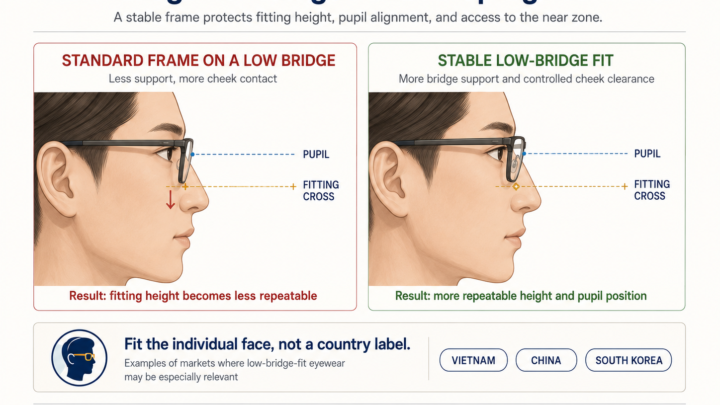
| Stable bridge | Keeps optical zones aligned |
| Limited wrap | Reduces position-of-wear complications unless a customized wrap design is used |
| Adequate vertical depth | Avoids forcing an unnecessarily compressed corridor |
Material: thinner is not the only goal
Higher-index materials can reduce thickness, but material selection also affects weight, chromatic aberration, reflections, impact performance, tinting, and cost. A strong anti-reflective coating is commonly useful on higher-index materials because they reflect more surface light.
Ask the dispenser to compare predicted thickness in the chosen frame for at least two appropriate materials. Sometimes changing the frame produces a larger improvement than moving from 1.67 to 1.74.
Measurements to prioritize
- Monocular distance PD for each eye.
- Separate right and left fitting heights.
- Frame level and bridge position before measurement.
- Vertex distance, pantoscopic tilt, and face-form angle when the design uses them.
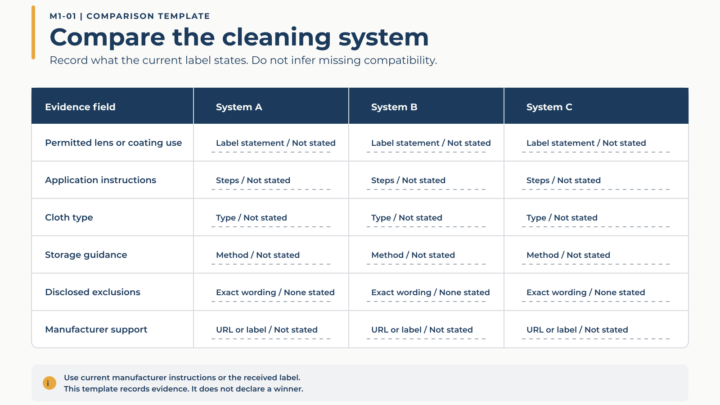
- Actual frame shape and size sent to the design calculation where supported.
Self-measured binocular PD is a higher-risk shortcut here. See our PD guide for online progressive orders.
Different powers between the eyes
Anisometropia can make the two eyes experience different magnification and vertical prism, especially in downgaze. The wearer may report one image larger, difficulty fusing at near, or discomfort that is not solved by “getting used to it.” Options can include design changes, slab-off or other prism management, frame and lens choices, contact lenses, or task-specific strategies. These require professional assessment.
Online ordering: when risk rises
Online purchasing is most defensible when the prescription falls within the retailer’s supported range, measurements are professionally obtained, the frame is predictable, and the remake policy clearly covers progressive non-adaptation. Risk rises with:
- Prism.
- Large right/left power difference.
- Very strong sphere or cylinder.
- Previous progressive failure.
- Strong wrap or unusual frame geometry.
- No frame-based fitting-height process.
How to compare a quote
- Ask for the exact progressive model.
- Confirm supported power and ADD ranges.
- Request predicted center/edge thickness and finished weight if available.
- Compare 1.60, 1.67, 1.74, Trivex, or polycarbonate only where appropriate.
- Verify coating, UV, and impact requirements.
- Document all fitting measurements.
- Read the high-prescription exclusions in the warranty/remake policy.
Troubleshooting priorities
With high powers, do not assume every symptom is adaptation. The dispenser should verify the finished sphere, cylinder, axis, ADD, prism, layout, fitting cross position, and frame adjustment. If the glasses are correct but uncomfortable, compare the previous pair’s base curve, vertex distance, frame size, and design.
Use our guide to normal versus abnormal progressive symptoms.
Frequently asked questions
Is 1.74 always best for a strong prescription?
No. It may reduce thickness, but frame choice, optical properties, coating, weight, impact needs, and cost must be considered. Ask for a thickness comparison.
Can high astigmatism use progressives?
Often yes, but axis accuracy, frame rotation, design optimization, and adaptation can be more sensitive. Professional verification is important.
Are small frames always better for high minus?
Smaller and well-centered often reduces edge thickness, but the frame still needs enough vertical depth for the selected progressive corridor.
Sources and further reading
- Peer-reviewed analysis of progressive-lens performance with astigmatic prescriptions
- ZEISS: Prescription and fitting inputs in individualized lenses
Professional note: High prescriptions and anisometropia deserve individualized dispensing advice. This guide is not a prescription or product recommendation.

About Ho Truong
Ho Truong is a trained optician at a family optical practice established in 1991. Lens InsiderS explains lens design and fitting choices for buyers. It does not diagnose eye conditions or replace an eye examination.