Progressive lenses and bifocals both correct presbyopia, but they organize vision very differently. This guide compares the viewing zones, adaptation, computer use, frame requirements, and practical tradeoffs that matter before you order.
Quick answer
Choose progressive lenses if you want one pair for distance, intermediate, and near vision without a visible line. Choose bifocals if you value a wide, clearly defined reading area, want a lower-cost design, or have struggled with the narrow intermediate corridor and peripheral blur of progressives. Neither option is automatically “better”; the right choice depends on your tasks, prescription, frame, and tolerance for adaptation.
Progressive lenses vs bifocals at a glance
| Decision factor | Progressive lenses | Bifocals |
|---|---|---|
| Viewing distances | Distance, intermediate, and near | Usually distance and near |
| Visible line | No | Yes |
| Computer range | Available, but often narrow | Usually missing unless a special segment is prescribed |
| Peripheral blur | Expected in lower side areas | Less progressive-style peripheral distortion |
| Adaptation | Requires learning where to look | Image jump at the segment line may require adjustment |
| Fitting sensitivity | High: PD, fitting height, frame position, and design matter | Segment height and frame fit still matter, but the design is generally simpler |
How each lens organizes vision
A progressive lens changes power gradually from the distance zone at the top, through an intermediate corridor, to the near zone at the bottom. The benefit is continuous focus across different distances. The compromise is unavoidable unwanted astigmatism and blur toward the lower sides. Turning your head toward an object—rather than looking far through the lens edge—usually produces a clearer view.
A traditional bifocal has two distinct powers. The main lens normally handles distance, while a visible segment handles near work. The reading segment can be wide and predictable, but the abrupt power change can create “image jump” as your gaze crosses the line. Standard bifocals do not provide a continuous computer-distance zone.
Which is better for computer work?
Progressives usually beat standard bifocals for occasional computer use because they include intermediate power. However, the intermediate zone may be too narrow for large monitors, multiple screens, or eight-hour desk work. Users may raise their chin to reach the correct zone, leading to neck strain.
For sustained screen work, compare both options with an office lens. An office design can trade driving-distance vision for a wider desk and room range. Our separate guide explains why ordinary progressives can feel restrictive at a monitor.
Which is easier to adapt to?
Bifocals make the available zones obvious, so many wearers quickly learn to use them. The visible line and image jump can still be distracting, especially on stairs. Progressives require more gaze and head coordination. First-time wearers should point their nose toward side targets, lower their eyes for near work, and avoid switching repeatedly between old and new glasses during the initial adaptation period.
Mild “swim” or peripheral motion can be normal early on. Constant blur straight ahead, one-eye-only clarity, headaches that do not improve, or a need to hold the frame in an unusual position can indicate a prescription, centering, fitting-height, or frame-adjustment problem. See our guide to normal adaptation versus a fitting problem.
Frame choice matters more for progressives
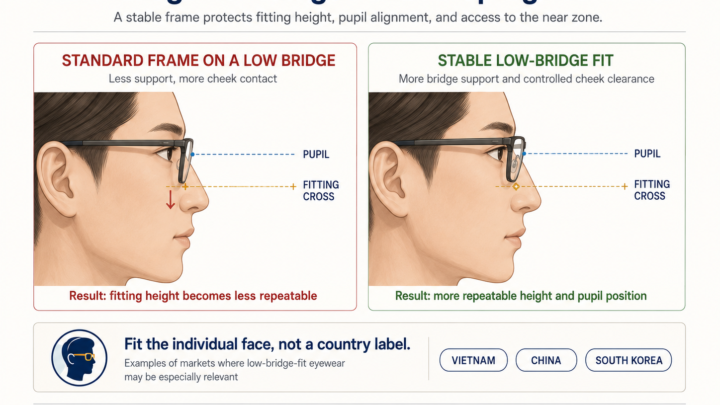
A progressive lens needs enough vertical room below the pupil to contain the corridor and near zone. A shallow frame may require a short-corridor design, which compresses the power change and can make the usable zones feel narrower. Bifocals also need correct segment height, but the near segment is not connected through a progressive corridor.
Before ordering, check the frame’s lens height, how the bridge holds the frame, whether the frame slides, and whether your pupils sit unusually high or low in the opening. Read the full progressive-friendly frame checklist.
Who should lean toward progressives?
- You move frequently between road, room, screen, and reading distances.
- You want one all-day pair without a visible bifocal line.
- You are willing to learn the viewing zones and return for frame adjustment.
- Your frame and measurements support the selected progressive design.
Who should consider bifocals?
- You primarily need clear distance and a wide near area.
- You dislike progressive peripheral blur or have not adapted after the fitting has been checked.
- You want a simpler, often less expensive multifocal design.
- Your work needs a stable near window and little intermediate vision.
Ordering checklist
- Use a current prescription and confirm the ADD value for each eye.
- Ask what intermediate tasks you need to perform and at what working distance.
- Confirm monocular PD and, for progressives, fitting height in the chosen frame.
- Ask whether the frame requires a short-corridor design.
- Compare the remake/adaptation policy—not only the advertised lens price.
- Have the finished frame adjusted so it sits consistently.
Frequently asked questions
Can I switch from bifocals to progressives?
Yes. Expect a learning period because the intermediate zone and side blur are new. Bring your old glasses and explain how you use them so the dispenser can compare fitting position and task needs.
Are progressives always more expensive?
Usually, because the design and fitting are more complex, but total price varies by material, design tier, coatings, and retailer. A higher price does not compensate for incorrect measurements or poor frame fit.
Can progressives replace every other pair?
Not always. A general-purpose progressive is a compromise. Heavy computer users, musicians, mechanics, and people with unusual working distances may benefit from a task-specific second pair.
Need to compare all four common spectacle layouts? See our guide to single vision, bifocal, trifocal, and progressive lenses.
Sources and further reading
Health note: This educational guide does not replace an eye examination. Sudden vision loss, flashes, new floaters, eye pain, or double vision requires prompt professional assessment.

About Ho Truong
Ho Truong is a trained optician at a family optical practice established in 1991. Lens InsiderS explains lens design and fitting choices for buyers. It does not diagnose eye conditions or replace an eye examination.