The best progressive frame is not simply the biggest frame. It is the frame that stays in a repeatable position, provides enough usable depth below the pupil, and matches the corridor and measurements the lens design requires.
Quick answer
For most first-time progressive wearers, start with a medium-depth frame that has a stable bridge, adjustable or well-fitting nose support, limited wrap, and enough lens height for the selected design. Avoid frames that slide, sit extremely low, or force a short corridor unless the lens is specifically designed and fitted for that geometry.
The five frame checks that matter
| Check | What you want | Warning sign |
|---|---|---|
| Vertical lens depth | Enough room below the pupil for corridor and near zone | Very shallow opening with no confirmed short-corridor plan |
| Bridge stability | Frame returns to the same position after movement | Sliding or frequent pushing up |
| Pupil position | Reasonable distance from frame top and bottom | Pupil sits extremely high, low, or close to an edge |
| Wrap and tilt | Moderate, measurable position of wear | Strong wrap without a compatible customized design |
| Adjustment | Temples, bridge, and nose pads can be stabilized | Frame cannot be adjusted to stop rotation or slipping |
How much lens height is enough?
There is no universal minimum because progressive designs have different fitting-height requirements. Some modern designs can be fitted at relatively short heights; others need more room. The useful question is: Does this exact frame, on this face, provide the minimum fitting height for this exact lens design?
Fitting height is measured from the pupil reference point to the deepest usable point in the frame. A frame’s catalog “B measurement” is helpful for screening, but it does not reveal where your pupil sits. Two people can wear the same frame and have different available fitting heights.
Are small frames bad for progressives?
Not automatically. A small frame may work with a short-corridor design, accurate measurements, and realistic expectations. The tradeoff is that compressing the power change into less vertical space can make the transition steeper and the intermediate or near zones feel less forgiving. First-time wearers and people with stronger ADD powers often appreciate more vertical room.
Read our detailed guide to corridor length and fitting height before choosing a shallow frame.
Frame shapes: practical strengths and weaknesses
Rectangular frames
They can provide useful width for distance vision, but very shallow rectangles may leave little depth for the near zone. Look at the actual lens height rather than the label “rectangular.”
Round and panto frames
These often provide generous vertical depth. However, a pupil positioned near the top outer quadrant can reduce usable side space. Strong prescriptions may also produce thickness or magnification considerations in larger round shapes.
Cat-eye frames
They may work well if the lower area remains deep and the pupil is not too close to the upswept outer edge. Check both fitting height and horizontal decentration.
Wrap and sport frames
High wrap changes how the lens sits relative to the eyes. A design optimized for face-form angle, vertex distance, and tilt is safer than placing a standard progressive in an extreme wrap.
Rimless and semi-rimless frames
These can work, but lens shape, drill position, material strength, and the risk of flexing matter. Confirm the lab supports the design and material combination.
Bridge fit is an optical issue
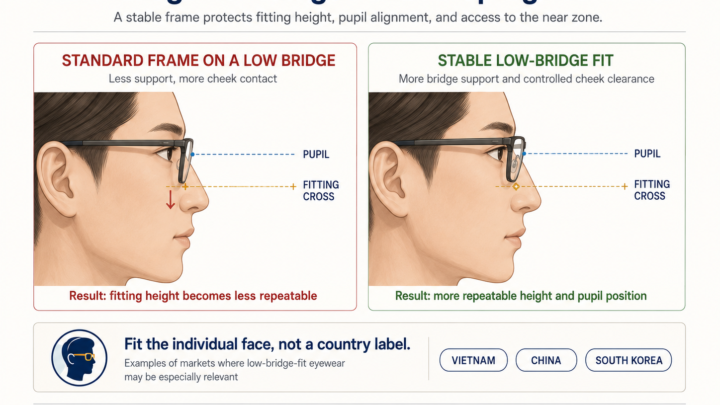
If a frame slides 4 mm down the nose, the eyes are no longer looking through the intended vertical positions. A keyhole bridge may suit some noses but gap on others. Adjustable nose pads can help tune position, while a well-matched molded bridge can be very stable. Neither is universally superior.
Before measuring, the frame should be adjusted for bridge contact, temple length, level, pantoscopic tilt, and vertex distance. Measuring first and changing the frame position later undermines the fitting data.
Online frame-selection checklist
- Find the lens height, bridge width, total frame width, and temple length.
- Compare them with a frame that already fits—not just with your face width.
- Use virtual try-on for appearance, not as proof of progressive suitability.
- Ask the seller whether the chosen frame is eligible for your prescription and progressive tier.
- Ask how vertical fitting is determined.
- Confirm the frame can be adjusted locally after delivery.
- Check the return/remake rules if the frame fit prevents proper alignment.
Signs the delivered frame needs adjustment
- It slides during normal head movement.
- One lens sits higher than the other.
- The temples bow outward or pressure the sides of the head.
- The bridge gaps or leaves excessive pressure marks.
- Clear vision improves only when you push or tilt the frame.
Do not train yourself around an unstable frame. Have the fit checked before deciding that the lens design is wrong. If symptoms continue, use our progressive troubleshooting guide.
Frequently asked questions
Are oversized frames best?
They offer vertical room but can add weight, thickness, edge distortion, and fit instability. “Enough room” is better than “as large as possible.”
Can I reuse my current frame?
Possibly, if it is structurally sound, still fits predictably, and the lab accepts it. Remember that sending a personal frame can shift breakage risk and leave you without glasses during production.
Can a frame adjustment fix blurry progressives?
It can fix problems caused by position, tilt, or slipping. It cannot correct an inaccurate prescription, wrong PD, wrong fitting height, or an unsuitable lens design.
If standard bridges slide or the lower rim touches the cheeks, use our low-bridge fit checklist for progressive lenses.
Sources and further reading
Health note: Frame selection cannot replace a current eye examination or professional verification of the finished lenses.
About Ho Truong
Ho Truong is a trained optician at a family optical practice established in 1991. Lens InsiderS explains lens design and fitting choices for buyers. It does not diagnose eye conditions or replace an eye examination.