“AI progressive lens” can sound as if the glasses watch your eyes and refocus themselves. Most products sold under that language do something less dramatic but potentially useful: data and algorithms help select or optimize the lens design before it is manufactured.
Quick answer
AI-assisted progressive lenses can use prescription, age, frame geometry, position-of-wear measurements and modeled visual behavior to refine a design target. They do not eliminate the optical tradeoffs of a progressive lens, fix inaccurate measurements or change power after delivery. A premium design is most defensible when the seller can explain which personal inputs alter the calculation and how the design matches a real task.
Three technologies that marketing often blends together
| Term | What it usually means | What it does not prove |
|---|---|---|
| Free-form surfacing | Computer-controlled production of a complex lens surface | That the design is individually optimized or better for every wearer |
| Personalization | The calculation incorporates selected wearer, frame or task data | That every possible measurement is used or measured accurately |
| AI / data-assisted design | An algorithm or model helps select and optimize a design target | That the finished lens senses, learns or autofocuses while worn |
A conventional modern progressive may also be digitally surfaced. “Free-form,” “digital” and “AI” are not standardized consumer quality grades. The exact product specification matters more than the label.
What data may change a personalized progressive
A premium calculation may use some or all of the following:
- distance prescription, cylinder, axis and near addition;
- monocular pupillary distances and individual fitting heights;
- frame dimensions and lens shape;
- back vertex distance, pantoscopic tilt and face-form angle;
- reading distance or working distance;
- age, task priorities or a reported balance of distance, intermediate and near use;
- modeled patterns of head movement, eye movement or visual behavior.
Two lenses with the same prescription can therefore be calculated differently. That does not guarantee that the more complex calculation will be perceptibly better. Its value depends on the sensitivity of the prescription and design, the accuracy of the inputs, the stability of the frame and whether the chosen target reflects the wearer’s actual tasks.
How current brands describe algorithm-assisted design
Essilor Varilux XR series
EssilorLuxottica says the Varilux XR series uses analysis of more than one million data points to predict a visual-behavior profile. The company describes this as “behavioral AI.” Its public evidence includes a 2022 in-life consumer study of 73 progressive wearers and manufacturer simulations.
Those details establish that a data model is part of the design story. They do not create an independent comparison against every competing premium lens. Percentages reported by the manufacturer should be read with the sample, comparator and study ownership attached.
ZEISS SmartLife Individual 3
ZEISS describes Intelligence Augmented Design as comparing individual wearer and frame data with age-related visual-behavior profiles. It also describes optical modeling that incorporates horizontal and vertical centers of eye rotation. Public performance claims cite a company-sponsored consumer acceptance test with 172 participants across Germany, Italy and China; the underlying results are described as unpublished or data on file.
Again, the design inputs can be meaningful without treating every promotional percentage as an independent universal result.
Rodenstock B.I.G. NORM
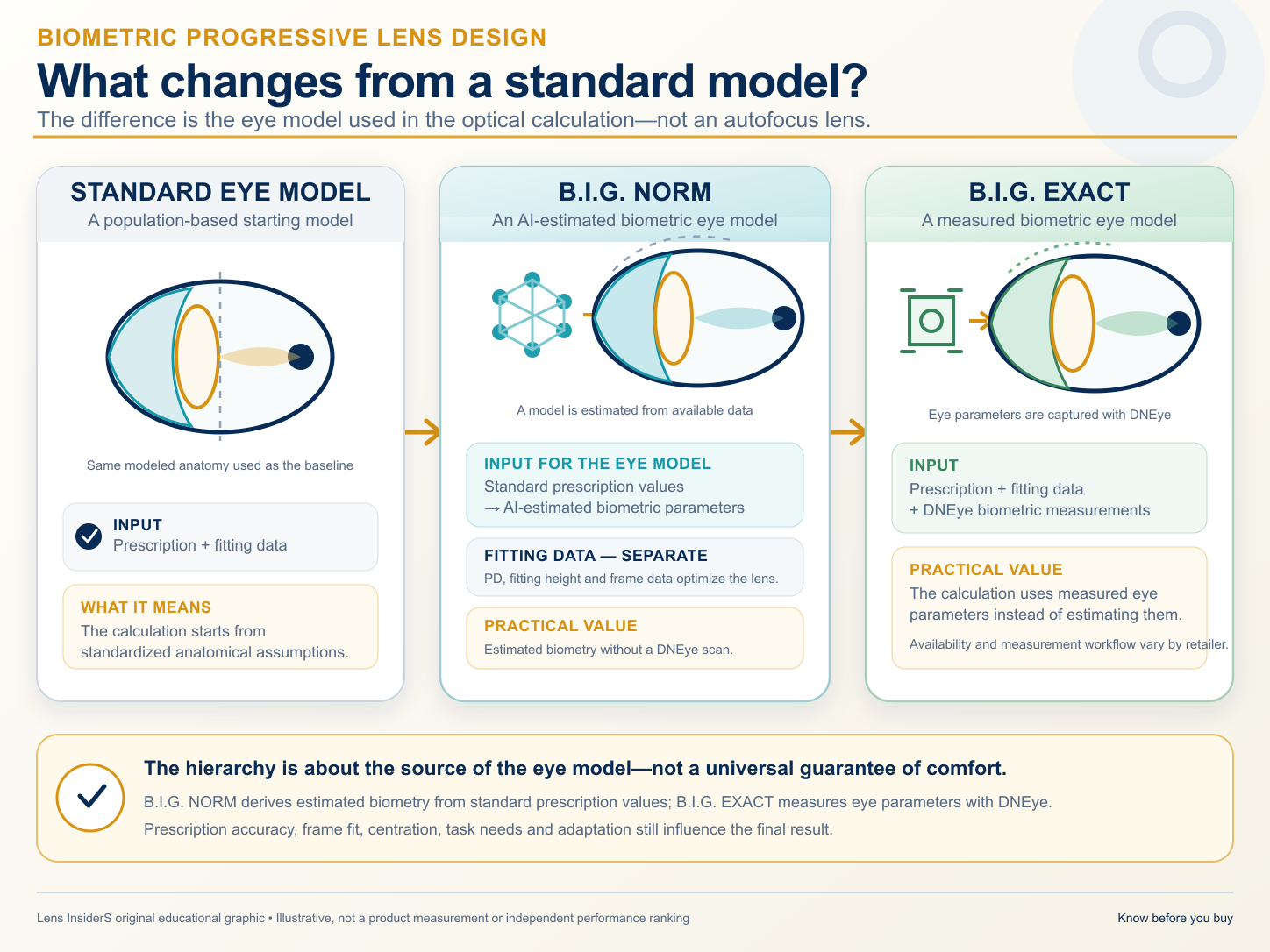
Rodenstock’s B.I.G. NORM is one of the clearest examples of what an AI-assisted lens calculation actually does. The system starts with the standard prescription values and uses correlations learned from Rodenstock’s biometric dataset to create an approximate biometric eye model. That estimated model is then used in the lens calculation.
The word approximate is important. B.I.G. NORM does not measure the individual eye’s complete biometry from the prescription alone. Rodenstock says its B.I.G. EXACT family instead uses actual measurements collected with a DNEye Scanner to create a measured biometric model. B.I.G. NORM is therefore the more accessible data-estimation pathway; B.I.G. EXACT is the measurement-led pathway.
| Rodenstock pathway | Primary input | What the lens calculation receives | Buying implication |
|---|---|---|---|
| Conventional reduced-eye model | Prescription plus standard assumptions | A generic model | Lowest level of biometric specificity in this comparison |
| B.I.G. NORM | Standard prescription values plus AI-derived correlations | An approximate biometric eye model; separate fitting data can further optimize an eligible design | No DNEye scan is required, but the eye biometry is estimated rather than directly measured |
| B.I.G. EXACT / EXACT Sensitive | DNEye measurements and the ordered fitting data | A measured individual biometric model; Sensitive adds a visual-sensitivity profile | Requires an equipped Rodenstock partner and usually sits above NORM in the product hierarchy |
Rodenstock offers the NORM concept across several design tiers and use cases, including progressive, occupational/Ergo and single-vision families. The exact name matters. An Impression B.I.G. NORM progressive is not the same quote as Progressiv B.I.G. NORM, Multigressiv B.I.G. NORM, an Ergo design or a Mono lens.
Lens InsiderS verdict on B.I.G. NORM
B.I.G. NORM is a technically credible premium option, not proof that AI automatically makes the best progressive for every wearer. Its strongest idea is practical: use a large biometric dataset to reduce reliance on one generic eye model when a DNEye scan is unavailable. The remaining outcome still depends on the selected NORM tier, prescription, design priority, monocular centration, fitting height, position-of-wear measurements, frame stability and dispensing quality.
Author perspective from Vietnam: Based on Ho Truong’s experience selling lenses in the Vietnamese market, B.I.G. NORM deserves attention as a high-end line with room to grow beyond a niche technical product. That is a professional retail assessment of its positioning and sales potential, not a claim that Lens InsiderS has completed a controlled optical or wear test of the product.
Rodenstock reports an external 2024 wearer trial with 47 progressive-lens users comparing B.I.G. NORM with their previous lenses. The manufacturer reports high percentages for reduced peripheral aberrations, wider progression zones and reduced swim. Because the comparison used each wearer’s old lens rather than a standardized current competitor and the public page does not provide a full peer-reviewed protocol, these results support interest but do not establish universal superiority.
How much does Rodenstock B.I.G. NORM cost?
There is no single B.I.G. NORM price. Design tier, index, coating, photochromic option, prescription complexity, fitting service and the retailer’s remake protection can all change the quote. Prices below refer to a pair of lenses unless stated otherwise; frames, eye examinations and insurance effects may be separate.
| Market and evidence | Observed price information | How to interpret it |
|---|---|---|
| Vietnam retail listing, checked August 14, 2026 | VND 22.5–86 million for B.I.G. NORM progressive lenses | A publicly posted retailer range across multiple progressive configurations, not one like-for-like SKU or an independently obtained quote. The same source lists NORM single vision at VND 7.3–19 million and Ergo at VND 23.5–76 million. |
| Germany 2025 recommended pair prices | €808–€1,676 across listed B.I.G. NORM progressive configurations | A useful manufacturer-market reference showing how design, index and coating widen the range; it is not a U.S. price list. |
| United States, exact B.I.G. NORM SKU | No reliable public price found | Rodenstock’s U.S. directory identifies a small partner network, but neither the manufacturer nor the listed practices reviewed by Lens InsiderS publish an itemized Progressiv, Multigressiv, Impression or Ergo B.I.G. NORM price. |
| United States partner promotion | US$599.99–$799.99 complete-spectacles offers | Live pages associated with an official partner use conflicting promotional prices and do not identify the exact design tier, index, coating or prescription. These offers are evidence of advertised package pricing—not a verified B.I.G. NORM price. |
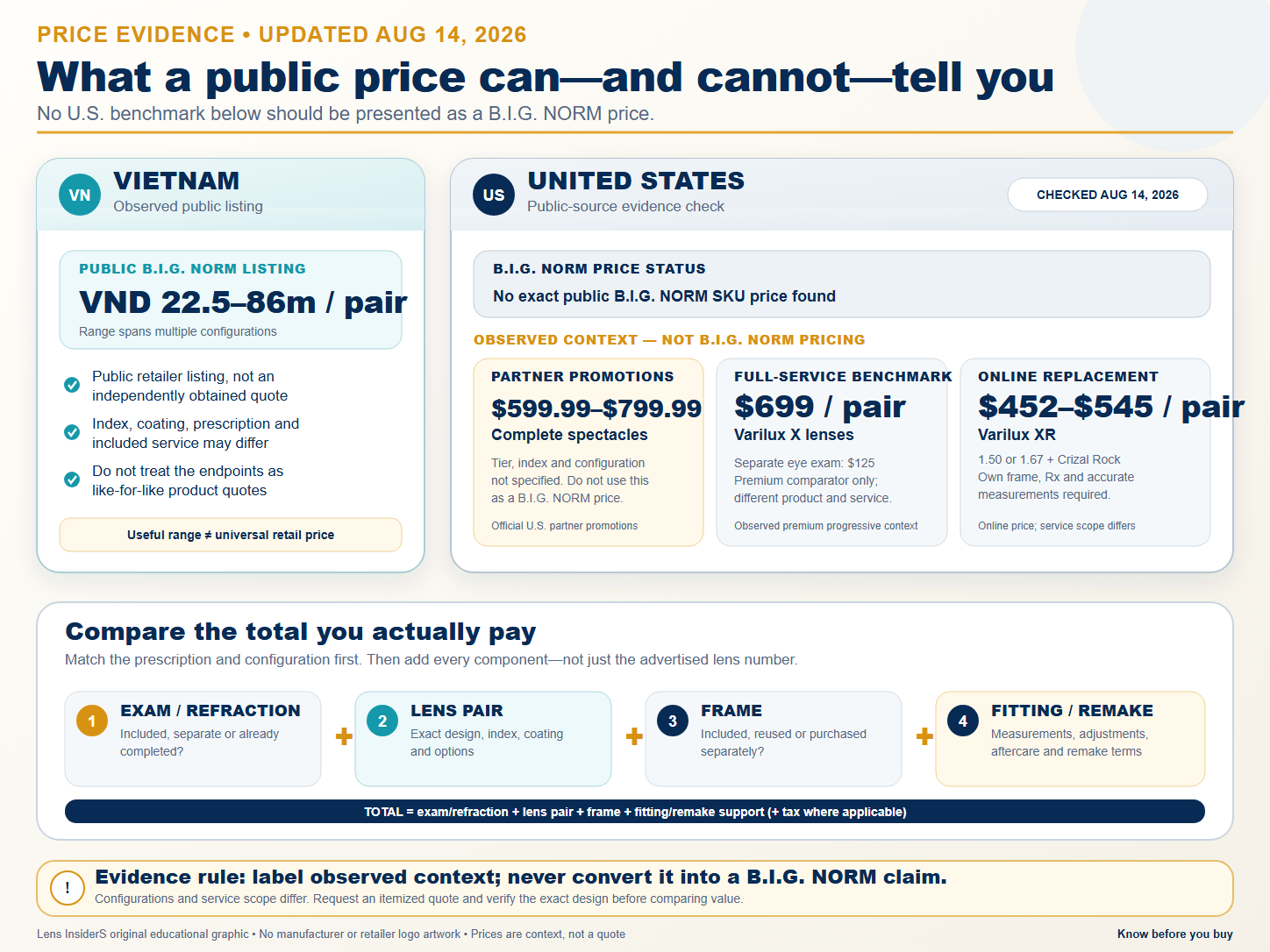
It is reasonable to expect a premium U.S. quote, but the evidence does not support publishing a national B.I.G. NORM range. Rodenstock’s official U.S. directory confirms a limited group of partner practices, and an officially listed partner describes B.I.G. NORM, but the exact tier and configuration are missing from its advertised packages. The two related promotional pages also disagree on price. Lens InsiderS therefore removed its earlier US$1,000–$2,500 planning estimate rather than let an inference look like observed U.S. pricing.
What other premium progressives reveal about U.S. pricing
Public Varilux pricing helps explain the market structure without pretending it is a direct substitute for B.I.G. NORM. A transparent Texas optical lists a Varilux X lens pair at US$699, including Crizal Sapphire HR, scratch resistance and UV filtering, while charging US$125 separately for the eye examination and prescription. An online replacement-lens seller lists a Varilux XR Design configuration at about US$452 for 1.50 with Crizal Rock and about US$545 for 1.67 with Crizal Rock; that lower-price channel requires the wearer to supply a frame, prescription and fitting measurements.
A Vietnam retailer lists Varilux XR Design with Crizal Rock at approximately VND 17.58 million in 1.50 and VND 26.48 million in 1.67, but the page does not state whether each figure covers one lens, a pair or another bundle. Confirm the unit and current promotion before comparing it with a U.S. quote. The directional lesson is not that one country is always cheaper. It is that an online re-lens price, a full-service optical price and a catalog lens listing purchase different amounts of professional service.
For a fair cross-market comparison, add the whole path: eye-health examination + refraction + exact lens pair + coating and light-adaptive options + frame + centration and position-of-wear measurements + edging and mounting + adjustments + remake protection. In the United States these elements may be unbundled; in other channels some are bundled or described as free with purchase.
Do not assume insurance reimbursement. Rodenstock’s U.S. site says its products and services are not intended for reimbursement by third-party payors. Ask the retailer whether any store discount or eyewear-plan allowance can be applied without submitting the Rodenstock item as a reimbursable product.
For a fair quote, request this line in writing: exact design + index + coating + photochromic/tint + prism or special-order charges + lens-only price + remake/non-adapt terms. Compare that complete specification, not the words “B.I.G. NORM” alone. Our guide to what creates large progressive-lens price differences explains the same cost layers across brands.
Who should consider B.I.G. NORM?
- A progressive wearer who wants a premium data-assisted calculation but does not have access to a DNEye-equipped practice.
- A wearer whose prescription or frame position makes better-than-default optimization worth discussing.
- Someone who can obtain the exact Rodenstock design name, complete fitting measurements and a credible remake policy.
- An existing Rodenstock wearer who wants design continuity while moving to a newer calculation platform.
Who should hesitate or compare another option?
- A buyer receiving only a brand-level quote without the Progressiv, Multigressiv or Impression tier.
- Someone paying a premium while the dispenser uses default frame-position values or an unstable frame.
- A wearer expecting the lens to autofocus, learn after delivery or eliminate all peripheral blur.
- A buyer who can access DNEye measurements but has not been shown the price and measurement differences between B.I.G. NORM and B.I.G. EXACT.
- Anyone whose main need is a wide desk-working zone that may be served better by a properly specified Ergo or office lens than an all-day progressive.
Questions to ask for a B.I.G. NORM quote
- Is this Progressiv, Multigressiv or Impression B.I.G. NORM—and which task profile or corridor is selected?
- Which position-of-wear measurements are included: monocular PD, fitting height, vertex distance, pantoscopic tilt, face-form angle and near working distance?
- Is a DNEye scan being performed? If yes, why is NORM rather than EXACT being quoted?
- What lens index, coating and light-adaptive option are included?
- Is the price lens-only or a complete pair with frame and examination?
- What is the non-adapt/remake window, and does a remake preserve the selected design tier?
What AI cannot remove from a progressive lens
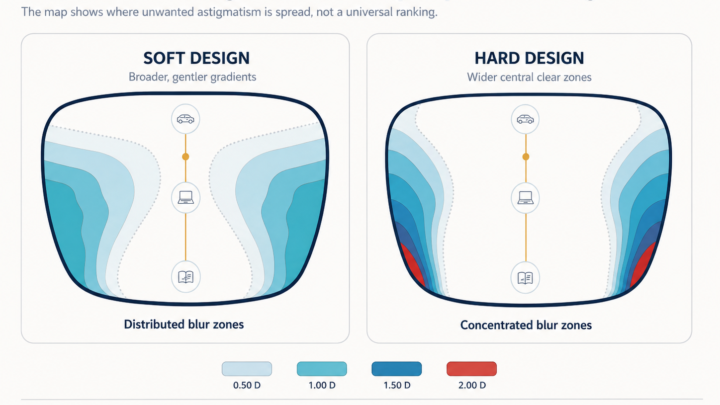
A progressive addition lens must create a continuous power change between distance and near viewing. That process produces unwanted astigmatism away from the central progression corridor. Optimization can redistribute those errors, change gradients and prioritize useful zones. It cannot make every point on a passive lens simultaneously correct for distance, intermediate and near.
This is why an AI label does not answer whether a design is soft, hard, distance-prioritized, near-prioritized or compressed for a shallow frame. See our explanation of where peripheral blur goes in soft and hard progressive designs.
Corridor geometry remains important too. A short fitting configuration can place the near zone inside a shallow frame, but it compresses the power progression into less vertical space. Read our guide to long and short progressive corridors before comparing product names alone.
Measurement quality is the gatekeeper
Additional inputs help only when they are measured and transferred reliably. An error in monocular PD or fitting height can move the intended corridor away from the natural line of sight. An unstable frame changes vertex distance, tilt and vertical alignment after the measurements are taken.
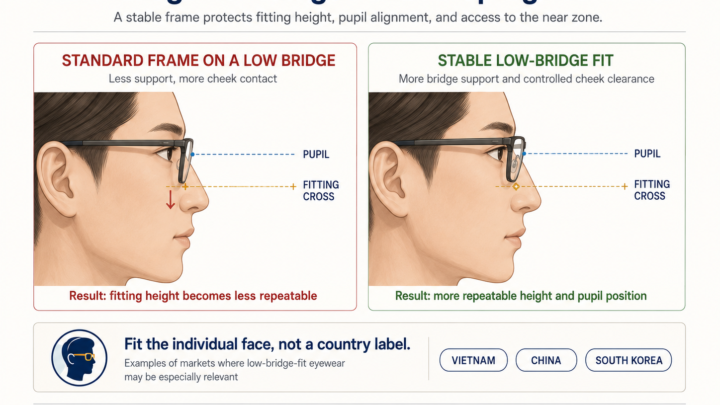
That is especially relevant when the frame has limited bridge support or frequent cheek contact. A properly selected low-bridge-fit frame can make progressive measurements more repeatable.
When a premium personalized design may be worth considering
- A higher or more complex prescription makes position-of-wear effects more consequential.
- The wearer has a clear priority, such as prolonged intermediate work or frequent dynamic distance changes.
- The dispenser measures the fitted frame rather than relying only on default values.
- A previous successful lens can be identified and its design characteristics preserved or intentionally changed.
- The seller offers a credible non-adapt or remake process.
When a conventional design may be sufficient
- The prescription is straightforward and the wearer has succeeded with a standard design.
- The premium package does not add measurements or a task-specific design change.
- The frame has not been fitted before measurement.
- The salesperson can describe only a marketing tier, not the exact lens design.
- The price difference would be better spent on accurate dispensing, a stable frame or a task-specific second pair.
Seven questions to ask before paying for “AI”
- What is the exact manufacturer and design name?
- Which individual measurements will be captured?
- Which of those measurements change the final calculation rather than only checking fit?
- Which distance or task does the selected design prioritize?
- Are performance claims based on peer-reviewed research, an independent wearer test or manufacturer data on file?
- How will the frame be adjusted before the measurements are finalized?
- What happens if the result is clear centrally but uncomfortable in normal movement?
AI progressive lenses versus autofocus glasses
An AI-assisted progressive is still a passive lens with fixed optics. An autofocus spectacle attempts to change power while it is worn, usually by combining gaze sensing with a tunable optical element. The autofocus designs reviewed by Lens InsiderS remained development-stage as of August 14, 2026; they should not be confused with commercially established algorithm-assisted progressives.
Sources and further reading
- EssilorLuxottica: Varilux XR series, design description and study notes
- ZEISS: SmartLife Individual 3 and Intelligence Augmented Design
- ZEISS: how its current lens calculation uses wearer and frame inputs
- Rodenstock: B.I.G. NORM approximate biometric model and manufacturer-reported wearer trial
- Rodenstock: B.I.G. NORM dataset, calculation concept and distinction from B.I.G. EXACT
- Rodenstock U.S.: current partner-practice directory
- Rodenstock U.S.: current market information and third-party-payor notice
- Better Spectacles: official-partner page combining B.I.G. NORM context with a non-itemized complete-spectacles promotion
- Rodenstock Spectacles: related U.S. promotional page showing a conflicting package price
- Vietnam retailer: publicly listed 2026 Rodenstock price ranges
- German retailer price list: 2025 recommended pair prices and B.I.G. NORM configurations
- CLEAR Eye + Optical: transparent U.S. self-pay eye-exam and Varilux X lens-pair pricing
- RxFramesNLenses: U.S. online pair pricing for Varilux XR design, material and coating options
- Patrick Eyewear: Vietnam Varilux XR Design retail listing
- Optics Express: 2025 research on free-form progressive-addition lens optimization
Professional note: Persistent blur, double vision, headaches or imbalance should not be dismissed as a need to “adapt to AI.” Ask the dispenser to verify the prescription, lens markings, measurements and frame position. Sudden vision changes require prompt professional assessment.
Sources and further reading

About Ho Truong
Ho Truong is a trained optician at a family optical practice established in 1991. Lens InsiderS explains lens design and fitting choices for buyers. It does not diagnose eye conditions or replace an eye examination.